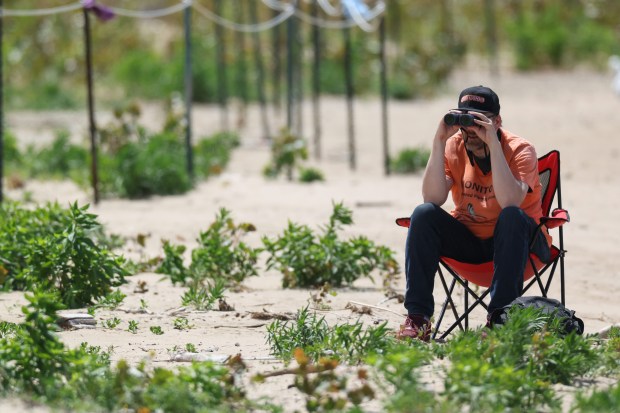
As warm temperatures lingered around 80 degrees, many individuals seized the chance to delight in a summer day at Montrose Beach. Kids fashioned holes in the sand, families engaged in soccer, and some dared to enter the water amid crashing waves. Meanwhile, others at a nearby stone pier indulged in bird-watching, seeking different sightings.
Bird enthusiasts wandered to the border of a fenced-off sanctuary, repeatedly querying if anyone had glimpsed a piping plover. These diminutive shorebirds, along with North America’s tallest bird, and a unique dragonfly, are some of the creatures in the Midwest threatened by recent alterations to the Endangered Species Act. The revised legislation weakens wildlife conservation by altering the definition of “harm” to exclude significant habitat adjustments.
“If you take water away from a fish, you harm that fish,” remarked Ben Greuel, national wildlife campaign manager at the Sierra Club. “You’re removing the habitat necessary for its survival. It was a sensible part of the Endangered Species Act.”
Reduced Protections
Ben Greuel pinpointed the piping plover as substantially threatened due to the modification of harm’s definition. The Great Lakes’ piping plover numbers descended to roughly 13 pairs in the 1980s because of habitat depletion from beach expansion. Conservation efforts led to their recovery, boosting numbers to about 80 last year.
Chicago Piping Plovers leader, Tamima Itani, praised the sanctuary provided by the Chicago Park District. Nevertheless, she voiced concerns about the federal changes, worrying about the birds’ possible lack of protection when migrating south during winter.
The Endangered Species Act previously allowed developers to alter habitats but mandated “habitat conservation plans” for state, local, and private projects. Kristen Boyles, managing attorney at Earthjustice, explained that these plans describe how endangered species’ habitats will be damaged to a lesser degree than they would have been.
“That permit says, ‘Proceed. What you now plan, even if it eliminates habitat, is lawful due to your mitigation measures,’” Boyles noted. Without needing a habitat conservation plan, developers now face fewer restrictions.
Earthjustice, representing conservation groups, challenged the Trump administration’s definition change of harm last month. Despite the U.S. Supreme Court specifying single statute interpretation, Boyles argued it gives regulatory interpretation roles to courts.
Two more Endangered Species Act changes were introduced, removing automatic protection for threatened species and considering economic and security impacts for critical habitats.
Concerns for Whooping Cranes
Earlier in the year, Ben Greuel took his children to observe North America’s tallest birds, whooping cranes, in Wisconsin. Conserving their habitat showcased the success of the Endangered Species Act.
Rich Beilfuss of the International Crane Foundation explained that the Endangered Species Act aids in preventing crane collisions with power lines.
“Though balancing human and environmental interests, the act attempts to ensure sustainable development without significant impact on pivotal species,” Beilfuss said.
Threats to the Hine’s Emerald Dragonfly
Marla Garrison discussed the vulnerability of species like the Hine’s emerald dragonfly, living in specialized habitats. These insects, residing in northeastern Illinois, require specific environmental conditions which are often disrupted by human activities.
Andres Ortega, aquatic resources supervisor, spoke of the dragonfly population in Wisconsin remaining stable, although small.
Creating environments mimicking natural conditions proves challenging, as Ortega noted, despite the Forest Preserve’s close attempts to achieve this.
Individual Efforts
Alex Terrana, participating in bird-watching on the stone pier, remarked on how Chicago’s efforts, including expanding plover habitats, upliftly contribute to bird conservation.
While local involvement is beneficial, Terrana pointed out that federal-level regulatory changes bear a considerable impact on regional conservation. “Long-term, everyone’s actions shape our outcomes, even with protective measures in Chicago,” Terrana concluded.
Leave a Reply