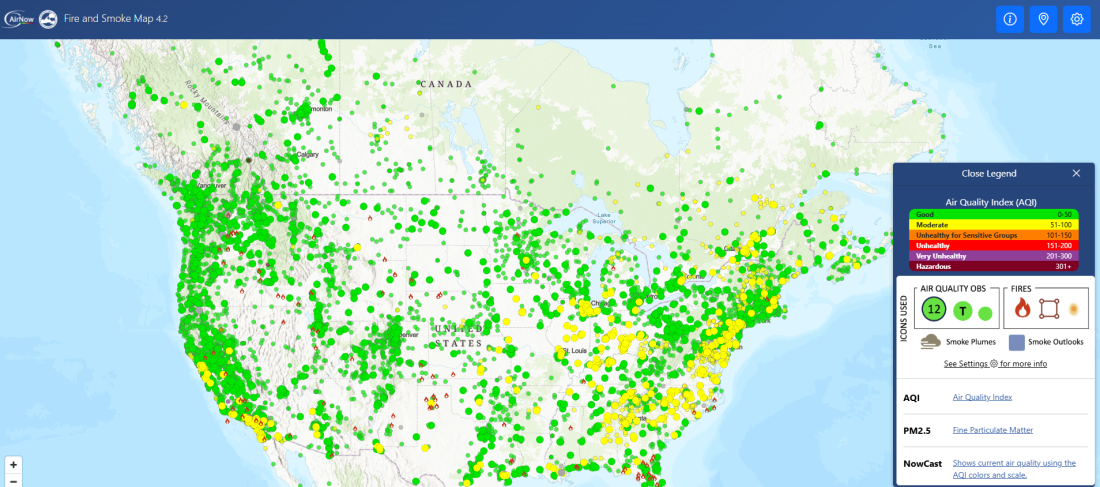
Maps tracking wildfires and smoke, such as those on the fire.airnow.gov website, are partly the result of research funded by the U.S. Forest Service. The University of Washington (UW), being a top recipient of federal research dollars, feels the pressure from proposed budget cuts by the Trump administration. These changes could have a significant impact on institutions like UW’s School of Environmental and Forest Sciences.
Fire ecologist Ernesto Alvarado emphasizes the importance of wildfire research. He uses a detailed map on his computer to monitor wildfire smoke movement. This tool shows smoke forecasts and particle pollution levels, providing crucial information, especially for people with compromised health. Alvarado and his team at UW, along with the U.S. Forest Service, continuously update this map. They integrate years of research to help governments and firefighting teams manage smoke complications.
“We have a wildfire crisis in the West and in the United States,” says Alvarado, highlighting the critical nature of this research.
Despite its importance, the Seattle smoke lab is among those listed for closure due to the Forest Service’s controversial reorganization plans under the Trump administration. These plans involve relocating headquarters to Utah and consolidating regional offices, raising concerns among scientists like Morgan Varner, a former fire behavior scientist. The strategic location of the Seattle lab, near major research institutions and an international airport, underscores its significance.
Forest Service Chief’s Stance
U.S. Forest Service Chief Tom Schultz defends the proposed reorganization. From his office in Washington, D.C., he argues the restructuring, previously considered by other administrations, is essential. Schultz wants to recast the narrative, asserting that research remains a priority despite a $3 billion maintenance backlog. Closing some research facilities, he argues, is a step towards financial responsibility. Scientists might relocate to nearby offices, which he believes remains practical.
Yet, President Trump’s proposed budget eliminates research funding for the Forest Service. Congress, however, holds the final say in budget approvals. Recently, bipartisan resistance to the administration’s proposal has surfaced in Congress. Schultz acknowledges the need to adapt the agency’s structure based on Congress’s decisions.
Concerns from State Officials
If Trump’s budget cuts are approved, the U.S. Forest Service would reduce significantly at a time when wildfires are increasing due to climate change. This concerns staff and residents in western states relying on the Forest Service for employment, wildfire management, and smoke forecasts. Dave Upthegrove, Washington’s public lands commissioner, stresses that research from labs like those in Washington is crucial for the state’s wildfire response strategies.
Upthegrove expresses apprehension about a lack of communication from the Forest Service on the reorganization process. He notes initial optimism that this restructuring might improve cooperation on land management issues. However, recent silence from the Forest Service instills uncertainty as the region braces for a potentially severe fire season.
Leave a Reply