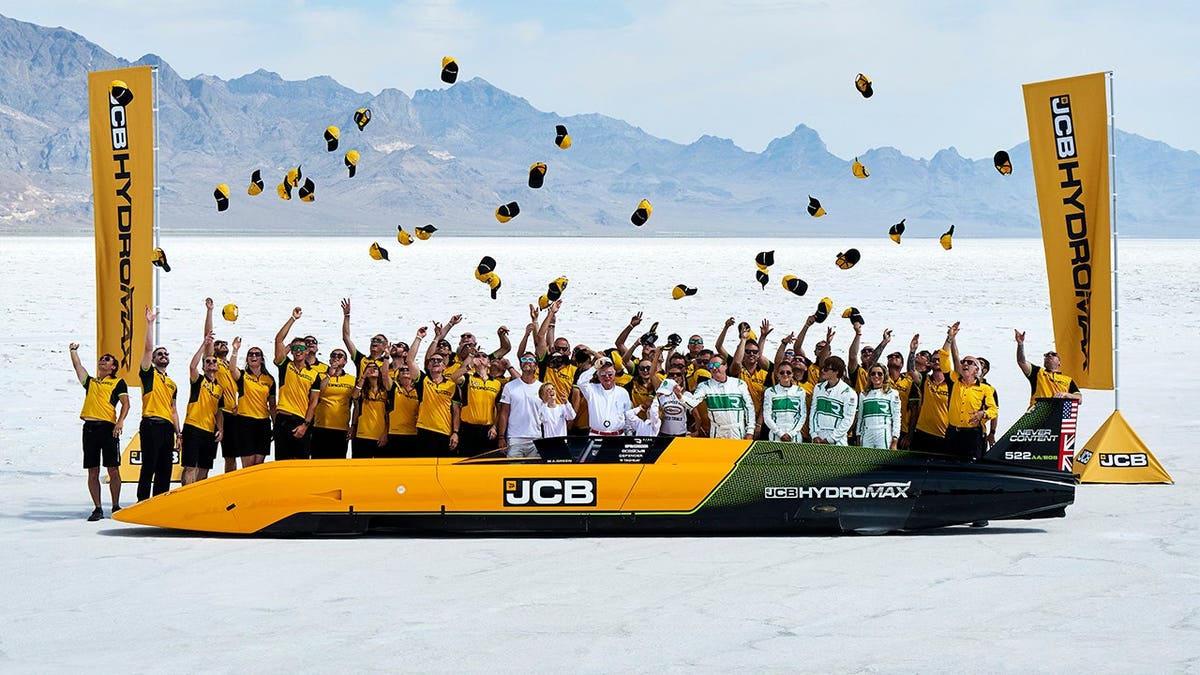
The hydrogen-powered car from JCB Hydromax achieved an impressive speed milestone at Bonneville Salt Flats. The vehicle recorded two significant runs, achieving 400.623 mph on the first and 412.135 mph on the second. This averaged 406.320 mph, setting a new world record for hydrogen-powered internal combustion vehicles. This speed surpasses the previous record of 185.5 mph set by the BMW H2R in 2004. The record is awaiting official confirmation from the Fédération Internationale de l’Automobile (FIA).
JCB Hydromax’s team rejoiced after this remarkable achievement on August 11, 2026.
“This is extraordinary engineering,” stated Wing Commander Andy Green, OBE, who drove the car.
Green highlighted the significance of the new class for hydrogen racing at Bonneville Speed Week, emphasizing its unparalleled performance compared to other hydrogen cars. He noted that such achievements typically take three to five years, yet JCB Hydromax managed this feat in just over one year. The car was designed, manufactured, and tested in a remarkably short timeframe using unique technology for hydrogen engines.
Green expressed admiration for the team’s rapid progress. The professionals in the field believed the process would require multiple visits over several years. Contrary to these expectations, JCB Hydromax achieved the record in five to six days.
The engineering team faced several challenges, such as high altitude and temperatures between 100 to 105 degrees. Efficient cooling was necessary, requiring around 400 pounds of ice and water for the engines and air intake. The hydrogen engines needed to be operated at optimal fuel ratios to prevent instant combustion.
Preventing engine oil damage due to water mixing required precise temperature control. Testing revealed the oil needed heating to 180 degrees Fahrenheit to ensure any water that mixed would evaporate immediately without harming the engine bearings.
Stopping safely was as crucial as reaching top speeds. The car was equipped with a specialized parachute system vital for decelerating a 5,500-pound vehicle traveling at 400 mph.
Andy Green confirmed the team’s success in achieving their target speed.
With every factor in alignment, the team managed to accomplish an average speed of 406 mph, subject to confirmation. They optimized the car to reach 412 mph on the second run. The entire process from measurement to stopping took about nine seconds, conducted on a track only 105 feet wide.
Despite the narrow track and fast pace, Green managed to maintain control of the car throughout. The peculiar visual effect of markers approaching at high speeds was challenging but manageable with his experience.
Green, an experienced pilot in the Royal Air Force, compared the task to jet fighting—requiring precision and understanding of supersonic speeds. His insights stem from his background in mathematics and piloting supersonic jets.
He holds the absolute world land-speed record of 763.035 mph set in 1997, where he first broke the sound barrier on land.
“This technology marks the beginning of a new era in motorsport,” Green said. “Using hydrogen for zero-carbon racing holds promising potential.”
As Green and the team celebrate their achievement, they look forward to the future of sustainable motorsport.
Leave a Reply