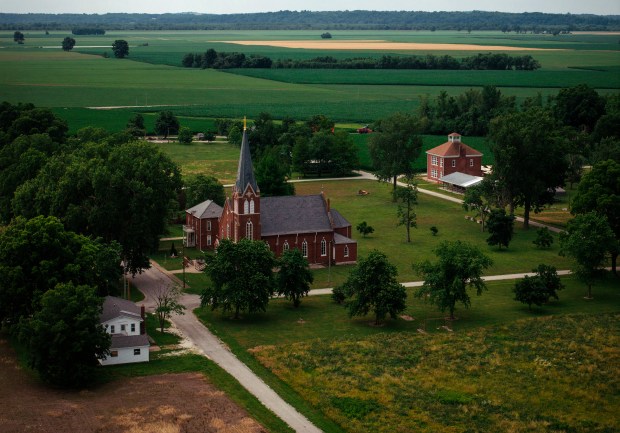
The congregation of Kaskaskia arrives before Mass, filling the old church with descendants and caretakers of a place marked by serenity and loss. Despite its history as the site of Illinois’ founding and first capital, Kaskaskia now stands mostly empty, reclaimed by nature through repeated floods. Positioned uniquely as the only part of Illinois west of the Mississippi River, the island bears the scars and stories of this powerful current.

Kaskaskia’s rich history begins with its soil that drew settlers, reaching periods where it became the most vital location in Illinois. Amid its historical backdrop is a small Liberty Bell from King Louis XV of France, and American tales predating the nation’s founding.
The Immaculate Conception Chapel stands as a resilient beacon, much like the land itself. Both symbolize perseverance against odds. Thousands thrived here centuries ago; this was a hub of America’s westward expansion, a French Colonial trading post, and a battleground during the American Revolution. It served as the capital upon Illinois’ admission to the Union in 1818 before being reduced by the Mississippi River’s whims.
The devastating flood of 1844 submerged the town, and another flood in 1881 transformed Kaskaskia into an island, leading to a population decline. In 1993, yet another flood tested the community’s resilience. Amid the few remaining inhabitants, Stanley Hurst represents those tied to this land through generations.
Stanley Hurst witnessed the 1993 flood lift pews and statues in Immaculate Conception Church, resulting in his relocation nearby on higher ground. However, he still finds himself drawn back to the island.
Faith remains the unyielding force at Immaculate Conception, hosting a weekly Mass that briefly revives the island. Congregants gather where their homes once stood, in a chapel hosting weddings and funerals over lifetimes. Despite other nearby churches, the connection runs deep: “This is my roots,” many affirm.
Mary Ellen Brown and Emily Lyons, both lifelong residents, dedicated themselves to maintaining the island’s legacy, despite the dwindling numbers. They serve as historians, preserving the past that shaped them. Lyons’ sentiment that the spirits are “friendly” captures the island’s embrace of the past, shared in a $1 welcome booklet.
The duo can recount the lineage of the church’s artifacts—like the altar from the 1730s and chalice from Jacques Marquette’s founding of the parish. They preserve the memory of Virgin Mary and Joseph statues submerged during the ‘93 flood, and the rescuers’ efforts to restore and continue their foundational mission.
Only 22 residents remain on the census, though Brown contends the solitude suggests fewer inhabitants. Beyond the Saturday Mass, the silence stretches long between encounters. The dynamism of the island is rediscovered sporadically, like during gatherings to pay homage to ancestors, or celebratory familial reunions honoring lost loved ones.
Warren Gendron cherishes family roots linked back to fur traders in the 1700s. Reflecting on fluctuations in accessibility, Gendron has revisited flooded cemeteries to pay respects when water recedes.
A gathering celebrates history while engaging the community in reflection, fostering a return to familiar grounds. Time seemingly halts amidst the vast grass fields and remnants of foundations, challenging the census idea of 22 residents.
Old structures fade, as no school or store remains today. Kaskaskia survives through Missouri; its approach veers onto roadsides displaying history that intertwines with more erect communities across the river.
Fort Kaskaskia stands in commemoration of Revolutionary significance, while the bell remains within the chapel—a casting of perseverance in unfamiliar times. Following the 1881 flood, the remaining church bricks were relocated inland for survival.
Post-1993, Stanley Hurst revived Immaculate Conception via painstaking efforts. Strong resolves preserved the chapel amid shifts in community demography, sustaining the church through pledges made by its steadfast congregation. Annual organized fish fry events remind resilient patrons of collective familial nostalgia.
Courage and loyalty prevail in homage to history, with a congregation that fills the pews in reverence. Mass extends continuity and faith among those determined to maintain their legacy. “We’ve kept up our end of the bargain,” affirms Brown.
Tested by temporal challenges and natural influences, faith leads the Dweller’s battle to safeguard the chapel’s weekly Mass against fading traditions.
Through collective actions by committed parish individuals, the chapel remains a living relic; yet new generations may yield differently. Still, for people like Hurst, it embodies more than sanctuary: it remains a defiant testament, “And I ain’t gonna give it up.”
The Mississippi’s rise defines universal realities governing island life, challenging resilience. Nature reigns beyond control, reinforcing fleeting permanence only tempered by legacy and faith.
Mary Ellen Brown outlines concerns over erosion of island connectivity, standing against skeptical views. Yet those who perceive substance in its historical veining understand: “You just don’t see it. There’s three centuries” woven here.
With habitual scheduling of weekly Mass, island tranquility restores its normal solitary cadence following congregational dispersal.
Leave a Reply