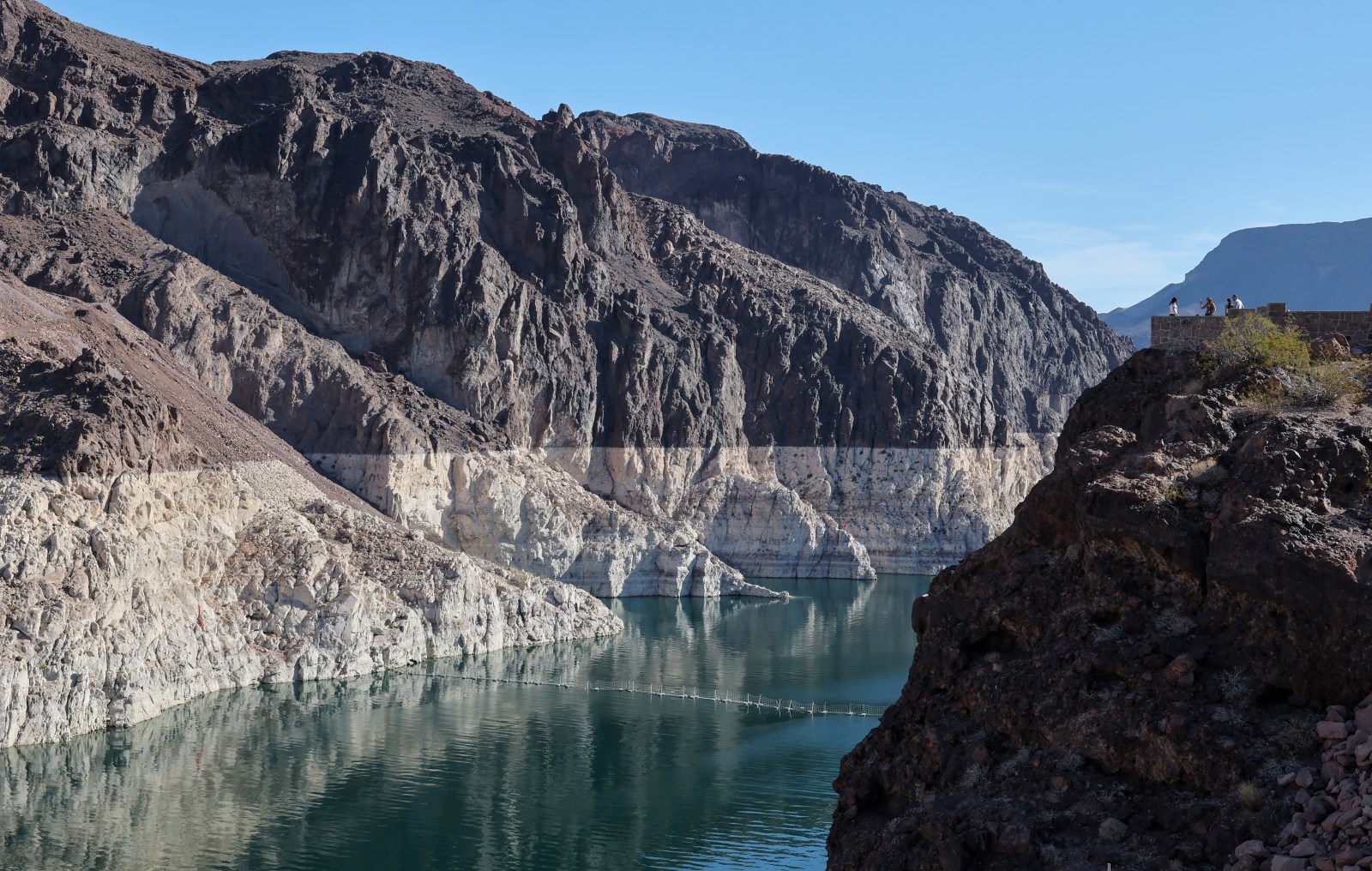
Lake Powell and Lake Mead, the largest reservoirs in the United States, have reached their lowest combined level on record, highlighting a critical point in the West’s deepening water supply crisis.
Record Low for Combined Storage
On July 12, data indicated the reservoirs’ combined live storage fell to 12,675,509 acre-feet. This surpassed the previous record low of 12,677,161 acre-feet, set on March 14, 2023. An acre-foot measures the volume of water required to cover one acre of land to a depth of one foot.
At the time of this record, Lake Powell’s surface elevation was 3,524.32 feet above sea level, housing 5,505,869 acre-feet of live storage, while Lake Mead was at 1,042.77 feet, containing 7,169,640 acre-feet.
On May 23, 1957, Lake Mead held 12,668,000 acre-feet before Lake Powell began filling, marking the last occasion such low combined water levels were recorded.
Understanding the Reservoirs as a Combined System
Though often treated separately, the report emphasizes their status as a connected system. Lake Powell is situated in the Upper Colorado River Basin, and Lake Mead in the Lower Basin. Together, they lie downstream of significant Upper Basin water uses and upstream of crucial Lower Basin utilizations.
The report describes them as a large reservoir separated by the Grand Canyon, where consumptive uses are minimal.
Implications for Future Storage
The decline in storage has proceeded rapidly throughout 2026. Since March, the combined storage has decreased approximately by 16,000 acre-feet daily, with a slowdown in May to about 11,000 acre-feet daily due to snowmelt and supplemental releases flowing into Lake Powell.
Monthly depletion rates ranged from 2,626 acre-feet per day in January to 16,661 from July 1 to July 13.
The report predicts that, without winter snowpack runoff from 2026-27, daily new record lows will continue. The authors describe this as a significant moment in the unfolding Colorado River water supply crisis.
The Importance of the Colorado River
The Colorado River is vital to North America’s water systems. According to the Bureau of Reclamation, it offers water supply, hydropower, recreation, and habitats across Arizona, California, Colorado, Nevada, New Mexico, Utah, Wyoming, and Mexico. Agriculture accounts for 70% of its use, and 35 to 40 million people depend on it for municipal water.
Scientists caution that reservoir levels could drop so critically by 2028 that normal functions, such as water deliveries and hydropower generation, may become unfeasible.
Upcoming Agreements and Reductions
As storage rates hit new lows, the federal government is reconsidering Colorado River management plans. Reports suggest a U.S. proposal will mandate Arizona, California, and Nevada to reduce Colorado River consumption by about 20% in 2027 and 2028. Greater reductions may be necessary afterward, per a state water official.
Arizona Governor Katie Hobbs opposes substantial cuts to her state’s Colorado River allocation.
Several operating agreements are due to expire at year-end, making forthcoming decisions pivotal for allocating the diminishing water resource.
Current data shows Lake Mead is 27% full, holding 7,061,904 acre-feet, and Lake Powell is 22% full, with 5,424,836 acre-feet.
Leave a Reply