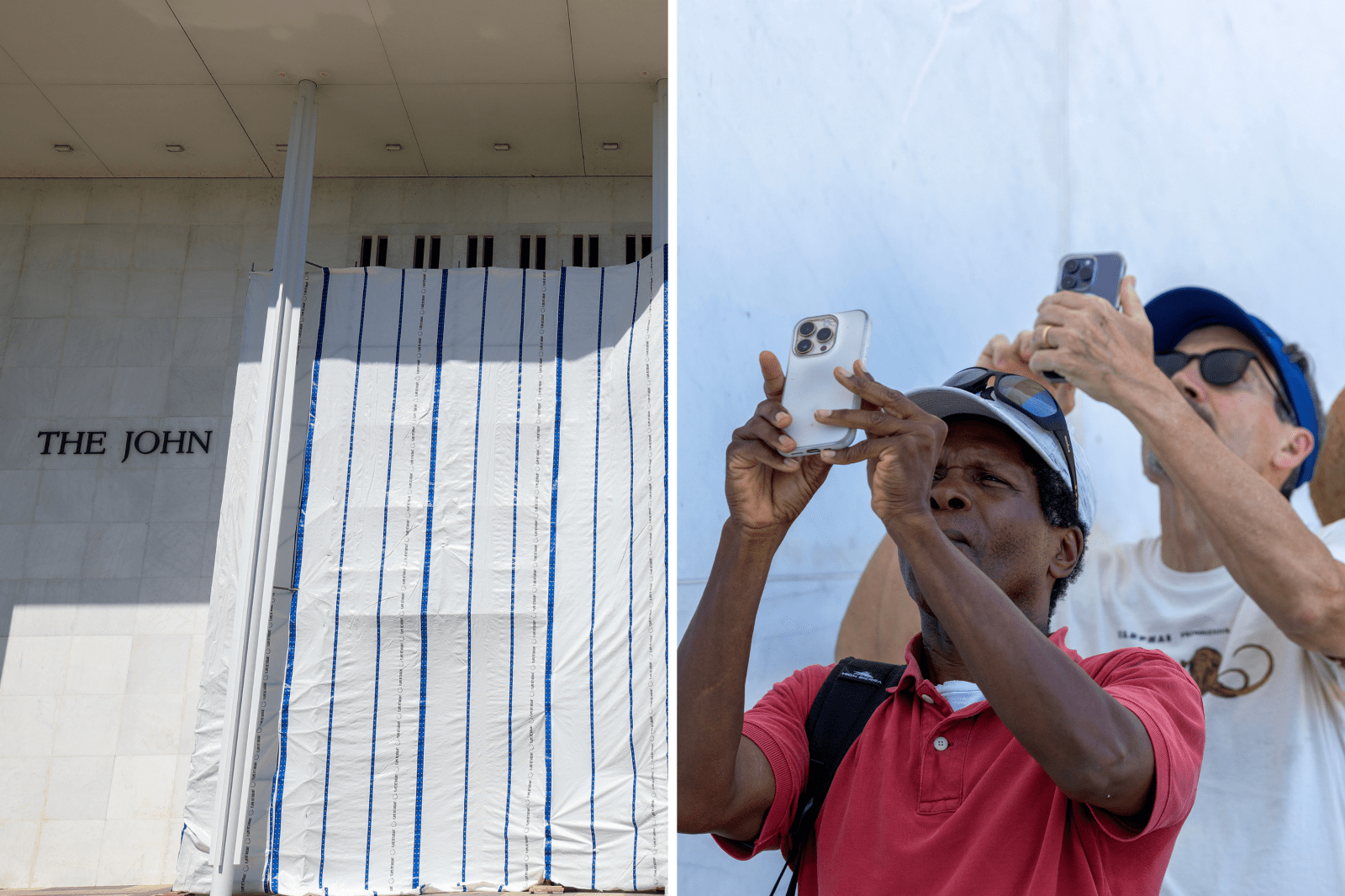
Claims have emerged in recent court filings suggesting that “broken egos” are influencing decisions at the Kennedy Center, amid a legal dispute about why large tarps still cover the building’s facade. This follows a federal court order for the removal of President Donald Trump’s name.
The John F. Kennedy Center for the Performing Arts in Washington, D.C. remains largely hidden from public view due to massive coverings that obscure the area where signage was removed. In a June 19 filing, attorneys for Representative Joyce Beatty, who filed the lawsuit, questioned the center’s reasoning for keeping the tarps in place. They challenged whether the coverings related to maintenance or if they concealed compliance with the court’s ruling.
U.S. District Judge Christopher R. Cooper had earlier ordered Kennedy Center officials to update renovation plans and detail how the venue would stay open during construction. The filing outlined three possible paths: full closure, partial shutdown, or phased repairs, with decisions pending a board vote in mid-July.
What the Court Ordered—and Why It Matters
The legal battle sits at the nexus of law, governance, and accountability. Judge Cooper is assessing if Kennedy Center officials have adhered to his directive. The dispute stems from Cooper’s ruling on May 29, which concluded that adding Trump’s name violated federal law. He emphasized that Congress alone can change the center’s name. The decision mandated removal of all Trump-related signage within two weeks and prevented a planned two-year closure.
Cooper’s decision drew upon the Kennedy Center Act, which defines the institution as a “living memorial” to John F. Kennedy and governs it through a federally specified framework. This statute establishes the site as a federally owned but politically overseen entity, fostering tensions now unfolding in court.
By mid-June, officials acknowledged in legal documents that they had removed all Trump-related physical signage. However, this process was largely unseen, conducted behind scaffolding and flame-retardant tarps installed overnight.
A Tarp That Won’t Come Down
More than a week later, the tarps persist, obstructing visitor views of the facade and hindering independent verification of the current displayed name. Kennedy Center spokesperson Roma Daravi explained to CNN that the tarps will stay until crews address “maintenance needs” related to marble and soffit panels.
No timeline has been provided for the tarp removal. Documents released earlier this year depict substantial repair needs, highlighting deferred maintenance issues, marble deterioration, and the failing soffit panels weighing more than 2,000 pounds.
Court Filings Raise ‘Broken Egos’ Claim
Beatty’s legal team disputed the maintenance explanation in their June 19 filing. They argued the tarp seems “semi-permanent,” positing it obscures whether the Kennedy Center complied fully with the court order. Attorneys alleged “broken egos” among leadership might indicate a breach of fiduciary duty to the institution.
These claims build on arguments that the board is failing in legal obligations. Beatty’s lawyers warned that shutdowns and governance decisions could transform the institution into a “lifeless husk,” defying its duty as a national cultural center.
What Visitors and Performers Say
Visitors anticipating the restored “John F. Kennedy Center for the Performing Arts” inscription have encountered a facade largely concealed. Even during the overnight removal of Trump signage, onlookers were hindered from observing due to coverings. Actor Tommy Gedrich from Moulin Rouge! expressed skepticism about the time needed for marble preservation, noting the tarp blocks backstage entrances.
Public opinion is mixed, ranging from skepticism to indifference. Democratic lawmakers have voiced criticism, with Representative Jamie Raskin labeling the situation a “literal cover-up,” while Beatty accused Trump of hiding “an embarrassing defeat.” Stephen Caken, visiting D.C. for an internship, commented on the lingering tarps as diverting attention away from the issue.
Others have expressed stronger views, questioning Trump’s intentions regarding American symbols. Luna Woo, a visiting violinist, noted uncertainty about the removal, while a theatergoer dismissed the controversy as “a lot of hoopla over nothing.” Protesters have gathered, chanting “Take down the tarp” and framing the issue as a symbol of political control over cultural institutions.
Renovation Plans Still Unclear
Amid the tarp dispute, broader uncertainty surrounds the Kennedy Center’s future. Court filings submitted June 19 revealed officials considering three options: complete closure with no programming, partial closure with limited access, or phased repairs while continuing performances. A planned complete shutdown starting in July had been court-blocked, mandating the center to remain open.
The Kennedy Center now plans to maintain an operational model beyond the initial July 5 closure date, ensuring public admission continues as programming decisions await resolution.
A Broader Battle Over Control
The tarp dispute represents a wider legal and political struggle over the Kennedy Center. After the 2025 board takeover by Trump and allies, efforts were made to rename the venue and initiate significant renovations, including a two-year shutdown. Beatty’s lawsuit contested these plans, leading to a May 2026 federal judge ruling against the renaming and the closure.
What began as a naming authority dispute has expanded into broader conflicts over governance, transparency, and programming, symbolized by the tarp.
What Happens Next
For now, the tarps remain, as do questions. The court is expected to further evaluate compliance with its order and whether additional clarification regarding the tarp and its removal timeline is needed.
Until then, views of one of Washington’s notable cultural landmarks remain obstructed.
Leave a Reply