Two days after a ceasefire was announced between Israel and Hezbollah, Yulia Bar-Dan stood outside her temporary home in Kibbutz Manara, northern Israel, as an interceptor’s sound echoed overhead. “There will probably be another siren soon,” she mentioned, aware of the routine alert that appeared on her phone, urging northern Israel residents to seek shelter.
For Bar-Dan, this moment exemplified daily life on Israel’s northern border, nearly two years after Hezbollah joined the conflict against Israel on October 8, 2023. As Hezbollah aligned with Iran in the recent conflict, the U.S. engaged in diplomatic efforts to extend the ceasefire into a broader agreement involving Lebanon.
Numerous discussions between Israeli and Lebanese officials have occurred in Washington, with President Donald Trump frequently announcing ceasefire understandings meant to restore peace along the border. Despite this, residents of communities like Manara report ongoing rocket and drone threats.
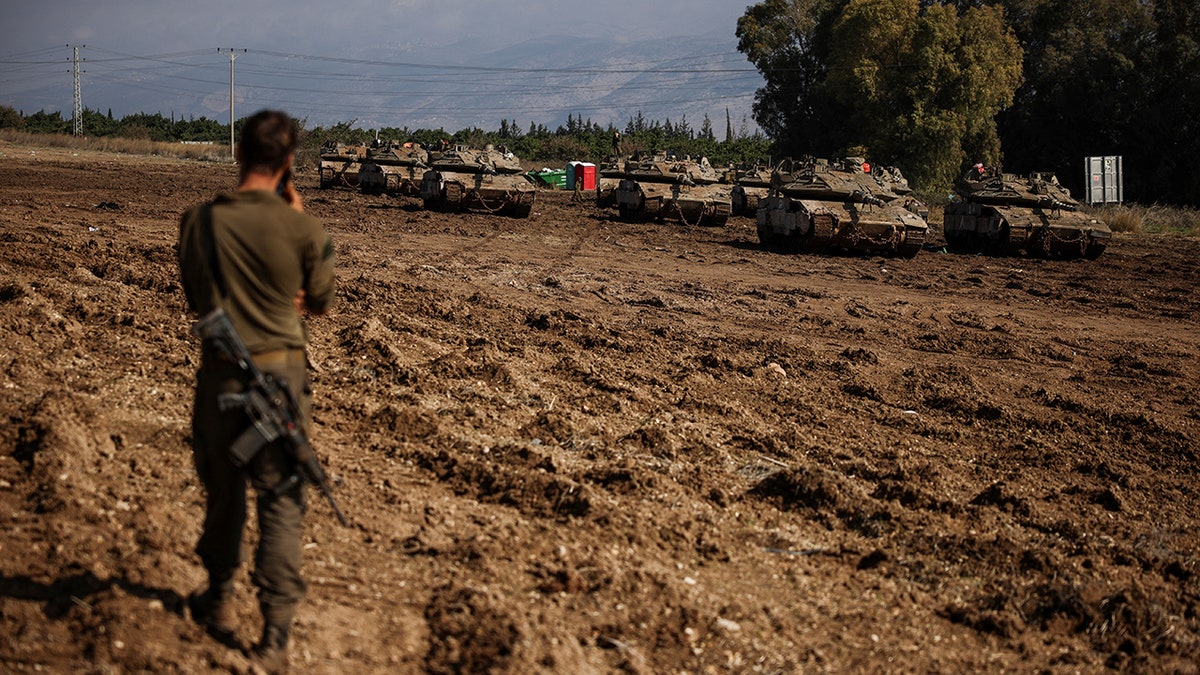
An Israeli soldier stands guard near military vehicles during the ceasefire’s second day between Israel and Hezbollah near the Israel-Lebanon border on November 28. (Stoyan Nenov/Reuters)
“A ceasefire is supposed to be on both sides,” said Bar-Dan. “Not where Hezbollah continues firing, and we keep absorbing.”
When first interviewed by Fox News Digital in December 2024, Bar-Dan, her husband, and three children had fled Manara, living in a hotel room, uncertain about their return. Approximately 200 of the kibbutz’s 280 residents have now returned, but destruction from the conflict prevents many, including Bar-Dan’s family, from occupying their original homes.
Despite multiple ceasefire announcements, residents find a return to normalcy elusive. “There hasn’t really been a routine or a quiet day since February,” Bar-Dan noted. Schools reopened in early June, but she chose not to send her children. “They take the bus to school,” she explained. “What if there’s a siren on the way? I can’t take that chance.”
Her frustration is not solely directed at Hezbollah. Like many interviewed, Bar-Dan perceives a disconnect between political rhetoric and border realities. “It doesn’t matter where decisions are made,” she said. “They just need to match reality. There’s a decision, but reality is different.”
A year and a half post-evacuation due to fears of a Hezbollah invasion, community leader Yochai Wolfin remarks on residents’ adaptations to current conditions, dubbing it “the ceasefire war.” This phrase is now familiar in the community.
Following evacuation and return, Wolfin describes enduring months of “fire within a ceasefire.” Uncertainty is a daily component, with children attending classes in shelters and some kibbutz areas still lacking fortified rooms. Construction projects remain unfinished as contractors hesitate to work near the border.
Many residents increasingly feel that decisions about their futures are made far away from the communities most affected. “Who knows what tomorrow will bring?” Wolfin questioned. “We know who’s in charge. We saw it when Trump announced another ceasefire, but our reality unchanged.”
Hezbollah’s Secretary-General Naim Qassem recently declared that northern Israel remains unsafe due to ongoing Israeli strikes in Lebanon. In a broadcast statement, Qassem condemned the Washington-mediated framework as “absurd, humiliating, and insulting,” labeling it a surrender roadmap.
Residents of Israel’s northern border communities viewed the statements as confirmation of a ceasefire on paper but not in practice. Naor Shamia, leading Manara’s emergency response team, expresses concern about temporary emergency measures becoming permanent. “The fear isn’t today,” he stated. “The fear is that this becomes years. We are in a deadlock.”
Across the border region, similar worries persist. In Adamit, resident Yael Cohen-Arazi contrasts the surrounding beauty with the constant threat. “Every morning I wake up and think I’m living in paradise,” she articulated in footage from the Israeli news agency TPS-IL. “Then come the explosions that shake my soul.” Her children, accustomed to life under fire, no longer recognize what is normal. “I tell them other children don’t live like this,” she stated.
Back in Manara, another alert disrupted the afternoon. Bar-Dan describes her prevailing emotions as tiredness and sadness. “I feel bad for the soldiers,” she said. “Every day there is another casualty, and still no solution.” However, she remains resolute in staying. “This is our home,” she asserted. “Someone has to live on the borders of this country.” Then another explosion sounded, marking the day yet again.
Leave a Reply