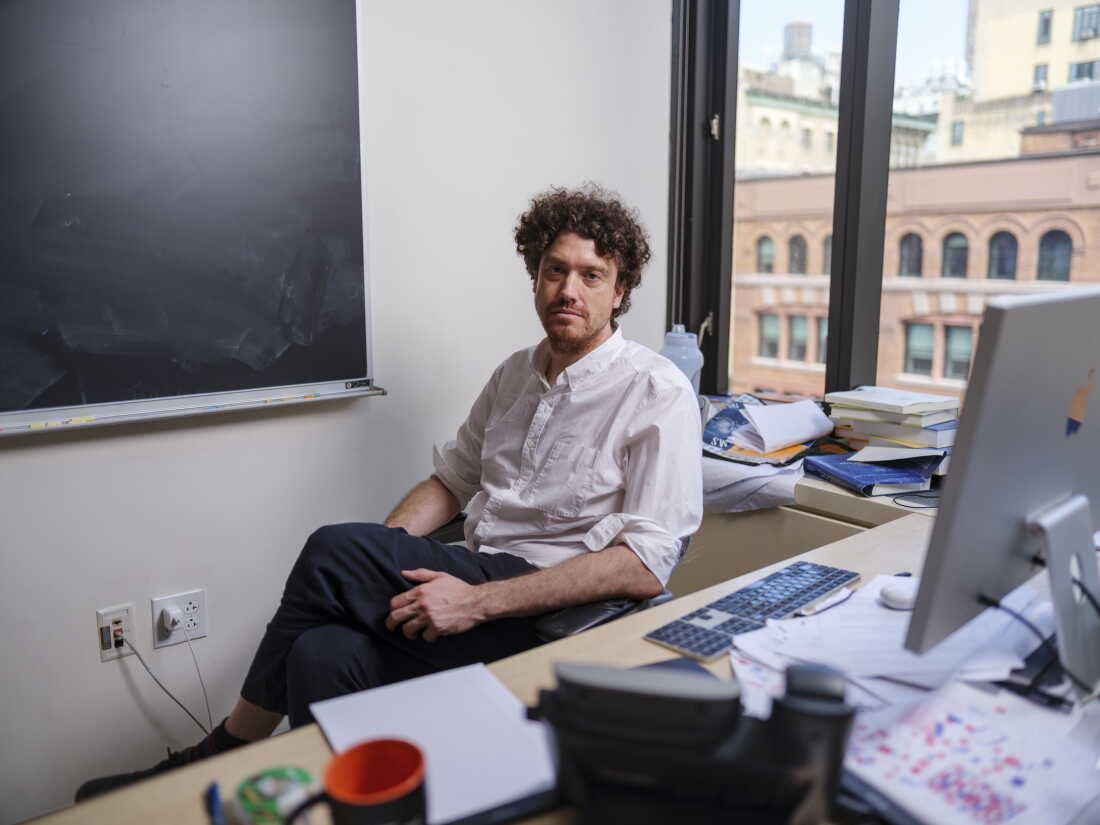
On September 11, 2026, mathematician Tristan Buckmaster from New York University was photographed in his Manhattan office. Alongside collaborator Levent Alpöge, he has been delving into the complexities of the Navier-Stokes equations. Their efforts contrast sharply with OpenAI’s claim of having solved these equations, stirring controversy.
OpenAI’s recent announcement celebrated their AI model’s purported solution to one of mathematics’ toughest problems, with ambitions of enhancing scientific research and technology for global benefit. However, many mathematicians argue that the 166-page manuscript produced by AI is challenging to interpret and has not contributed much to human understanding thus far. James Maynard from the University of Oxford remarked on the difficulty of extracting insights from the AI-generated proof, which he and others find not accessible for human readers. Javier Gómez-Serrano from Brown University, who utilizes AI in his research, noted the proof’s potential amid the need for substantial re-writing. The AI’s increasing role in mathematics, evident in its rapid advancements over the last six months, highlights the potential for new discoveries but also raises concerns about collaboration between AI and human mathematicians.
“The whole episode could have been a wonderful proof-of-concept of collaboration,” said Maynard, a Fields Medal recipient.
The Navier-Stokes problem remains one of the most significant unanswered questions in mathematics. These equations are crucial for describing fluid dynamics in physics and engineering. Buckmaster suggests that deeper insights could provide new tools for modeling turbulence and aircraft lift. Identifying scenarios where these equations fail was a goal linked to the $1 million Millennium Prize Problems, established by the Clay Mathematics Institute in 2000. Mathematicians anticipated solving the Navier-Stokes problem soon, with many believing it was the next Millennium Problem to be resolved. Martin Hairer of EPFL noted the community’s expectations.
A race to discovery ensued as OpenAI learned that a solution might be imminent. On September 1, the company reported hearing rumors of progress on two Millennium Problems and mobilized 10,000 AI agents to tackle Navier-Stokes over 88 hours, generating around 130 billion text tokens and incurring significant costs.
The controversy escalated when Buckmaster accused OpenAI of unethical practices, asserting they approached him with offers tied to dropping his collaborator Alpöge from Anthropic. Increased scrutiny followed OpenAI’s denial of utilizing Buckmaster’s work.
Despite OpenAI’s claims, mathematicians expressed difficulty understanding the legitimacy of their results. Buckmaster criticized the poor quality of the paper, describing a lack of clarity on important aspects and the rushed nature of the work. Both Buckmaster and other mathematicians published their preliminary findings, acknowledging the role of AI in their research yet criticizing the circumstances of their release.
While OpenAI’s complex proof is undergoing scrutiny, a computer code using Lean language provides some assurance of its correctness. Compilation of Lean code, utilized to verify mathematical proofs, gave the mathematical community confidence after it validated the solution. Gómez-Serrano affirmed the consensus on the accuracy of OpenAI’s results.
This episode hints at AI’s future role in mathematics, where computers handle many computations for advancements. However, Maynard argued mathematics involves more than mere solutions, emphasizing the importance of human comprehension.
Leave a Reply