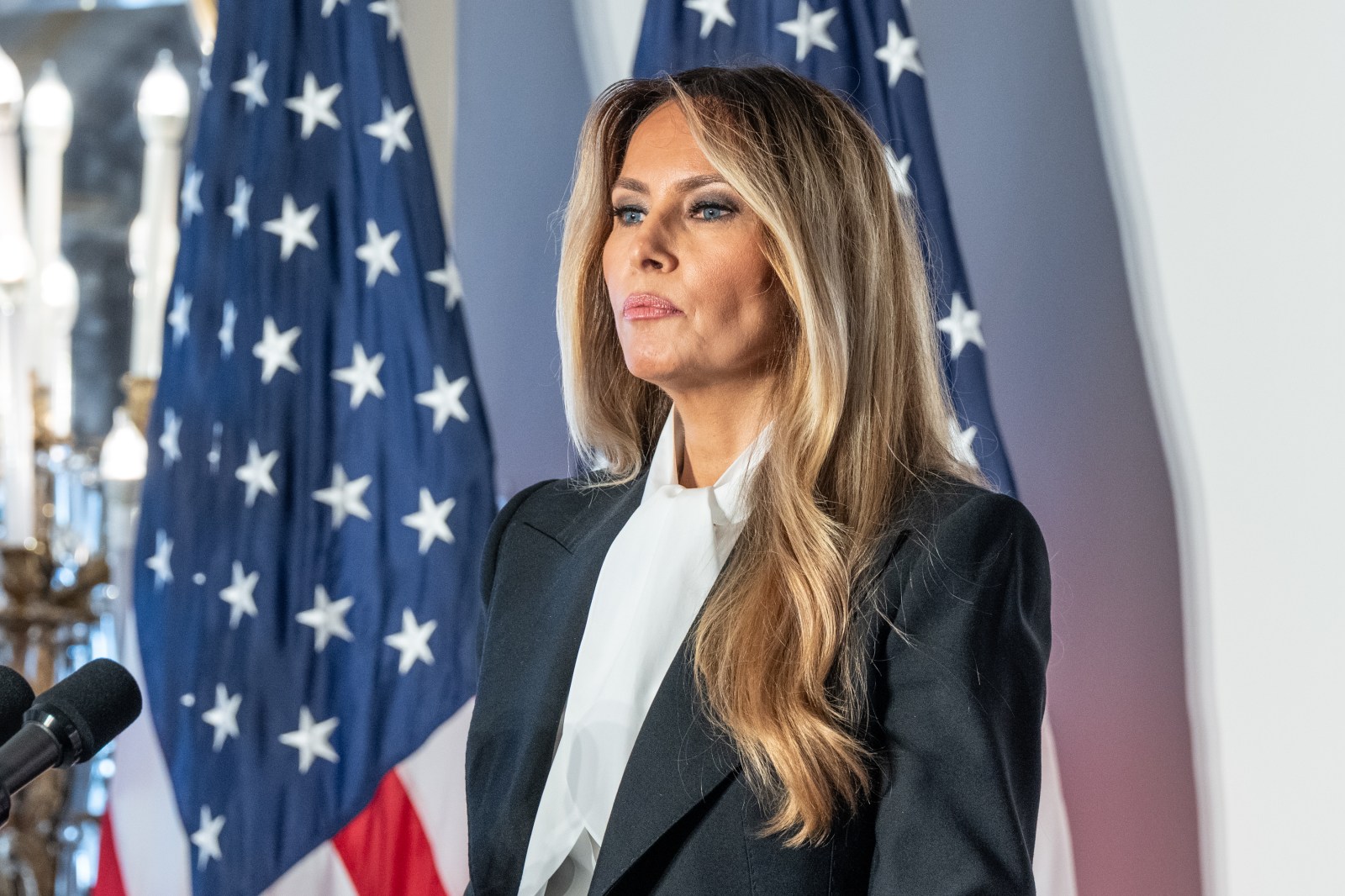
First Lady Melania Trump is advocating for increased use of artificial intelligence (AI) tools in education, even as educators express concerns about its impact on students’ independent thinking skills.
During a speech in New York, on the sidelines of the United Nations General Assembly, Melania discussed her initiative titled ‘Fostering the Future Together.’ This initiative aims to unite governments and major tech companies to enhance children’s access to technology, education, and digital skills.
“We are living in an extraordinary moment in human history,”
Melania stated.
“We stand together at the threshold of a technological revolution.”
She emphasized that providing children with access to technology is not sufficient on its own. “Access alone is not empowerment,”
she remarked. “We must give our children the tools and teach them how to use those tools wisely.”
This initiative comes as President Donald Trump stresses the importance of rapid AI development to maintain a technological edge over China. However, recent research raises questions about whether widespread AI use in classrooms may hinder students’ critical thinking, memory, and independent learning abilities.
Eric Klopfer, an MIT professor, referred to this as the “illusion of learning,”
highlighting early evidence suggesting overreliance on AI may weaken thinking skills. An MIT committee found potential links between extensive use of chatbots and diminishing critical thinking and confidence among students.
Although conclusive long-term evidence is lacking, these concerns arise amid an increasing integration of AI tools in education. The White House prioritizes accelerating technological advancements.
Melania’s AI Education Initiative
Melania Trump’s initiative involves partnerships with major tech firms such as Adobe, Amazon, Google, Intel, N50, Starlink, and Zoom. This collaboration spans 57 countries, according to the State Department. It focuses on AI in education, EdTech tools, online protection, and digital skills.
Melania expressed appreciation for these companies, stating they have “stepped up to empower our children.”
- Google is dedicating $4 million to its AI Educator Series to provide free training for educators globally.
- Amazon is offering free access to its Kiro AI software-engineering agent at 132 universities.
- Adobe is expanding AI-powered study tools for students.
- Intel is rolling out AI education and digital-literacy programs across 10 countries.
- N50 is piloting an AI education-device program in Uganda for over 10,000 students and 200 teachers.
- Starlink and Papua New Guinea are working together to improve internet access.
- Zoom has allocated $2.75 million in new grants for educational and workforce development.
Melania described the initiative as a strategy to provide young people with essential skills and technology for an increasingly digital economy.
“Our mission, to empower children through technology and education, is achievable,”
she affirmed at the initiative’s March summit.
Research Points to Potential Harm in Children’s Learning
As initiatives promoting AI in education advance, educators raise concerns over AI’s role in student work completion. A Washington Post report compiled studies and interviews showing that AI might negatively impact students’ ability to think.
Instances include students submitting polished AI-generated essays without understanding the concepts. Similar cases arose with students using AI to complete programming tasks but struggling during exams.
Several studies provide corroboration:
- Carnegie Mellon research revealed a decline in problem-solving abilities when AI assistance was removed.
- A study on essay writing attributed weaker brain connectivity to reliance on AI compared to traditional methods.
Educators respond by reducing technology use in classrooms, requiring handwritten work or oral exams, and eliminating take-home tasks. Shawna Dolansky, a professor at Carleton University, now has students write essays in class, avoiding AI influence.
Donald Trump’s AI Strategies
Concurrent with the first lady’s initiative, President Trump prioritizes rapid AI development for both economic and national security reasons. He emphasizes the U.S. maintaining its lead over China while resisting broad restrictions on AI development.
In his address to the United Nations General Assembly, Trump asserted the U.S. would advance AI technology swiftly. He mentioned the possibility of Justice Department intervention if AI becomes a threat, despite opposing regulations that might slow progress.
Trump considers AI a significant technological evolution, announcing plans for an ‘AI Force’ and an AI czar. These roles resemble the Space Force model, overseeing AI developments. Despite acknowledging AI concerns, Trump regards some warnings as exaggerated, urging the U.S. to act promptly.
In response to questions on oversight, Deputy Attorney General Trent McCotter explained the Department of Justice’s monitoring role in AI technology. However, he provided no specific examples.
McCotter noted ongoing collaboration with agencies like the Department of War, holding regular meetings to discuss AI developments.
AI Becomes a Midterm Debate Topic
The Trump administration’s push for AI advancement coincides with its emergence as a political issue. Voters and candidates in the 2026 elections debate AI’s effects on employment, automation, data centers, national security, and regulation.
A New York Times/Siena poll indicated widespread opposition to new AI data centers among likely voters, although AI ranked low among their priorities for the midterm election. Yet, AI safety concerns continue to rise in Washington and Silicon Valley.
While some tech executives advocate for stricter safeguards, Trump emphasizes continuous development and competition with China. Meanwhile, Melania focuses on the opportunities AI presents, stressing the importance of giving children confidence in their intellectual abilities.
“True empowerment begins by giving a child the confidence to believe that their mind has value,”
she conveyed.
“It means giving children the freedom to imagine a world beyond the one they know today.”
Leave a Reply