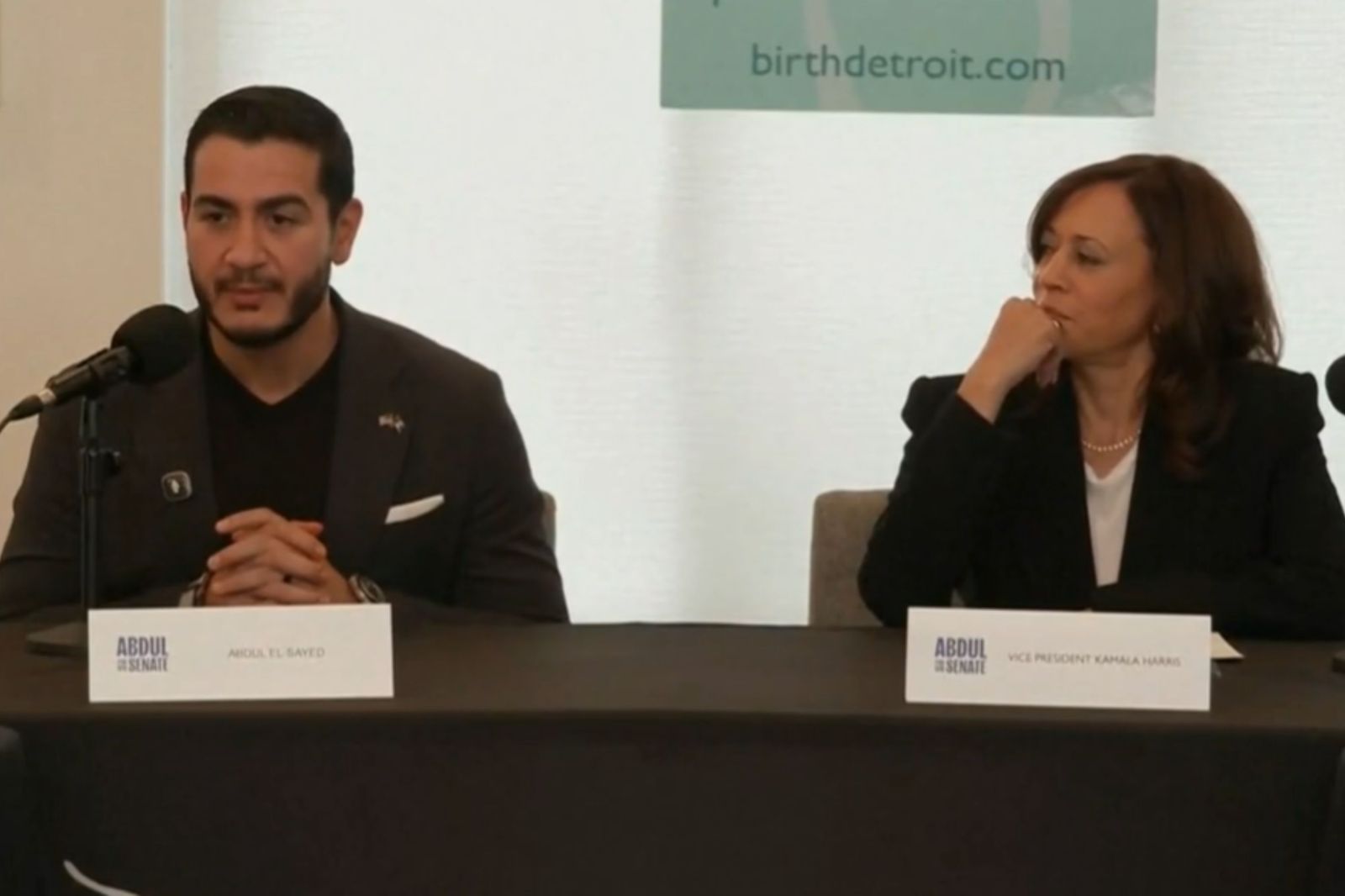
Former Vice President Kamala Harris participated in a campaign event with Democratic Senate nominee Abdul El-Sayed at a Detroit birth center. This marked their first joint public appearance since Harris endorsed El-Sayed after his primary victory in August.
During the discussion on Black maternal health, Harris and El-Sayed highlighted the importance of the election against Republican Mike Rogers. They argued that the outcome would influence federal funding for maternal care, affected under the Trump administration.
“One in 12 women in America lives in a maternal care desert,” Harris stated. “Black women are three to four times more likely to die in connection with childbirth.”
Harris attributed the crisis to Trump-era policies, emphasizing Medicaid’s role as the largest funder of maternity care and mentioning Trump’s trillion-dollar cut to the program. She noted Rogers’s support for the cut as well.
El-Sayed shared personal stories, recounting his grandmother’s loss of two infants and his father’s experience witnessing siblings die at a young age. He underscored the significance of society’s role in supporting transitions of life.
“Babies shouldn’t die,” El-Sayed said. “The measure of a society is what we do to empower people at that transition of life.”
He emphasized the urgency of the remaining campaign period, expressing gratitude for Harris’s visit and leadership on maternity care.
Harris, seen as a potential 2028 presidential candidate following her loss to Donald Trump in 2024, visited Michigan at a critical moment in the Senate race. The seat, made available after Democratic Senator Gary Peters’s decision not to seek reelection, holds key importance for Democrats aiming to regain Senate control in 2027.
El-Sayed Gaining Poll Momentum
The campaign event coincided with a positive shift in polls for El-Sayed. A recent Suffolk University Political Research Center survey indicated a widening lead over Rogers in Michigan’s Senate race, with El-Sayed holding a seven-point advantage—the largest margin reflected in September’s polling.
The Suffolk poll sampled 500 likely Michigan voters, revealing an error margin of plus or minus 4.4 percentage points. El-Sayed’s lead was attributed to strong support from independent voters.
David Paleologos, director of Suffolk’s Political Research Center, noted El-Sayed’s popularity with unaffiliated Michigan voters. Factors influencing shifting voter preference included dissatisfaction with recent tariffs on Canada and concerns over potential data centers in Michigan.
El-Sayed leads Rogers 51% to 35% among independents, marking independents as pivotal to the race. Gender divides were evident, with Rogers leading among men and El-Sayed among women.
Union membership and gun ownership also defined voter lines. El-Sayed led in union households, while Rogers was favored in gun-owning households.
Michigan’s Strategic Importance
Michigan ranks as a central state for Democrats aiming to reclaim Senate control. Amid a 53-47 Republican Senate majority, Democrats need to secure four additional seats, making Michigan a focal point of attention.
Ad spending further illustrates the stakes, with close to $125 million invested post-primary, marking Michigan as a prime location for partisan gains.
El-Sayed presents a new Democratic vision, aspiring to break establishment economic molds. Meanwhile, Roger leverages his law enforcement background and Trump endorsement to uphold Republican interests.
Controversy and Diverging Campaign Strategies
El-Sayed confronts controversy surrounding his association with streamer Hasan Piker without severing connections entirely. Piker’s prior inflammatory comment had sparked scrutiny, intensifying under establishment media perspectives.
Amid the challenge, El-Sayed campaigns to minimize party divisions following a contentious primary with Haley Stevens. Meanwhile, Rogers targets Democratic voters through sector-specific appeals: Wayne County’s Black population and Jewish Democrats critical of El-Sayed’s regional commentary.
Michigan promises close observation leading up to the November 3 midterms, emblematic of its standing as a battleground state.
Leave a Reply