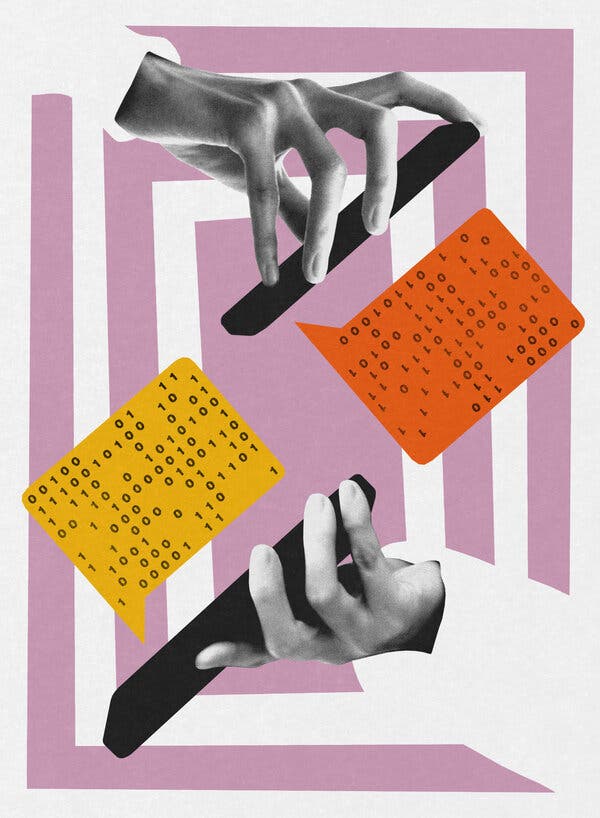
Good morning. A growing number of people are turning to AI to manage tasks. The question arises: Are we ready for a world where machines predominantly communicate with each other?
Image Credit: Photo illustration by Chantal Jahchan
I’m a flesh-and-blood reporter on the Style desk, and I crafted this newsletter without AI.
If you haven’t applied for a job recently, you might be surprised by the new standard procedure. Job seekers often use AI chatbots to generate résumés and cover letters. On the other side, employers utilize AI to sort through these applications. Individuals on both ends claim they need these tools to keep pace with each other. However, this process often feels hollow, impersonal, and frustrating. Are people truly getting to know one another better through this method?
AI in Everyday Scenarios
Such occurrences are becoming widespread. Consider a high school student who requests an AI chatbot to write an essay she submits. A teacher uses AI to grade that essay. Or think of someone who asks a chatbot for a witty opening line for an online romance, followed by a chatbot-generated flirty reply from the other person. There are even cases where individuals send AI agents to dispute with a company’s AI customer service system.
“We’ve officially reached the point where customer support is just two LLMs locked in a recursive loop of ‘I understand your concern,’ while the actual humans on both ends just watch the credits roll.” — Reddit user
Many have spent recent years adjusting to the idea of using chatbots as communicative partners. Now, as more daily tasks integrate AI, these directives often clash. I’ve termed these situations as “bot loops” — whirlpools that arise when humans outsource their roles in an interaction to AI.
The Future of AI Interaction
Some remain optimistic about bot-on-bot interactions enhancing our work and personal lives. It’s feasible that an AI voice agent could someday call the Department of Motor Vehicles for me, with another AI agent answering. If it saves a trip to the local DMV in Brooklyn, that prospect is certainly appealing.
Whitney Wolfe Herd, CEO of the dating app Bumble, envisions a future where AI personas go on dates and report back with the outcomes. (When a colleague attempted this, the results were lackluster. Better luck next time, Eli!)
Leave a Reply