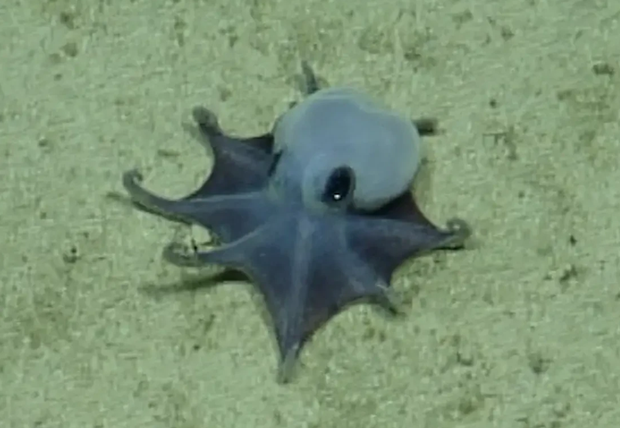
Scientists operating a submersible near the Galapagos Islands recently encountered a blue octopus on the ocean floor. This tiny creature, which could easily fit in the palm of a hand, grabbed the attention of the research team.
The discovery was made by the Charles Darwin Foundation, at a depth of approximately 5,900 feet. The newly identified species was confirmed after research findings were published.
Right away, I knew it was something really special,shared octopus expert Janet Voight.
Voight, who works with the Field Museum of Natural History in Chicago, initially recognized the octopus from photographs before receiving its preserved body for further examination.
She was particularly interested in the octopus due to its unusual characteristics. Its nearest known relative lives off the coast of Uruguay, in a separate ocean.
To properly study the specimen without physically dissecting it, Voight and the Field Museum team employed CT scans. Thousands of X-ray images produced a 3D model, uncovering its internal structures. Stephanie Smith, head of the museum’s X-ray lab, expressed excitement at observing something never before seen by humans.
Unique Characteristics of Microeledone galapagensis
The new species, named Microeledone galapagensis, is notable for several distinctive features beyond its striking blue color, which is rare in nature. It is the smallest member of the Megaleledonidae family, usually known for larger octopuses residing in Antarctica’s Southern Ocean.
The octopus is characterized by short arms with a single sucker row and has smooth skin on its back. Its coloration varies with a deep purple underside, which is believed to provide protection by concealing its light-producing prey from predators.
Discovering new octopus species in the deep sea is relatively common, particularly in regions less explored. The vastness of the ocean floor remains mostly uncharted, as Voight emphasizes.
The first sighting of this blue octopus occurred in 2015 near Darwin Island. This area is named after Charles Darwin, whose visit to the Galapagos played a role in developing his evolutionary theory.
The current research marks the first instance of Voight leading a team to officially describe a new octopus species, enhancing her four-decade career studying octopus evolution. Her study was published in the journal, Zootaxa.
Globally, about 300 octopus species inhabit various oceans. In 2024, another group of scientists reported discovering four new octopus species off Costa Rica’s coast.
Leave a Reply