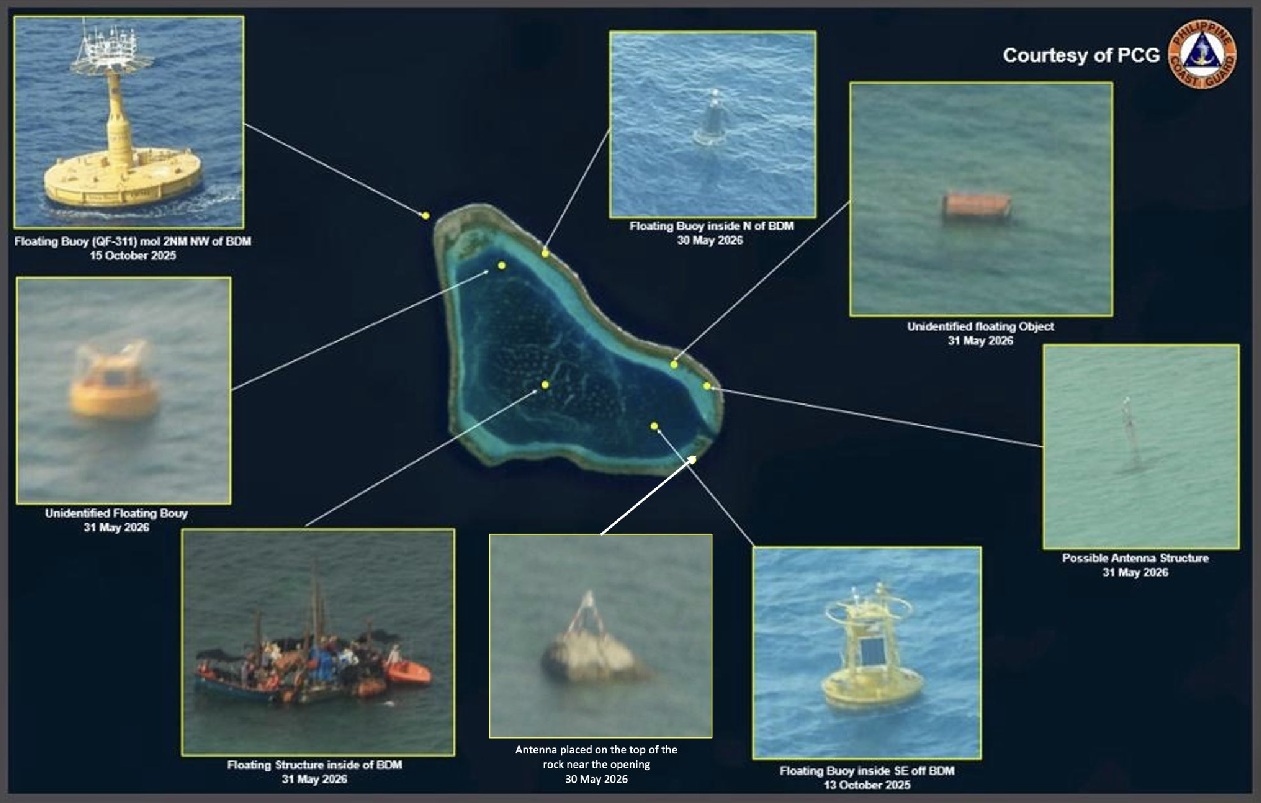
The Philippine authorities have shared images of several structures at a disputed reef, attributing their placement to China. The number of foreign objects identified has grown to six since the initial report from inside Scarborough Shoal’s lagoon on May 30, according to a statement by a Philippine coast guard spokesperson.
Scarborough Shoal, referred to as Bajo de Masinloc in the Philippines and Huangyan Island in China, remains a sensitive issue in the South China Sea dispute. China has exerted de facto control since a confrontation in 2012, but physical occupation has not occurred thus far.
“We conducted aerial surveillance over Bajo de Masinloc, or Scarborough Shoal, to observe the structures being erected, whether floating or fixed,” Philippine military chief Romeo Brawner Jr. announced to reporters in Quezon City.
“We will also dispatch ships,” he added.
The newly discovered objects being scrutinized by Manila include an antenna positioned atop a rock near the lagoon entrance, another suspected antenna, a floating structure, an unidentified cylindrical object, and three buoys, adding to two previously found in October.
Additionally, a makeshift mobile structure with dimensions roughly 20 by 20 feet, housing six occupants, is under surveillance, as noted by Brawner. Previously, China had installed barriers—later removed by Philippine authorities—to prevent local fishermen from accessing the rich fishing grounds of the lagoon.
The proliferation of these structures, especially those with personnel, might further complicate Manila’s territorial disputes with Beijing. The Philippine Foreign Affairs Department stated it pursued “appropriate diplomatic action” with the Chinese government regarding the “illegal presence” of these structures, per the interagency task force for the West Philippine Sea, the term used by Manila for the South China Sea area within its exclusive economic zone.
An exclusive economic zone allows a country exclusive rights to exploit resources within approximately 230 miles of its coastline. Beijing has not refuted Philippine assertions that the objects are Chinese but reiterated its long-established claim over the Shoal.
“China has irrefutable sovereignty over Huangyan Dao and its surrounding waters. It possesses full sovereign rights to conduct activities, including scientific research at Huangyan Dao,” stated Chinese Foreign Ministry spokesperson Lin Jian.
“China urges the Philippines to cease all infringement activities, provocations, and false accusations at sea,” Lin added.
Tensions surrounding Scarborough Shoal escalated significantly last summer when a collision occurred between a Chinese navy destroyer and a China coast guard vessel, trying to obstruct a Philippine government mission to support local fishermen. The Philippine coast guard ship suffered severe damage, and officials later asserted they suspected Chinese casualties occurred, though Beijing did not publicly confirm this.
Weeks later, Beijing unilaterally designated a national nature reserve covering about one-third of the Shoal, prompting objections from Manila and Washington. The emergence of new objects has heightened concerns regarding China’s potential intentions to fortify control over the area.
Colin Koh from the Institute of Defense and Strategic Studies in Singapore commented, “The same modus operandi is replicated across the South China Sea, East China Sea, and Yellow Sea.” Koh added, “Given a ‘national nature reserve’ was unilaterally declared by Beijing, the floating structure might signal more escalatory moves to solidify its control.”
China’s claim of sovereignty over most of the South China Sea, citing “historic rights,” encompasses a pivotal area facilitating over $3 trillion in annual maritime trade. The presence of Chinese coast guard, naval, research, and maritime militia vessels in disputed areas has led to protests from Vietnam, Taiwan, Malaysia, Brunei, and Indonesia.
The Philippines filed a case with the Permanent Court of Arbitration in The Hague, which, in 2016, ruled largely against China’s extensive claims in the South China Sea. However, Beijing denied the verdict and continues to dismiss the ruling.
Leave a Reply