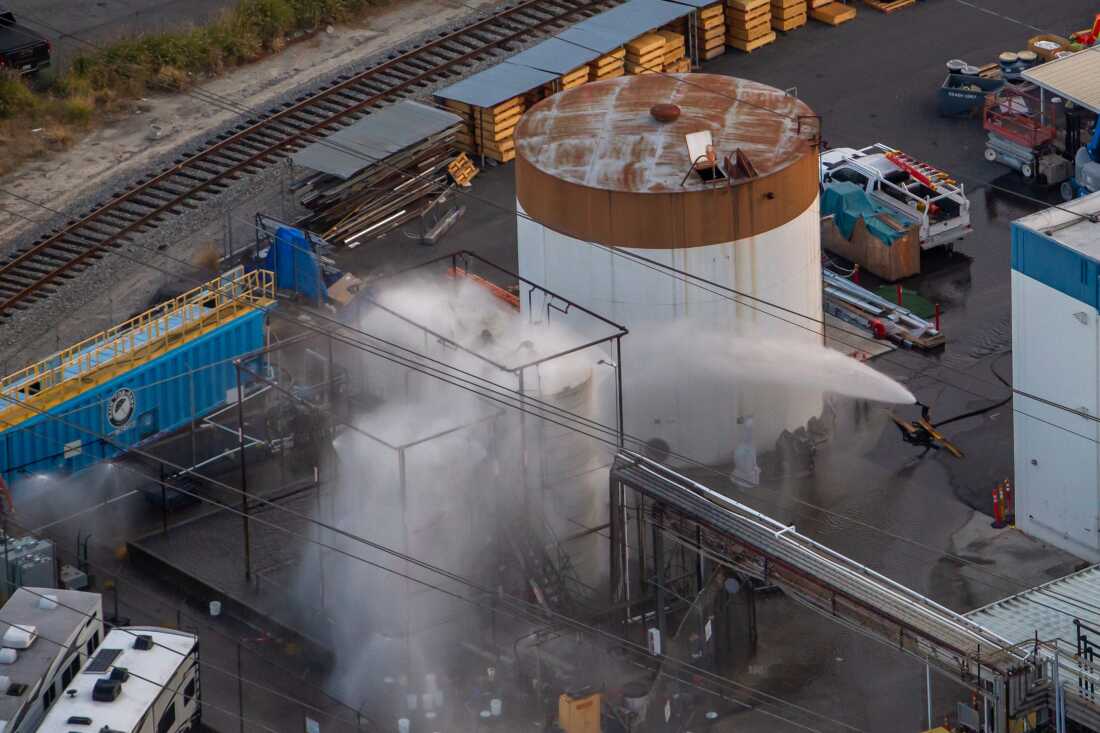
An aerial snapshot captures water being sprayed onto an overheating 34,000-gallon tank at GKN Aerospace on May 23, 2026, in Garden Grove, California. This manufacturing facility faces a serious threat due to a malfunctioning tank, raising concerns about a chemical leak or explosion.
Some 50,000 residents of Garden Grove, California, are under evacuation orders as emergency teams work to manage the dangerous situation at the aerospace plant. The following provides insight into the current status at the facility and possible future developments.
Tank Concerns and Response
Overnight, the chemical tank sustained damage, potentially developing a crack. Positioned in the southeastern section of the GKN Aerospace site, the tank holds around 7,000 gallons of methyl methacrylate. This chemical is highly toxic and flammable, used in producing resins and plastics. Late Saturday, firefighters examined the tank’s condition, as described by TJ McGovern, interim county fire chief for the Orange County Fire Authority. They identified a potential crack, which might surprisingly present an opportunity.
The Damage Improves Stability
The situation ignited on Thursday, yet the underlying issues remain unclear. Chemicals in the tank became dangerously hot. Methyl methacrylate is volatile, releasing energy exothermically, which can trigger a pressure increase and potential explosion when confined. A similar incident happened in the UK in October 2009, where a chemical blast caused devastating damage, affecting buildings over 600 feet away from the site.
In this California incident, the tank’s structure suffered, causing it to bulge outward, reported Craig Covey, the incident commander at the Orange County Fire. Cooling efforts include continuous water spray. Nearby tanks have been safely drained and stabilized. On Friday, Covey explained to reporters that a crack in the tank might be better than an explosion. He suggested that while leaking is less than ideal, it removes the explosive risk.
Environmental and Health Threats Persist
GKN Aerospace, the plant owner, stated they are working tirelessly to reduce leak risks. Methyl methacrylate poses multiple threats, including skin and eye irritation and respiratory and neurological problems such as headaches and lethargy. Prolonged exposure can damage lungs and organs.
Although environmental impact data on potential spills is limited, it’s expected to be detrimental. Experts are implementing preventive measures, as Covey mentioned, to handle potential leaks. Measures include utilizing sand and other materials to block chemical flow into surrounding storm drains and waterways.
Evacuation Orders Remain
Residents displaced by the threat checked into shelters due to orders established on Friday. The measures aim to prevent exposure to both blast impacts and toxic fumes. The fire department lacks the ability to predict fume travel patterns, urging widespread evacuations.
No fumes have been detected so far, as confirmed by active monitoring by the Environmental Protection Agency and fire officials. McGovern expressed optimism regarding the crack in the tank, suggesting it might be relieving internal pressure. He acknowledged the progress and anticipated further updates shortly.
Leave a Reply