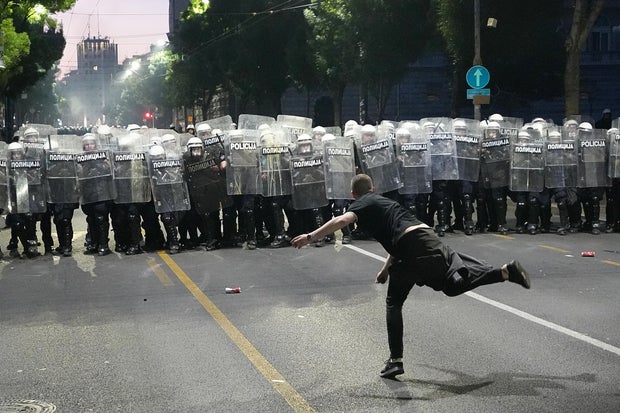
In Belgrade on Saturday, significant unrest followed a large anti-government rally targeting Serbian President Aleksandar Vucic’s leadership. Although the event initially remained peaceful, clashes erupted later between young demonstrators and riot police. Protesters hurled flares, rocks, and bottles, prompting police to use pepper spray in efforts to disperse them. The confrontation saw demonstrators roll trash cans into the streets as riot police equipped with shields attempted to contain them. Anti-riot vehicles were stationed in central Belgrade to prevent the return of protesters, leading to a swift end to the violence.
Earlier, thousands of protesters flooded into Belgrade, many displaying banners and wearing T-shirts with the “Students win” slogan, indicative of the youth movement’s influence. Supporters from various Serbian towns joined, forming columns of cars entering the city. The gathering represents ongoing dissent against President Vucic, whose leadership has faced large-scale protests for more than a year. These protests initially began following a tragic incident at a train station in northern Serbia in November 2024 that left 16 dead.
President Vucic addressed the situation through a video on Instagram, accusing the protesters of demonstrating violence and being intolerant of political opposition. He assured that the government remains functional and committed to legal protocols during a state visit to China. The protests stem from allegations of corruption linked to negligence in renovation work on a train station. A concrete canopy collapse during this work, conducted with Chinese companies, sparked anger among citizens.
Activist and prosecutor Bojana Savovic criticized the government during the rally, stating that selective law enforcement transforms the state into “a mafia organization.” Despite criticism, parliament speaker Ana Brnabic downplayed the rally’s significance, asserting that democracy is alive, citing a police estimate of 34,300 attendees.
The unrest initially flared near a camp set up by Vucic’s supporters outside the Serbian presidency. Loud folk music emanated from this fenced area, surrounded by riot police. The Serbian state railway canceled all train services to and from Belgrade on the day of the protest, a measure seemingly intended to limit participation from other regions.
International attention has focused on President Vucic’s heavy-handed tactics over the last year, including arbitrary arrests and excessive police force. Council of Europe Commissioner for Human Rights, Michael O’Flaherty, criticized Serbia’s handling of the situation, pledging to monitor developments closely. Reports also suggest police protection for masked individuals attacking journalists and protesters.
Serbia’s EU accession efforts are in jeopardy due to democratic backsliding, as warned by EU officials. The country risks losing significant EU funding due to its political climate, which has raised concerns internationally.
Slavija Square in Belgrade, the site of Saturday’s rally, previously witnessed significant protests marred by allegations of sonic weapon use, which the government denies. The youth movement’s calls for justice resonate with citizens frustrated by prolonged political instability. As they prepare to contest in upcoming elections, students aim to challenge Vucic’s administration, advocating for a political shift between September and November. Vucic and pro-government entities have labeled dissenters as foreign agents, fueling polarization.
Protester Maja Milas Markovic expressed optimism, crediting the youth and their energy as rallying points for the movement. Citizens increasingly seek effective governance and a departure from political strife.
Leave a Reply