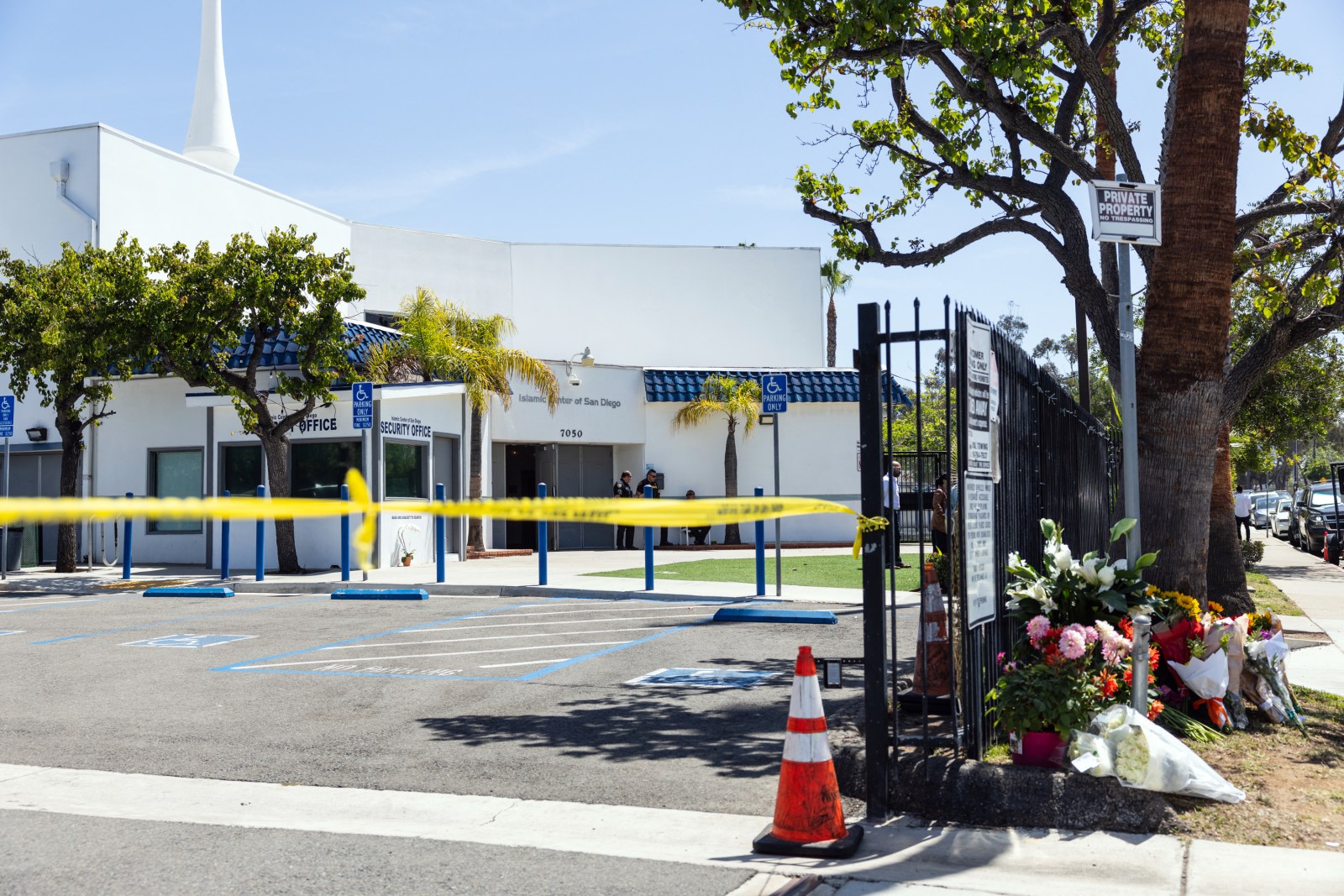
As America celebrates its 250th birthday, discussions on freedom, pluralism, and religious liberty abound. One of the most significant expressions of this liberty comes from George Washington’s 1790 letter to the Hebrew Congregation of Newport, Rhode Island, where he promised that the United States would “give to bigotry no sanction, to persecution no assistance.” Over two centuries later, it is pertinent to question whether we still adhere to this commitment.
Recently, on the fourth Friday following the tragic attack on the Islamic Center of San Diego, I visited a mosque in Los Angeles. Five armed guards were present, overseeing the large gathering of more than a thousand worshippers. Families with children were there, friends were greeting each other, and volunteers were managing the traffic. The security presence seemed almost ordinary.
Three weeks prior, while I was visiting from Canada, my daughter joined me for Friday prayer. As we approached the mosque, she paused to photograph a security guard wearing a bulletproof vest and carrying a weapon. “Is this normal?” she asked. The honest answer is yes—this might be the most troubling aspect.
The San Diego attack resulted in three deaths, including a security guard who reportedly died protecting worshippers. Over 130 children were present at the time. This incident is seen as possibly the first ideologically motivated lethal attack on a U.S. mosque this century, according to the Center for Strategic and International Studies. It is a somber milestone, bringing closer comparisons to the deadly mosque attacks in Christchurch, New Zealand, and Quebec City, Canada.
The Islamic Center seemed prepared, having reportedly received federal and state security funding, with surveillance cameras, fencing, bullet-proof glass, trained personnel, and emergency procedures in place. Still, the tragedy occurred. These measures might have prevented a larger catastrophe, but San Diego highlights how common intense security measures have become at places of worship nationwide.
This issue is not confined to Muslims alone. Jewish, Christian, Sikh, Hindu, and other religious communities have faced deadly attacks and threats. Across all faiths, the central question persists: how to maintain open, welcoming houses of worship without leaving them exposed to danger?
Security is costly. Every dollar allocated to guards and cameras is diverted from education, charity, counseling, or community programs. After prayer, I noticed this as I contributed money for security expenses. Since the attack, I have increased my donation. It is noteworthy that religious institutions increasingly fundraise for protection rather than service.
The Muslim Public Affairs Council notes that attacks against Muslims have grown elevenfold. Yet, according to UC Berkeley’s Othering and Belonging Institute, over 80 percent of anti-Muslim incidents are not reported, suggesting the problem is larger than official records show.
Fear is not always reflected in government data. It manifests in daily decisions: parents questioning the safety of sending their children to classes, worshippers assessing their surroundings before entering, and community leaders deliberating the affordability of additional security.
Security funding is crucial. California’s chapter of the Council on American-Islamic Relations has questioned whether Muslim-serving institutions receive adequate nonprofit security grants amid rising threats. The bigger question lies not in the quantity of security funding these institutions receive, but in why it has become necessary.
Since 9/11, American Muslims have faced increased scrutiny. Mosques have been surveilled, vandalized, threatened, and sometimes attacked, while anti-Muslim conspiracy theories have moved from fringe to mainstream discussions. Most exposed to this rhetoric will not resort to violence, but such rhetoric shapes perceptions of belonging and suspicion. Violence is rarely isolated; it thrives in environments where fear and dehumanization become normalized.
The San Diego attack and the presence of armed guards are not isolated events. As America commemorates its 250th anniversary, it remains essential to celebrate national achievements. However, this milestone also calls for introspection. San Diego is a reminder that the issue is not solely about how Muslims safeguard mosques, but about how America protects religious freedom itself.
This concern affects all houses of worship across the country. The more religious communities feel the need to fortify themselves, the further we move from Washington’s promise to “give to bigotry no sanction, to persecution no assistance.” A quarter millennium after the nation’s founding, the pressing question is not how many guards or cameras are needed. It is why so many feel it is essential to worship with such measures in place.
Faisal Kutty is a professor of law at Southwestern Law School, a member of the affiliate faculty at the Rutgers Center for Security, Race and Rights, and contributing editor for the Washington Report on Middle East Affairs.
Leave a Reply