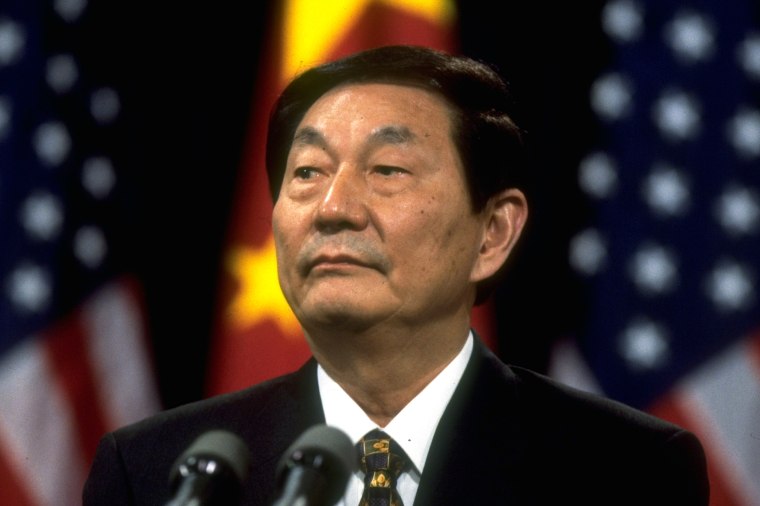
Beijing marked the death of Zhu Rongji, China’s former Premier, by cremating his body and lowering the national flag. Zhu, who passed away last week at 97, was remembered for his straightforward approach to reform. Citizens used the occasion to recall his era and consider his complex legacy.
Security was notably heightened across Beijing, particularly near Tiananmen Square and Zhongnanhai, areas central to political power. These locations were along the route to Babaoshan crematorium, where Zhu was honored. President Xi Jinping and the Politburo standing committee members paid their respects with a silent tribute and three bows before Zhu’s cremation at the cemetery reserved for top officials and national heroes. Former President Hu Jintao, aged 83 and absent from recent public events, sent a wreath in condolence.
Zhu served as vice premier from 1991 to 1998 and premier from 1998 to 2003. During the 1990s, he spearheaded significant economic reforms. These included controlling inflation, tightening tax and banking systems, and restructuring the state sector, resulting in job cuts at unprofitable firms. His efforts significantly contributed to China’s accession to the World Trade Organization in 2001, enhancing the country’s global economic integration.
In a 1988 statement to officials in Shanghai, before becoming mayor, Zhu emphasized his commitment to independent thought, stating, “I believe I should say what I truly think.” His membership in the Communist Party was revoked in the late 1950s due to a brief, imprudent speech, and not restored for about two decades.
Zhu’s death sparked a wave of mourning on social media, although some responses were mixed. One post, later removed, criticized Zhu for causing job losses. Despite this, numerous voices defended his resolute leadership. Zhu once acknowledged his polarized reputation, remarking, “Quite a considerable number of people like me, but some hate me to the core.”
The manner of Zhu’s death aligned with the subdued response to former premiers’ passings in recent years. These events often unfold under heightened security and censorship, as authorities tend to monitor public emotion and potential instability arising from these occasions.
The mourning for Zhou Enlai in 1976 led to protests against the Cultural Revolution. Similarly, Hu Yaobang’s 1989 death prompted pro-democracy demonstrations resulting in violence at Tiananmen Square.
Despite restrictions, memories of Zhu continue to circulate. Zhao, a 39-year-old IT worker, noted, “People are nostalgic and some seemed genuinely moved.” His passing evoked feelings from two decades ago when China adopted reforms and saw rapid economic growth.
Leave a Reply