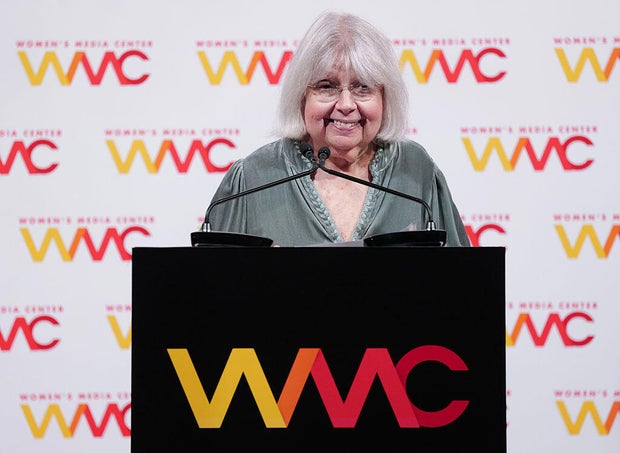
Robin Morgan, a once-darling child star of the 1940s and 1950s, transformed into a prominent poet, essayist, editor, and second-wave feminist. Morgan passed away at the age of 85 in New York after recent health challenges, her son Blake Morgan announced. Her passing followed closely after the death of her friend and fellow activist Gloria Steinem.
In the transformative decades of the 1960s and 1970s, Morgan was a key figure in advancing women’s rights. Known for challenging norms, the former ‘Ideal American Girl’ became an outspoken advocate with a remarkable record, including a prison sentence and an FBI file. Her influence was pivotal to the second-wave feminist movement, continuing the work of earlier suffragists.
One of her notable acts was organizing the first protest against the Miss America pageant in 1968. With fellow activists, she symbolically discarded bras into a ‘Freedom Trash Can,’ an act that became legendary as ‘bra burning.’ Her 1970 essay anthology, ‘Sisterhood is Powerful,’ is regarded as an essential feminist text.
Morgan considered herself primarily a poet and artist, drawing inspiration for her activism from her artistic endeavors. Her son Blake highlighted her ability to distill complex ideas into impactful phrases. One of her famous quotes, ‘hate generalizes, love specifies,’ exemplifies her succinct expression of profound thoughts.
“She was someone who could take very big ideas and distill them succinctly, like a poet, into a few words,” Blake explained.
Robin Morgan was instrumental in coining ‘herstory’ and the clenched fist/female symbol, significant icons of the liberation movement. Her poem ‘Monster,’ with lines like ‘I want a women’s revolution like a lover/I lust for it,’ became a rallying cry for feminists.
Morgan also addressed social issues in her personal life, having relationships with both men and women. Her long-term marriage to gay poet Kenneth Pitchford was described as a ‘two-member commune.’ She frequently faced labeling, both by those who felt she should fit a particular mold and those who assumed she did.
Beyond poetry, Morgan contributed over 20 books, including ‘The Word of a Woman: Feminist Dispatches.’ Her ‘Sisterhood’ trilogy, featuring esteemed contributors, expanded her influence. As editor-in-chief of Ms. Magazine, she shaped feminist discourse. Steinem regarded her as an ‘ideal utility player,’ capable of fulfilling various roles essential to the movement.
As an organizer, she co-founded several feminist groups and was a part of the Yippies before leaving due to their treatment of women. Morgan helped form the Sisterhood Is Global Institute in 1984 and, alongside Steinem and Jane Fonda, launched the Women’s Media Center in 2005.
Despite being diagnosed with Parkinson’s disease 16 years earlier, she remained engaged in activism and poetry. Her experiences transcended the roles expected of a former child star who began performing at age 3. From her early life in Florida to New York, her journey was marked by a misrepresented family history and an early entrance into entertainment.
In adulthood, Morgan pursued education at Columbia University, became politically active, and interacted with notable poets, establishing her presence in literary circles. Her marriage to Pitchford, whom she met at a party in 1962, symbolized her openness to unconventional life choices.
Leave a Reply