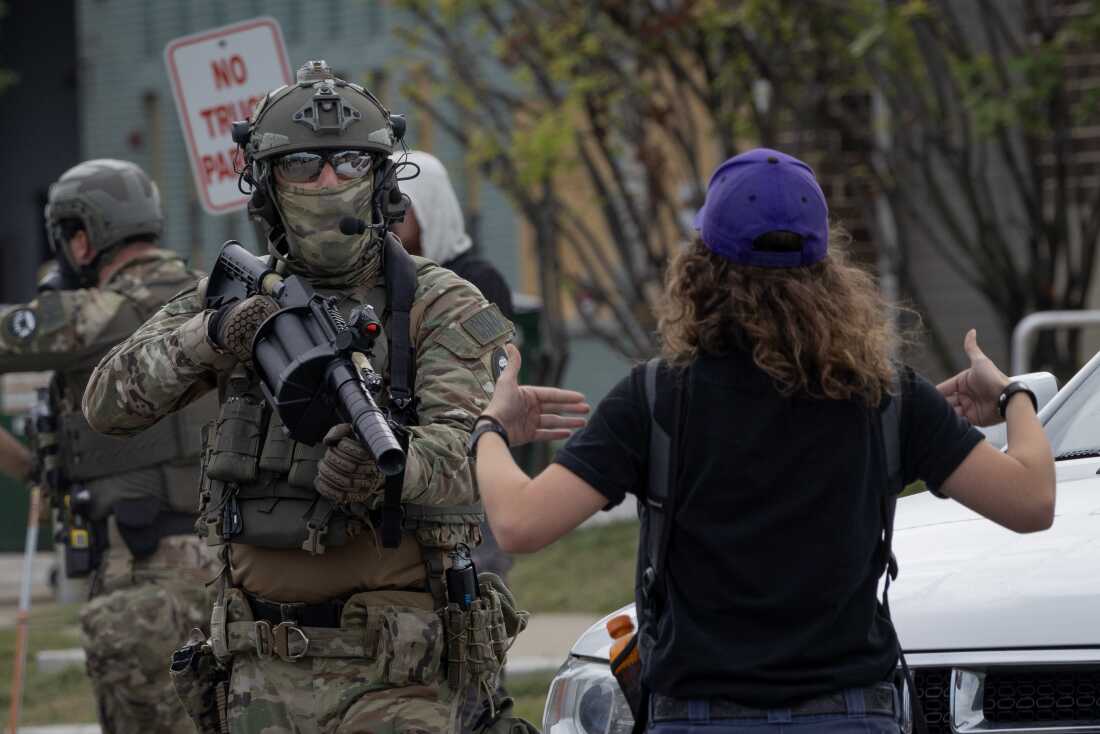
Federal law enforcement agents recently confronted demonstrators protesting outside an immigration processing center on September 19, 2025, in Broadview, Illinois. The protesters objected to a recent surge in ICE activity in the Chicago area, a part of the Trump administration’s Operation Midway Blitz aimed at cracking down on undocumented immigrants.
A report from the American Civil Liberties Union (ACLU) sheds light on widespread use of force by the federal agency. Released on Thursday, the report examines over 1,200 immigration enforcement operations by ICE officers or law enforcement in coordination with ICE across eight states. The timeframe spans from President Trump’s inauguration in January 2025 to the end of last year.
Forceful immigration encounters are more common than rare. Nearly a third of incidents in the research involved the use of force or threats.
Naureen Shah, director of policy and government affairs for immigration at the ACLU, notes a troubling shift towards using force as a default enforcement tool. The analysis drew from news reports, school and hospital press releases, community group reports, and more, recording enforcement details including the nature, participants, and locations of these encounters.
Seth Stoughton, a University of South Carolina law professor, comments on the need for government transparency and accountability: “Living in a democracy means that the government is doing a good job only when the people say it is. Transparency is key to understanding governmental operations.”
How Immigration Officers Use Force
The study documented immigration agents engaging in forceful actions like pushing, tackling, or pinning people to the ground more than 400 times. Officers often used weapons such as chemical irritants, rubber bullets, and tasers. They also used potentially lethal tactics restricted by many local police, like kneeling on necks and chokeholds. ICE and DHS did not comment on the findings.
Operations often occurred in everyday settings, such as bus stops and grocery stores. The ACLU noted hundreds of incidents involving children, U.S. citizens, protesters, bystanders, and journalists. The report included a diverse range of federal immigration enforcement activities, not solely those reported as unlawful, and the data provides only a partial snapshot of incidents occurring across a handful of states. Many operations remain undocumented.
With President Trump back in office, ICE ramped up enforcement with increased federal funding, leading to concerns about more violent encounters. Shah expressed worry about future violence: “There’s a culture of abuse and impunity, with pressure for unprecedented arrest quotas intensified by funding supporting force and intimidation practices.”
Increased Traffic Stops
Alongside more frequent encounters, ICE changed its enforcement strategy. Previously, operations were less common in communities and more targeted, says Jillian Snider, a retired New York City police officer and lecturer at John Jay College of Criminal Justice. “Earlier, they focused on locations with known targets. Now, there’s an uptick in car stops, raising concerns if officers lack proper training.”
Recently, ICE officers killed two men, Lorenzo Salgado Araujo in Texas and Joan Durán Guerrero in Maine, during car encounters. Neither was subject to targeted operations. The Department of Homeland Security stated Durán Guerrero tried to flee, prompting a shooting for “public safety” reasons. ICE claimed Salgado Araujo “weaponized” his car, though witnesses dispute this. In both cases, officers lacked body cameras.
Experts note that in traffic stops, there’s no need to shoot without a direct threat. The ACLU documented many incidents where officers rammed cars, boxed them in, or broke windows. Stoughton emphasizes the role of supervision: “Why don’t supervisors address repeated issues in conducting traffic stops wrongly?”
This week in Florida, a third person died after being struck by a semi-truck while fleeing from ICE during a traffic stop. In such stops, officers must juggle complex considerations, which previous training inadequacies may have compromised. Marc Brown, with the University of South Carolina’s Excellence in Policing and Public Safety Program, stresses training improvements are necessary. Without policy and training adjustments, enforcement difficulties arise.
Following the two shootings, ICE will pause non-urgent traffic stops, though future developments remain uncertain. President Trump, via Truth Social, urged ICE to continue traffic stops. ICE affirmed ongoing evaluation to ensure officer safety but declined to discuss tactics.
NPR’s Sergio Martínez-Beltrán contributed to this report.
Leave a Reply