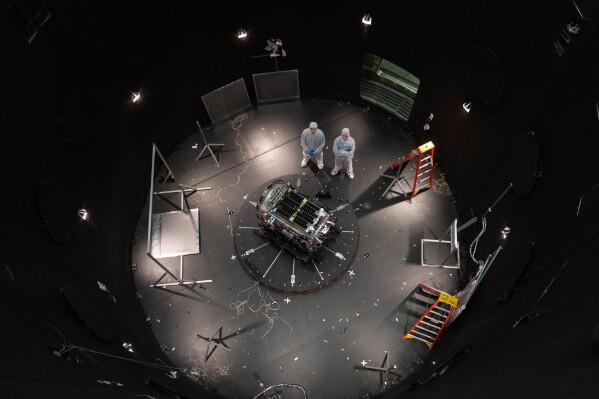
In an effort to save a deteriorating telescope, a three-armed spacecraft launched on Friday toward orbit from the Marshall Islands in the Pacific. The mission aims to rescue NASA’s Swift Observatory, which faces the risk of falling to Earth due to rapidly decreasing altitude.
Northrop Grumman deployed the Link spacecraft from Katalyst Space Technologies. The Pegasus rocket, launched from a modified aircraft, is on a course to reach and capture the Swift Observatory approximately in a month.
Swift, launched in 2004, is descending rapidly due to recent solar storms. NASA allocated $30 million to Katalyst to capture Swift, elevating its orbit to continue tracking cosmic events like gamma-ray bursts and exploding stars. If successful, Swift could resume scanning the universe by September. Currently, observations are paused to conserve the telescope’s orbit.
NASA’s Hubble Space Telescope may undergo a similar operation in the coming years, as it too is descending from increased atmospheric drag caused by solar activity.
The 1.6-ton Swift Observatory currently orbits 360 kilometers (224 miles) above Earth. Katalyst aims to elevate it by 240 kilometers (150 miles) back to its original altitude. Link’s boosters will activate to move Swift carefully, avoiding abrupt jolts. Katalyst organized this mission in just nine months due to the urgency imposed by NASA. Without intervention, the telescope could plunge to Earth by October.
Poor weather and technical issues caused last-minute delays in the launch. “This is a high-risk, high-reward mission,” stated Katalyst Space’s CEO, Ghonhee Lee, before the launch. “The greatest threat was launching nothing and allowing Swift to burn up in the atmosphere. We sought to prevent that risk, and our team has succeeded.”
This report is supported by the Department of Scientific Education of the Howard Hughes Medical Institute and the Robert Wood Johnson Foundation. AP holds full responsibility for the content.
Leave a Reply