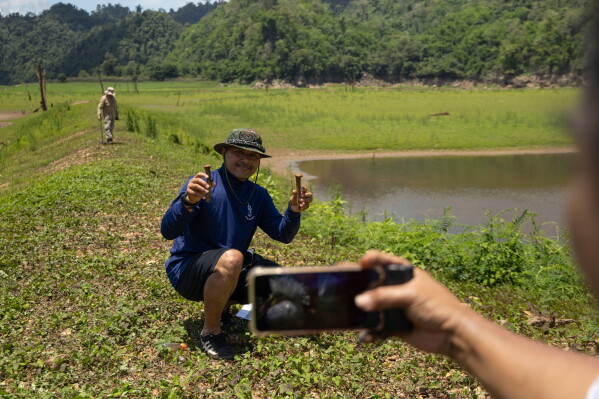
A depot on World War II’s notorious ‘Death Railway’ has emerged from beneath a reservoir in Kanchanaburi, Thailand, offering researchers a unique chance to study its remnants. Known as Nithe Station, the site was submerged for decades due to the Vajiralongkorn Dam. Its temporary revelation follows maintenance by the Electricity Generating Authority of Thailand, which drained the reservoir.
The railway holds grim historical significance. Built by Allied prisoners and Asian laborers under harsh conditions, it served as a supply route for Japanese forces. Historians estimate over 12,500 Allied POWs and 75,000 laborers died during its construction.
The exposed remnants have attracted attention from locals and researchers eager to delve into its history. Australian researcher Martyn Fryer traveled from Perth to explore the site in the sweltering heat, driven by personal ties—his grandfather died as a POW working on the railway after being captured in Singapore in 1942.
Fryer has visited Nithe Station several times but was previously unable to adequately assess its infrastructure due to high water levels. Equipped with a metal detector, he uncovered iron dog spikes, bridge staples, and other relics. His work is supported by historical records, including wartime aerial photographs from the National Archives in London.
Andrew Snow, another researcher from the Thailand–Burma Railway Centre, emphasized the importance of this opportunity for surveying. He compared historical photographs and hand-charted maps to locate POW camps. Snow’s father also endured the harsh conditions on the railway after capture in Singapore.
The region’s dry season often reveals parts of the station, but this year presented a rare chance due to unprecedented low water levels. Local residents have been drawn to the uncovered site, sharing images on social media that have garnered millions of views. People like Channarong Noimala have traveled significant distances to pay homage to those who suffered and died during the railway’s construction.
About 100 kilometers southwest of Nithe lies Hellfire Pass, another site haunted by its brutal history. The Hellfire Pass Interpretive Centre saw a record 169,000 visitors last year, marking the 80th anniversary of WWII’s end. Managed by Australian Army veteran Mick Clarke, the center aims to preserve memories of war and convey their significance to future generations.
For Australians, Hellfire Pass holds profound meaning; about 22,000 Australians became POWs during WWII, with 13,000 working on this railway. Mick Clarke believes such sites are pivotal for connecting families and the nation to a vital part of wartime history.
Leave a Reply