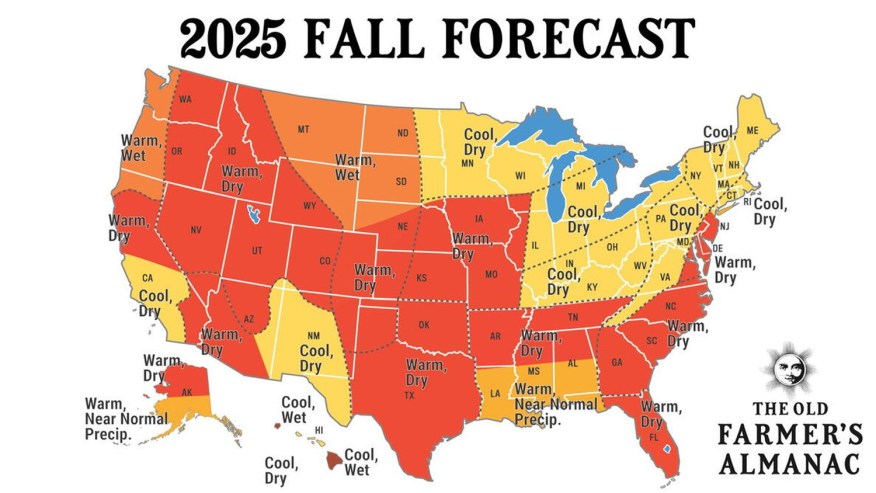
The season is changing. Sunsets are moving earlier, mornings give a crisp feel, and the autumnal equinox is a month away. Almanacs have released their forecasts. The Old Farmer’s Almanac and the Farmers’ Almanac are separate publications. They include extended weather predictions, gardening tips, and skywatching advice.
Last month, the Old Farmer’s Almanac issued its fall outlook. It predicts a warmer-than-average fall, with cool, wet weather in the Pacific Northwest and northern New England. The Plains and Rocky Mountains may experience a warm and dry season, as with parts of the central Gulf. The Midwest, Ohio Valley, and East Coast might see cooler, drier conditions.
The Farmers’ Almanac has also shared its winter forecasts. It suggests “snow, sleet, and surprises” for the U.S. Generally, snowy conditions are likely in the upper Plains and Midwest. Wet weather is expected along the Gulf and southern East Coast. The South could be wetter, with coastal storms projected for New England.
The Old Farmer’s Almanac’s formula, created in 1792, uses solar science, climatology, and meteorology. The Farmers’ Almanac, dating from 1818, focuses on the moon’s influence and historical weather conditions.
Accuracy remains debated among meteorologists and readers. Both almanacs claim about 80% accuracy, yet research indicates only roughly half these predictions are correct. Rich Segal, a retired meteorologist, notes the challenge of predicting long-term weather. Forecasts may falter soon after release.
The National Weather Service provides its winter forecast in mid-October. These predictions can change with time. Jon Gottschalck of NOAA mentions the difficulty in predicting specific events like winter storms. NOAA bases its forecasts on probabilities, such as the upper Pacific Northwest having a warmer-than-average early fall.
NOAA, the Farmer’s Almanac, and the Old Farmer’s Almanac consider similar variables. A strong El Niño pattern could appear, the strongest since 1950, with predictions high for a “super” El Niño between October and December. This pattern could maintain the quiet hurricane season in the Atlantic and affect winter weather. Normally, El Niño leads to warmer, drier conditions in the northern U.S. and wetter, rainy winters in the southern parts.
Some trust almanac predictions and find value in them. NOAA continues to provide seasonal outlooks, with updates for winter in mid-October. While no forecast is perfectly accurate, they offer guidance for planners and outdoor enthusiasts, as explained by Sandi Duncan, editor of the Farmers’ Almanac.
Leave a Reply