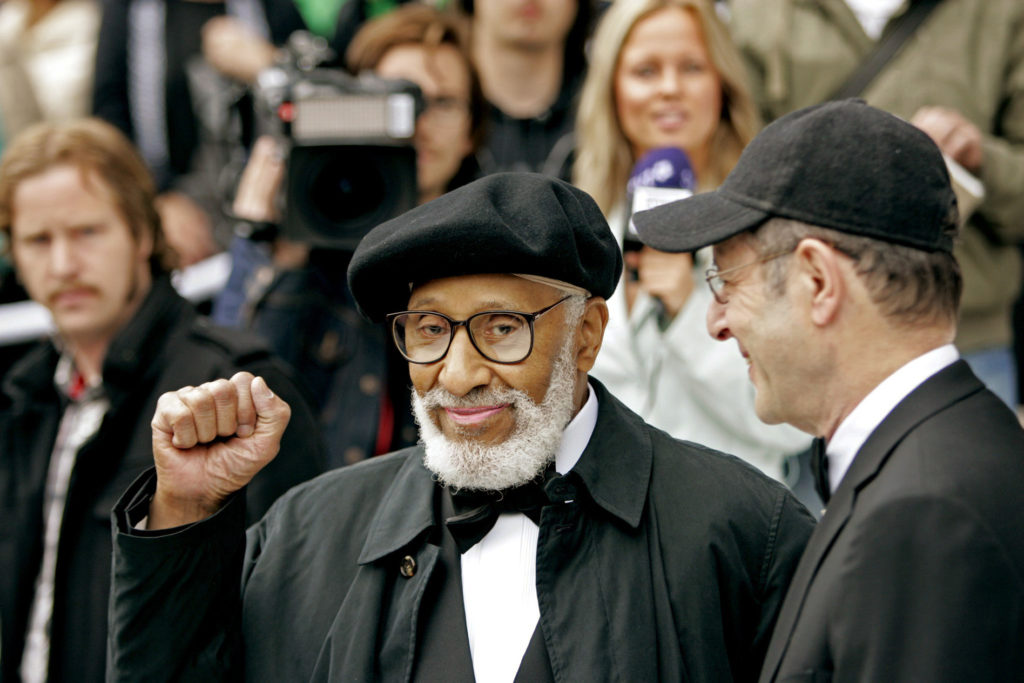
Sonny Rollins, a legendary tenor saxophonist known for his distinct tone and innovative style, passed away at age 95 at his home in Woodstock, New York. According to his spokesperson, Terri Hinte, no specific cause of death was given, though Rollins had faced various physical challenges in recent years.
Rollins, renowned for his improvisational prowess, began his career as a young prodigy. His influence, alongside jazz greats like John Coltrane and Charlie Parker, was profound. Among rock fans, he is remembered for his sax solo on the Rolling Stones’ 1981 album ‘Tattoo You’ in the song ‘Waiting on a Friend.’
Despite his fame, Rollins continually sought to evolve his music. He viewed himself as ‘a work in progress,’ often exploring new styles, sometimes stepping away from playing altogether. Rollins expressed dissatisfaction with his early work, stating it was ‘excruciating’ to listen to past recordings.
Significant Achievements
During the 1990s and 2000s, Rollins released several acclaimed albums, continuing to perform into his 80s. His career was halted due to pulmonary fibrosis, leading to his retirement. His last concert was in 2012, with his playing coming to a close in 2014.
His connection to larger forces became evident when playing outdoors. ‘I felt that I was part of something bigger,’ he told the New York Times in 2020.
Rollins’ 2001 album, ‘This is What I Do,’ earned him a Grammy for Best Jazz Instrumental Album. He won again in 2006 for Best Jazz Instrumental Solo with ‘Why Was I Born?’ The latter was part of ‘Without a Song: The 9/11 Concert,’ recorded shortly after the September 11 attacks.
His wife and manager, Lucille, encouraged Rollins to continue performing despite the 9/11 tragedy. She passed away in 2004. Rollins is survived by his nephew, Clifton Anderson, and nieces Vallyn Anderson and Gabrielle DeGroat.
The Early Years
Rollins’ first significant opportunity came in his late teens when he joined Thelonious Monk’s band. He played with jazz icons like Miles Davis and Bud Powell before finishing high school. Rollins struggled with heroin addiction during the late 1940s and early 1950s. He was incarcerated twice and lived on the streets in Chicago before seeking treatment in Kentucky. His recovery spurred a new philosophical outlook on life.
Joining the Max Roach-Clifford Brown quintet marked his career’s revival. Rollins’ solo album, ‘Saxophone Colossus,’ in 1956, cemented his reputation as a leading saxophonist. Experimental albums followed, leading to Rollins’ seclusion to practice on a Williamsburg Bridge walkway for two years.
He returned to the jazz scene in 1961, embracing the new free jazz sound, which polarized his audience. Rollins toured Europe in the mid-60s and composed music for the British film ‘Alfie.’ A discovery of Zen Buddhism led to another sabbatical until the early 1970s.
Later Recognition
Upon his return in 1972, Rollins’ status as a jazz icon continued to grow. He received a Guggenheim fellowship and was inducted into the Downbeat Hall of Fame. He transitioned to performing in concert halls, achieving mainstream fame.
Theodore Walter Rollins was born on September 7, 1930, in Harlem. His musical family included a father who played clarinet, a sister on piano, and a violinist brother. Initially encouraged to learn piano, Rollins took up the alto saxophone at age 11 after convincing his parents to purchase one. Mostly self-taught, he transitioned to tenor saxophone, quickly making his name in New York’s jazz scene.
Rollins left behind numerous unreleased recordings. He expressed no intention to dictate their future use, saying in 2020, ‘After I get out of this planet I’m not going to have any say about what’s going on.’
A free press plays an essential role in maintaining democracy. Support reliable journalism and civil dialogue.
Leave a Reply