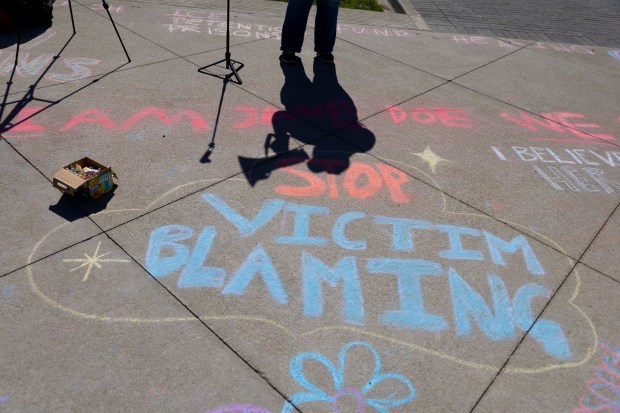
By noon Thursday, the normally quiet quad at the University of Illinois Chicago was filled with roughly three dozen students holding signs and distributing flyers against sexual violence. The sidewalk outside the Lecture Center Building B featured a colorful chalk mural with messages like “We are Jane Doe” and “Stop Victim Blaming.”
UIC is one of several campuses in Chicago and across the state where students are protesting. This follows a two-year-old sexual violence case that resurfaced last month at Cornell University. A woman known as “Jane Doe” filed a civil suit after a prosecutor chose not to pursue charges against seven men she claims raped her in 2024 while she was intoxicated at a fraternity party on the Ivy League campus in Ithaca, New York. The reopening of the criminal investigation and the appointment of a special prosecutor have brought fresh scrutiny to Cornell’s and law enforcement’s handling of the case, attracting national headlines and sparking conversations about campus sexual violence.
The outcry has prompted schools nationwide to enhance advocacy, resources, and support to help students and sexual assault victims cope. This month, Illinois students have used the opportunity to raise awareness and discuss the prevalence of sexual assault and how authorities respond to it. Thursday’s “National Day of Action” led hundreds of students at Lincoln Park High School to leave class in solidarity with “Stop Sexual Violence” protests at UIC and Southern Illinois University Edwardsville.
On UIC’s quad Thursday afternoon, student speakers used a megaphone to emphasize the need for accountability and justice in the Cornell case. Nova Mohiuddin, 23, a member of the UIC student chapter of Chicago Socialist Alternative, began the speeches. “It is important to push back against sexism, especially when many normalize it,” said the fourth-year economics major. “Now, more than ever, is the time to speak out.”
Although women outnumbered them, male students also joined the protest. Jacob Belencion, a fourth-year mechanical engineering student at UIC, urged more men to participate. “We need to encourage men to attend these spaces and call out any misogynistic behavior,” said Belencion.
Almost 300 miles away, Southern Illinois University Edwardsville students opposed sexual violence. Prompted by online information about the National Day of Action, Isabel Montano, a junior studying philosophy and economics, decided to act at SIUE. It might be easy to feel overwhelmed, but Montano wanted to channel her feelings into positive change. “Even if I’m just one person with a sign, I think one voice makes a difference,” Montano said. “It’s not just for [Jane Doe] at Cornell. Many women are coming forward now, sharing their experiences. It’s about the collective.”
High school students also felt inspired to speak up. On Thursday afternoon, hundreds walked out of Lincoln Park High School. At the front, students carried a banner with “#EndSexualViolence” in pink. They marched, chanting: “No means no, sexual violence has got to go” and “My voice, my choice.” The march culminated at the steps of the Lincoln Park Zoo’s administrative office, where students shared the megaphone. “You don’t have to be a victim to say something, to do something,” one student exclaimed, receiving cheers from the crowd.
This was not the first protest for LPHS junior Isabella Scaffai, who helped plan the demonstration with the LPHS Women Empowerment Club. Scaffai noted that word of the Cornell incident had spread across the school, prompting students to speak out. “It’s disheartening to be excited about college independence, only to realize there’s still a threat of abuse,” Scaffai said. “I know that when I walk out, it’s not just for me and my future. It’s for my friends and the women who raised me.”
LPHS senior Chloe Woodall, 17, helped promote the rally through posters and social media. The event also aimed to educate students about consent, Woodall explained. “I hope this clarified what consent and sexual assault entail for those who weren’t clear,” she said.
Chicago campuses offer support through resources like Northwestern University’s Center for Student Advocacy and Wellness, and UIC’s Women’s Leadership and Resource Center. For survivors dealing with the news, resources such as the 24-hour Chicago Rape Crisis Hotline are recommended by Sarah Layden, chief program officer and interim director of Resilience, a nonprofit organization.
While the Cornell case has garnered attention, survivors may respond individually. Providing education and safe spaces for healing remains vital, Layden mentioned. “Building community with other survivors and speaking out can be healing, but it’s also okay if someone isn’t ready. Not reporting right away or typical trauma responses don’t invalidate their experience.”
Leave a Reply