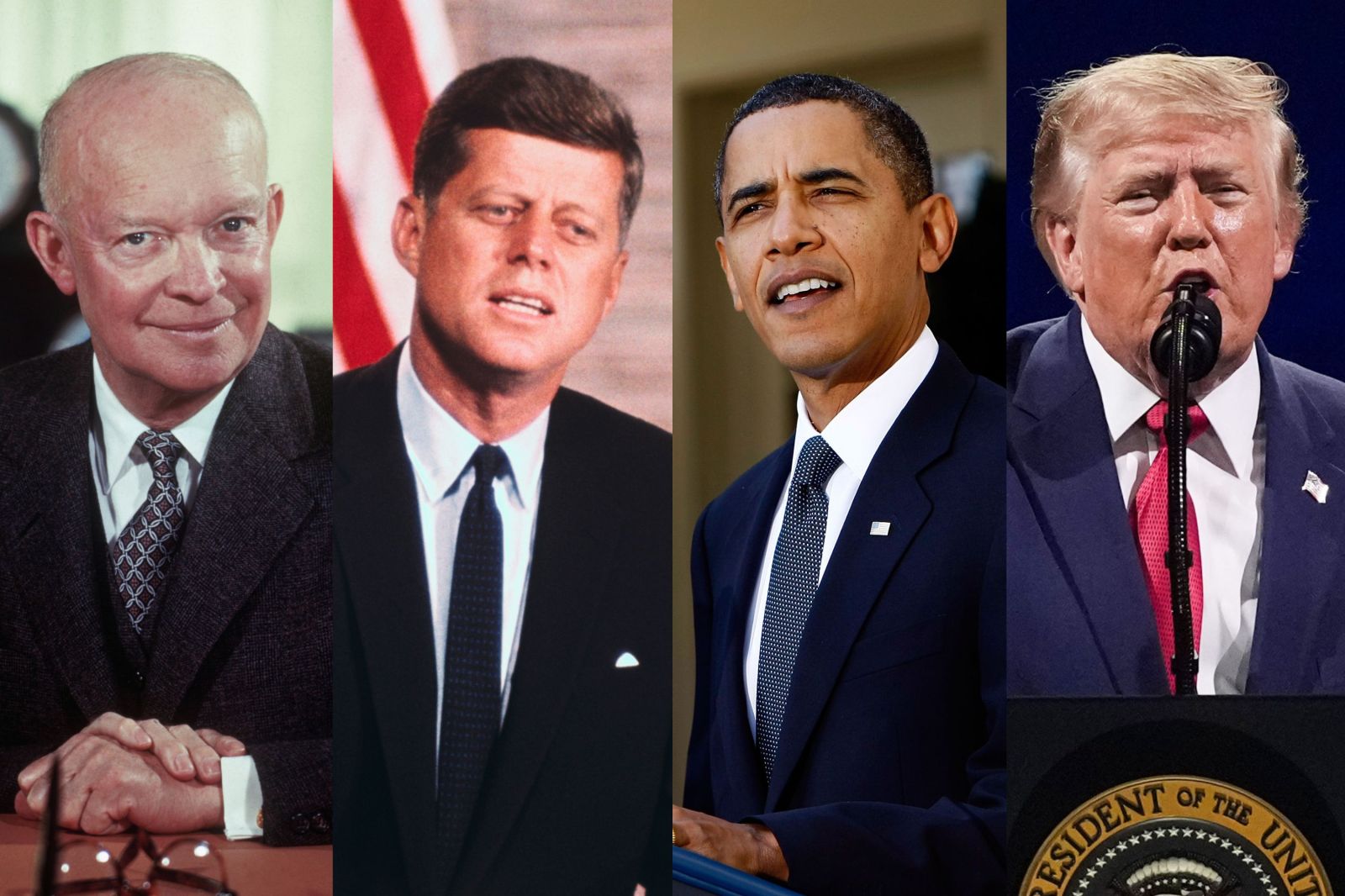
In the past, Americans generally supported their presidents regardless of party affiliation. During the tenure of Republican Dwight D. Eisenhower, approval ratings were more unified across party lines. However, political polarization has surged over the decades, creating a substantial partisan divide in presidential approval.
The Pew Research Center released a survey showing this divide is currently the widest it has been since Eisenhower’s era. Donald Trump’s approval rating, as of mid-July, stands at 34%. This is a decrease from previous ratings but has remained relatively stable following joint strikes on Iran with Israel that initiated hostilities in the Middle East, causing inflation in the U.S.
Approval ratings typically decline from a president’s inauguration to the midterms. Yet, Trump’s lack of cross-party support is stark, with his second term averaging an 84% approval rating from Republicans and just 6% from Democrats. This 78 percentage point gap is nearly a record, surpassed only by an 80 percentage point gap during his first term. Data does not account for independents.
Presidential approval has long displayed partisan bias. Historical data shows Eisenhower had 88% support among Republicans and 49% among Democrats. Similarly, John F. Kennedy received approval from 84% of Democrats and 49% of Republicans. Political historian Julian Zelizer points to the trend’s roots in the 1970s.
Lyndon B. Johnson had 70% approval from Democrats but only 40% from Republicans. Richard Nixon received 75% Republican support, but only 34% from Democrats. Gerald Ford’s gap was smaller, with approval from 67% of Republicans and 36% of Democrats. The divide grew under Jimmy Carter and Ronald Reagan, with Reagan securing 83% Republican approval, contrasted by just 31% from Democrats.
Polarization intensified post-Reagan, according to William A. Galston of the Brookings Institution. He notes that opposition parties reject the intellectual and emotional principles of presidents since the early 2000s. The contested 2000 election marked the beginning of enhanced polarization, persisting to this day.
George H. W. Bush’s presidency had a 44 percentage point gap in approval, which grew during George W. Bush’s term to 58 points. Bill Clinton experienced a similar divide at 53 points. Under Obama, Biden, and Trump, the partisan gap widened.
A study by the University of Cambridge indicates political and social divisions have grown by 64% since 1988, significantly after 2008. Events like the financial crisis, Obama’s election, and Apple’s App Store launch all contributed. The study shows Americans on the left have shifted 31.5% more liberal by 2024 compared to 1988, while the right largely remains stable.
Zelizer asserts voters have become less flexible. In the 1950s, states were more swingable and featured greater partisan diversity. Affective polarization now drives deeper emotional discord between political sides.
Galston remarks on events like long-lasting Middle East conflicts post-9/11, financial crises, and COVID-19’s handling contributing to division rather than unity. He labels Trump as perhaps the most divisive modern president due to his strategic use of polarization.
Despite not originating the divide, Trump exploited it for political gain. His approach deliberately avoids conciliatory policies, aiming to keep his base engaged. This prevents bridging party divides and consolidates his influence within his party.
The future likely holds continued polarization. Galston sees it as a key issue in the upcoming presidential primaries but is skeptical conciliatory candidates can succeed. Yet, he suggests that to build sustainable majorities, policy should focus on conciliation instead of division.
Galston warns that ongoing division risks diminishing the U.S. as a global democratic force. A divided nation loses strength domestically and internationally, a reality already visible.
Leave a Reply