In the winter of 2015, Dr. Tom Chiller received a call from British public-health officials. They were alarmed. A novel fungus was causing severe infections in a large London hospital. “They weren’t able to eliminate it,” said Chiller, then chief of the CDC’s fungal-diseases branch. “They didn’t know what to do.” The fungus, a yeast known as Candida auris, was spreading from patient to patient. British officials planned to shut down parts of the hospital. “That was astounding,” Chiller remarked.
At first, Chiller was more puzzled than concerned. Candida is a yeast known to cause common fungal conditions like thrush and vaginal infections. Some species lead to severe illnesses, including bloodstream infections. Yet, no Candida species was known to spread easily among people. “I’ll never forget that call,” Chiller commented. “A yeast acting like a bacteria? It was strange.”
First identified in 2009 in Japan from a patient’s ear, Candida auris differs from most fungi. It withstands higher temperatures and salty environments, thriving in places like human ears, armpits, and groins. Exceptionally sticky, it clings to skin, hair follicles, and surfaces. Resistant to antifungal drugs and tough to eradicate with standard disinfectants, it causes severe, often fatal illnesses. It spreads rapidly via contact and contaminated surfaces, as the British noted in 2015.
Much about Candida auris remained unknown during that call. Reports from a few countries had surfaced but seemed inconsequential. The U.S. had no reported cases. “It was a wake-up call,” Chiller stated. “This little ear fungus might be more than that.” Since then, understanding of Candida auris has deepened. In September, at a three-day fungal disease conference near Denver, Candida auris topped the agenda.
“In some U.S. states, it’s just endemic now. It’s there to stay,” Chiller said.
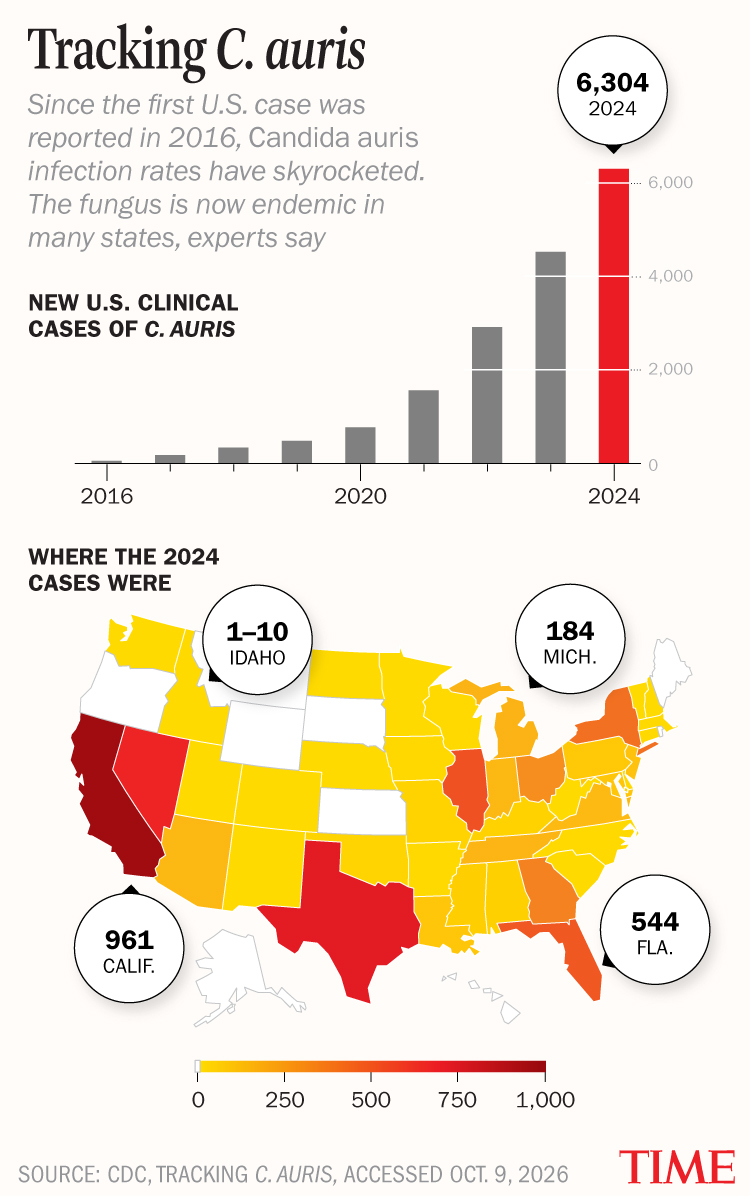
Candida auris has rapidly spread since 2015, affecting over tens of thousands across 80 countries on six continents. The WHO has listed it as a high-priority fungal threat. The CDC named it a top-priority drug-resistant pathogen in October, highlighting the need for urgent action. Thousands of U.S. cases now occur yearly, with Candida auris infecting over 3,000 people across 27 states this year alone. It is deadly, with a mortality rate of up to 60%.
More concerningly, fungi are finding new opportunities for infection, spurred by human activity. Rising global temperatures are likely behind Candida auris’ emergence. The overuse of antifungals in medicine and agriculture contributes to rising drug resistance. “We are creating environments favoring pathogenic fungi and resistance,” said Dr. Andrej Spec from Washington University. “They are becoming better at infecting us and evading treatments.”
Fungi surround us. An estimated 6 million species exist, with only about 300 causing human diseases. Humans are mostly shielded by body temperature and immunity, but as the earth warms, fungi adapt. Researchers believe Candida auris, from marine ecosystems, evolved to withstand salty and high-temperature environments, now surviving at 107°F.
Candida auris is not the sole threat exploiting warmer conditions. A new pathogen disfigures cats and humans in South America. Molds previously infecting plants now affect people too. Spec noted the first case of mold infecting a human, previously only affecting trees, was recorded in 2021. “From never causing human disease to three cases in five years,” he said.
In October, the CDC reported a fourfold rise in cases of a brain-attacking mold. “This is a nasty pathogen,” Spec remarked. Infecting healthy people, it causes brain abscesses, fatal in up to 70% of cases. Many once-rare molds are becoming more common, likely driven by climate change.
Doctors and officials work to combat malignant fungi, making progress in awareness, surveillance, and drug development. Advances in medicine increase vulnerability to fungal diseases. Immunosuppressive drugs, essential for autoimmune and cancer treatments, heighten the risk of infections among immunocompromised individuals, numbering at least 7 million in the U.S.
“We have people with conditions who might have died in the past but now are immunosuppressed,” Spec stated, “leading to a bigger pool at risk.”
Invasive medical devices, like heart-lung machines and ventilators, provide pathways for fungal entry. “Medical progress comes at a cost,” Dr. Arturo Casadevall noted. The proliferation of these devices is one factor facilitating Candida auris’ spread.
Ryan Zwick, a healthy 22-year-old nursing graduate, faced a near-total organ failure from COVID-19 in December 2023. Attached to a heart-lung machine, his body was vulnerable. Candida auris capitalized on this weakness. Awake after a month, he learned of his infection, likely transmitted through medical tubes. “It got into my bloodstream,” Zwick said.
Despite aggressive antifungal treatment, the infection lingered. Discharged in April 2024, Zwick soon returned due to blisters at an incision site, leading to osteomyelitis—an inflammatory bone condition caused by the fungus. “They removed bone and prescribed more antifungals,” he said. Now a nurse in New Hampshire, Zwick receives weekly antifungal infusions. “I worry these drugs might stop working for me,” he confessed.
Candida auris has expanded. Initially a rarity largely affecting the sick and elderly, it now infects broader demographics. “Ten years ago, we saw one patient every few months,” said Dr. Luis Ostrosky-Zeichner from UTHealth Houston. “Now, it’s several cases a day in Houston.” States like Texas, New York, Nevada, Florida, and California report high case numbers. Young, non-immunocompromised individuals are increasingly infected.
Spec’s recent experience treating a woman with a Candida auris vaginal yeast infection—normally treated with azole pills—highlighted the yeast’s resistance to common drugs. “It’s no joke to tell someone they need IV medication instead of a simple pill,” Spec stated. Similarly, Candida auris is causing difficult-to-treat urinary tract infections (UTIs). Public-health experts fear the yeast could become as widespread as MRSA, which evolved from an exclusive hospital pathogen to common in public settings.
Chiller reflected, “Initially, we tried to eradicate it, but Candida auris is here to stay.”
When Candida auris first emerged in the U.S., the CDC was unware of its extent. Chiller, after that pivotal 2015 phone call, sought to uncover if Candida auris was already present. Hospitals and researchers were asked to test samples for identification. “We found no historical Candida auris,” he said.
Collaborating with health officials globally, the CDC studied fungal samples. At least three distinct Candida auris strains emerged almost simultaneously on different continents. Experts suspect climate change played a role in this transformation. Rising temperatures likely influenced these fungi, adaptable to heat. Lab experiments show fungi adapt when gradually exposed to increasing temperatures. “It doesn’t take many mutations,” Casadevall explained.
Local fungal adaptation was illustrated in Baltimore, where researchers found fungi in warmer areas grew at higher temperatures than in cooler areas. “This kind of adaptation is occurring,” Casadevall said. Many fungi already pose threats to plants, insects, and cold-blooded animals. Examples include rice and banana crop destruction, and bat population declines due to fungal infections.
Doctors see more fungi changing in concerning ways, leading to new disease patterns. Histoplasma, historically limited to central U.S., is expanding. U.S. cases have doubled in a decade. Valley fever, primarily confined to the U.S. Southwest, spreads to states like Washington, once too wet or cold.
Fungal diseases considered manageable, like ringworm, are evolving. A recent ringworm species, resistant to antifungal drugs, spreads beyond the Indian subcontinent. This ringworm leads to widespread, itchy skin plaques. “Think of athlete’s foot body-wide and untreatable,” Chiller described.
In South America, a fungus causing a disfiguring skin disease affects cats, dogs, and humans. The fungus, once linked to plants, now spread by cats, defied expectations. “Is it climate or environmental change causing this evolution?” asked CDC scientist Dallas Smith. Sporothrix brasiliensis emerged as a separate species, leading to dramatic increases in affected cases since the 1998 Rio de Janeiro outbreak.
The disease now impacts remote Amazon villages and spreads to neighboring countries. It reached Uruguay in 2025, and Peru in 2023, Smith noted. “It’s a matter of time before it arrives in the U.S.,” he warned.
“Sporothrix and other fungi are changing our understanding of fungal behavior,” Chiller stated.
At a Denver conference, Chiller attracted a line of scientists eager for discussions. Known for his advocacy, Chiller wore a jacket lined with fungi-themed fabric. His leadership at the CDC expanded fungal surveillance and research efforts. “Certain individuals, like Tom Chiller, change the field,” noted Spec.
Chiller aided development of a test for Cryptococcus, a fungus causing meningitis, potentially saving thousands of lives. He left the CDC following staff reductions and travel restrictions, now serving as chief medical officer at IMMY, focusing on fungal test development.
In September, Chiller engaged in a roundtable discussion with U.S. health officials, including Robert F. Kennedy Jr., emphasizing his commitment to fungal awareness. His campaign “Think Fungus” aims to improve fungal disease diagnosis, critical for patient outcomes.
Pipelines over fungi are challenging. Almost half of patients misdiagnosed for valley fever—a fungal disease—go undiagnosed for a month or longer. Justin John, diagnosed wrongly with COVID, then with the common cold, faced severe complications before proper valley fever diagnosis. Fungal lesions caused spinal and skull damage necessitating surgeries.
A new, more accurate urine test for valley fever is under development, potentially minimizing diagnosis delays. Dr. Fariba Donovan, treating John, said, “This test could reduce diagnostic delays.” Early diagnosis markedly improves prognosis. Challenges remain, as the complexity of fungal diseases often garners insufficient attention.
Leave a Reply