The final day of June saw flags fluttering briskly above Wrigley Field, welcoming Moe Mullins who arrived over three hours prior to the first pitch, his usual practice. Stationing his camping chair beneath an ash tree at the intersection of Waveland and Kenmore, adjacent to the rear of the left field bleachers, he watched as the neighborhood slowly awakened. Street vendors began to appear, merchandise stalls opened, and Murphy’s patio, just a block away, gradually filled with patrons. Spectators congregated alongside the brick wall, waiting patiently for the bleacher gates to open. Initially, a serene quiet enveloped the place, a reminder of old Wrigley Field and its surrounding neighborhood, which momentarily belonged to Mullins.
Known as the unofficial mayor of Waveland and Kenmore avenues, Mullins serves as the elder figure among the distinctive personalities who lend character to the area. This weekend marks the Chicago Cubs’ celebration of their 150th anniversary as a National League member, with 110 years spent at Wrigley Field. Here, the corner beyond left field remains a vestige of simpler times amidst ever-present change. The Cubs have acquired numerous nearby buildings, transforming the rooftops into less organically charming yet pricey attractions, alongside trendy bars and restaurants. Even the iconic Wrigley marquee now sports a corporate sponsor for over a decade. Nevertheless, this legendary corner retains its traditional charm, featuring lawn chairs, lifers, and lively conversations, some of which are even suitable for children.
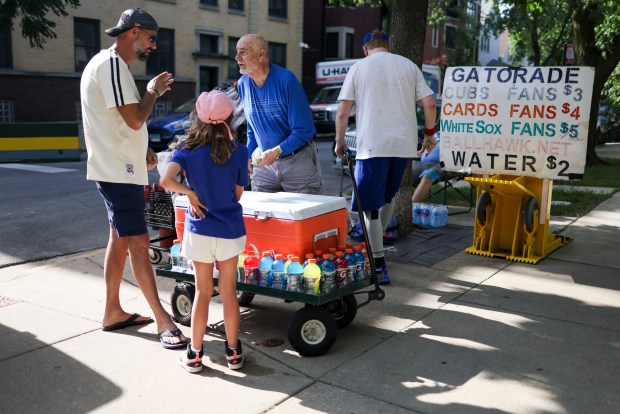
The premier advertisement there is a handwritten sign promoting Gatorade by Dave Davison, selling at $3 for Cubs fans, $4 for Cardinals fans, and a playful $5 for White Sox fans, humorously crossed out to read “stay thirsty.” Like Mullins, Davison has been a fixture on the corner for years. The location attracts a unique blend of individuals – oddballs, superfans, ballhawks, locals, Cubs employees, dog walkers offering free treats, and curiously keen-eyed tourists who readily sense friendly company.
Moe Mullins, the esteemed ballhawk, assists a customer at his friend Dave Davison’s vendor cart situated at the corner of Waveland and Kenmore avenues, outside Wrigley Field, preceding the Cubs’ game against the Padres on June 30, 2026. (Eileen T. Meslar/Chicago Tribune)
Among the regulars is Ken Keefer, at 68, residing in the first house on the corner. Bob Krause, 54, lives a short distance away on Kenmore. Mary Ellen Gourley, 67, has been a bleacher regular for half a century. Each visits from the corner, heading across the street to their seats game after game. Changes, however, threaten even this resilient corner. The once-vital presence of Wrigley’s historic ballhawks is dwindling. Mullins, 75, and Davison, who hesitantly claims to be in his 50s, represent the old guard’s final bastion. Younger successors have yet to emerge, signaling a transition in Wrigley’s decades-old tradition.
Mullins, briefly occupying the corner alone, breaks its silence through the voice of a nearby stadium tour guide. A man presenting to his group from a balcony behind the bleachers, offered an aerial view of Waveland. The guide gestures toward the individuals on the street, querying the purpose behind their gathering. Noticing Mullins standing solemnly, the guide marks his presence.
Since 1958, Mullins has deftly dominated that corner, making himself known at just 8 years old when he discovered baseballs could be sold for 50 cents, enough to purchase a burger at O’Henry’s. “A Chicago street legend, Moe Mullins,” the guide proclaims to the group, raising his voice with enthusiasm.
“How many baseballs do you have?” the guide inquires, calling toward Mullins’ corner. “Over 6,400,” Mullins proudly replies.
The guide eagerly enlightens his followers, sharing Mullins’ hiatus for duty in Vietnam. Awe sweeps through as Mullins presents his impressive count to the Padres’ visiting fans, some adorning Trevor Hoffman jerseys. “I don’t take them home anymore,” Mullins declares, confessing his reduced interest in collecting baseballs – his deteriorating knees dampening his chase capabilities. Yet, after a brief pause, he couldn’t resist boasting, a trifle. “Two-hundred and forty-six game homers,” Mullins pronounces, more than anyone globally, highlighting the genuine pride he retains. Regardless of his physical challenges, he undeniably remains a ballhawk.
Reflecting on his past, akin to a retired manager contemplating “what ifs,” Mullins recalls the burden of missed baseballs. He accurately stood for Ernie Banks’ 400th home run “in the middle of the street, in front of that pole,” before losing the ball to a rival. During Sammy Sosa’s monumental 62nd home run in ’98, amidst a crowd seeking a million-dollar piece, someone brandished his hand, sabotaging his grip. Mullins vividly recalls Dave Kingman’s towering 530-foot hits landing on Kenmore’s far end and the third house’s front steps. Random trivia sticks with him due to his tangential role in those moments. For example, he remembers Shawon Dunston’s two home runs on Aug. 17, 1990, because he caught both. These serve as tokens in his basement, where he maintains three large aquarium tanks brimming with baseballs.
Regrettably, contemporary opportunities for chasing baseballs have sharply declined. The massive video board introduced in left field in 2015 is the primary cause, although it’s not the sole factor. Expanding bleachers with additional rows, concourses, and an imposing ad further diminish this pastime. The old chain-link fence, a modest final barrier between the stadium and street, of yore remains an evanescent memory. Ballhawk Moe Mullins prepares for a December 2015 attendance at Wrigley Field (Jim Cooper/AP file photo). Even during batting practice, days or entire homestands often pass without balls reaching Waveland. A game homer can require several games before landing on the street.
Despite reduced probabilities, Mullins loyally carries his old Mizuno glove on Waveland’s corner, poised for a surprise celestial catch. His glove dates back to the ’80s, perhaps longer, and back then ballhawks gathered en masse. A dozen regulars lined Waveland and Kenmore equipped with gloves, seeking hope during daylight while bleacher occupants teased them to find a job – a jest the ballhawks would playfully challenge.
The skill behind ballhawking is an expressive art requiring adeptness. Generations passed this knowledge down. Ballhawks deciphered the game without seeing, recognizing hit balls by sound and crowd reactions. Regretfully, their numbers dwindle. Many long-timers relocated or succumbed, with remaining ballhawks appearing sporadically.
A once vigorous brotherhood continues its shrinking path.
Mullins resides with the faithful Super Dave, as he humorously dubs Davison. The nickname arose when Davison beat Mullins to a Derrek Lee grand slam. “I just got robbed,” Mullins recalls, and his recollections often suggest theft of any lost homer. Nonetheless, Mullins concedes “Dave came across behind me, and grabbed it,” affirming the story’s credibility. “Because he was super. That was just when he first started. He was super fast.” Super fast. Super Dave.
On June 30, two and a half hours before the first pitch, Davison parked his van on Kenmore, unloading his cooler and cart stocked with baseballs, cards, and handmade jewelry. At home, 20 baseball covers await cutting and preservation in resin. Providing humor, Davison placed an oversized glove, reminiscent of cartoons, near the corner – beside his usual glove, worn and weathered.
Inside his cart was an old bobblehead doll depicting himself. “There were 125 of them made for some strange reason,” he noted, although his had seen better days. “I’m missing the arm. I don’t know where the hell that went. The head falls off. “The Waveland sign is gone.” At its base: “Ballhawk Dave.”
He amassed a couple thousand balls with that blue glove alone, including 100 game homers.
Demonstrating anticipation, Davison observes the flags high, waving stiffly in the wind. “You don’t really get too many nights like this during the year,” he remarked.
“You might get five or 10 a year like this, when the ball is just flying.”
Swiftly, on the fifth pitch of the game, Fernando Tatis Jr., the Padres leadoff man, connected with an 80 mph changeup from Cubs lefthander Matthew Boyd. As the pitch broke, its trajectory was low and inward. The crowd fell silent as the ball sailed toward the street, bouncing before the Kenmore crosswalk and landing neatly in Trent Weyermuller’s glove. At 32, Weyermuller is the youngest regular, and only genuine regular identified as “young.”
“That’s the seventh one out this year,” Davison noted.
If it weren’t for the obstructing video board and expanded bleachers, there might’ve been 20-25 Waveland homers by the Cubs’ 42nd season home game.
Weyermuller experienced earlier catches, securing the first two batting practice homers of the season. This, however, marked his inaugural game homer achievement after years frequenting Waveland. Weyermuller resides locally, drawn by Waveland’s reputation. It’s likened to Cheers, where everybody knows your name.
“We’ve been to each other’s weddings,” shared Mario Irizarry, a former ballhawk visiting from Florida.
“And, I hate to say, a few funerals.”
The corner companionship envelops Weyermuller. Mullins, after managing a daily game-score prediction pool, returns to find his junior associate. “I missed everything,” Mullins lamented, saddened he missed Tatis’s homer.
Davison encourages Weyermuller to update his social media, eager to share the news. “All seven of your fans want to know what the hell just happened,” Davison teased, laughing.
This social hub is home to first-ballot hall of fame banterers, refined in tall-tale storytelling.
It demands robust humor and patience.
“I call it, ‘watching a brick wall,’” Weyermuller comments.
“I just tell people, like, have you ever fished before?”
A debate arises briefly: should they return the homer to the bleachers above toward its playfield origin? Davison dispels this notion. The ritual never appealed to him. “If he threw that ball back, I would’ve beat him, personally, in the street,” Davison jested, shaking his head.
“You don’t throw a homer ball back. That’s the dumbest stuff in the world.”
This opening homer prophesied something more. Dansby Swanson followed suit with two. Alex Bregman and Michael Busch added theirs. Pete Crow-Armstrong clouted another. Tatis achieved back-to-back homers. Cubs and Padres amassed nine during a season-high Wrigley showcase. Only one reached the street; ballhawks listened attuned, ready during moments of cracking bats and resulting crowds.
The corner transcends the street, extending to Section 503’s summit row, where Keefer, Gourley, and Krause enjoyed habitual seating. Bleachers remain general admission yet long-timers hold places. This section, atop Waveland, is theirs.
They serve not only as fans but caretakers. Keefer, occupying the first neighborhood house, and Krause, located nearby. Keefer and Krause offered a notable growth from a small invite into a 200-person summer cookout following mid-July game days. An unofficial reunion of sorts.
Former Cubs pitcher Ryan Dempster converses with Cubs stadium workers Kirsten Lombardo, left, and Leslie Boyer-Hurlbut as they relax on Ken Keefer’s apartment porch stairs during the annual cookout situated at the corner.
The menu varies yet consistently celebrates corn, fresh from a farmers market beyond city limits. Krause warrantying its unrivaled taste with consistent “holy [expletive expletive]. That’s an ear of corn” reactions.
This congregation acts as their gratitude toward stadium workers frequently attending. It cultivates the corner’s cultural essence, forming an annual summer tradition, distinctively weaving into the community defining their niche within Wrigleyville.
Bleachers transformed alongside changes around.
Some parts relinquished soul through expansion.
“It was like watching your neighborhood get razed,” Gourley lamented, maintaining scanned ’70s era photos assisting with nostalgic reminiscence.
As the longest-standing group member, Gourley adored Steve Stone.
“I still have mine” reflecting fond memories.
Progress affects surroundings: upscale since early photos chronicling sparse attendance when the Cubs weren’t trendy.
A relief pitcher, Knowles, appeared “always hungover every morning,” Gourley jests.
Compared to yesterday, bleachers matured, adopting sophistication.
“Progress is progress,” Gourley rationalizes.
“Let’s put it this way: I’m blessed to have been here when it was a little ballpark and more of a neighborhood.”
Charisma persists.
Through years, Keefer secured fame briefly via pre-game catches in his beer.
Though abstinent now, “ain’t easy to do,” amusing internet folklore persists.
Recalling kitchen windows provides wondrous outlooks on Wrigley field’s defining brick wall.
“I’m so freaking lucky,” Keefer concludes.
A sentiment reflecting genuine gratefulness, amid existing disparities compared with history.
“I think one of the bad things about getting old, is you think it’s getting worse,” Krause further elaborates.
“I don’t think it’s getting worse. I think it’s just getting different.”
A seamless summer evening of perfection—clear, mildly refreshing and Cubs leading their opponent.
Below, on the street, Mullins and Davison relished the corner alone.
Mullins harbors aspiration, speculated future plan for his baseball collection.
In due course, loading his pickup truck with balls then broadcasting children’s call to Waveland, instructing lining the street sides.
Driving deliberately while thousands drop strategically, distributing holiday-like magic via exploring excitement.
This cherished ambition resonates with childhood nostalgia.
A child once—Ernie Banks’ and Billy Williams’ era—and one day obtaining his inaugural baseball.
Then another.
Subsequently becoming hooked.
Despite selling some, he preserved numerous home runs meticulously as mementos.
Midsummer, Mullins exhibited the treasured collection; at his Elmwood Park residence.
“Setting alight downstairs,” thus revealing exhibit—for 67 years such connection preserved.
Even when serving Vietnam.
Moe Mullins, embracing over 6,433 hawked balls within basement confines.
September 1970 predated Vietnam duty.
Wrigley remained his initial revisit upon returning.
Post service: marrying Donna.
Spanning decades, enduring question returned: “How’d you put up with him attending all those ballgames over years?”
Donna endorses his passion; advocating excursion.
Privately enjoying TV haven at times.
“I push him,” Donna confirms.
Urging: “Get out there.”
Mullins acquiesces usually.
Tank atop displays disheveled Cubs schedules bearing personal milestones—every square denoting captured ball records.
Decades reclaim visible partnerships and lost connections.
An enduring heritage.
Upon schedule examination: recalling Dunston’s double-header.
Some squares remain readable; others falter vails block recognition.
“Do you want your glasses?” Donna offers.
Above lines: historic group photograph.
Black and white,
Seven ballhawks united.
Mullins positioned proud right:
A mustache,
Cocky grin.
No shirt.
Late 1970s documentation.
Mullins solely remains active.
“You see me,” he describes current habits.
“Sitting in my chair.”
Optimistic possession finds destiny approached without chase concerns.
Pledging enduring participation, Davison too vocalizes equivalent resolve, regardless of bleacher expansions or street-bound limitations.
Anticipating another season.
The Cubs hosted events planned context.
Mullins cherishes early arrival preparation.
Embarking onward journey.
Returning to embraced corner.
Leave a Reply