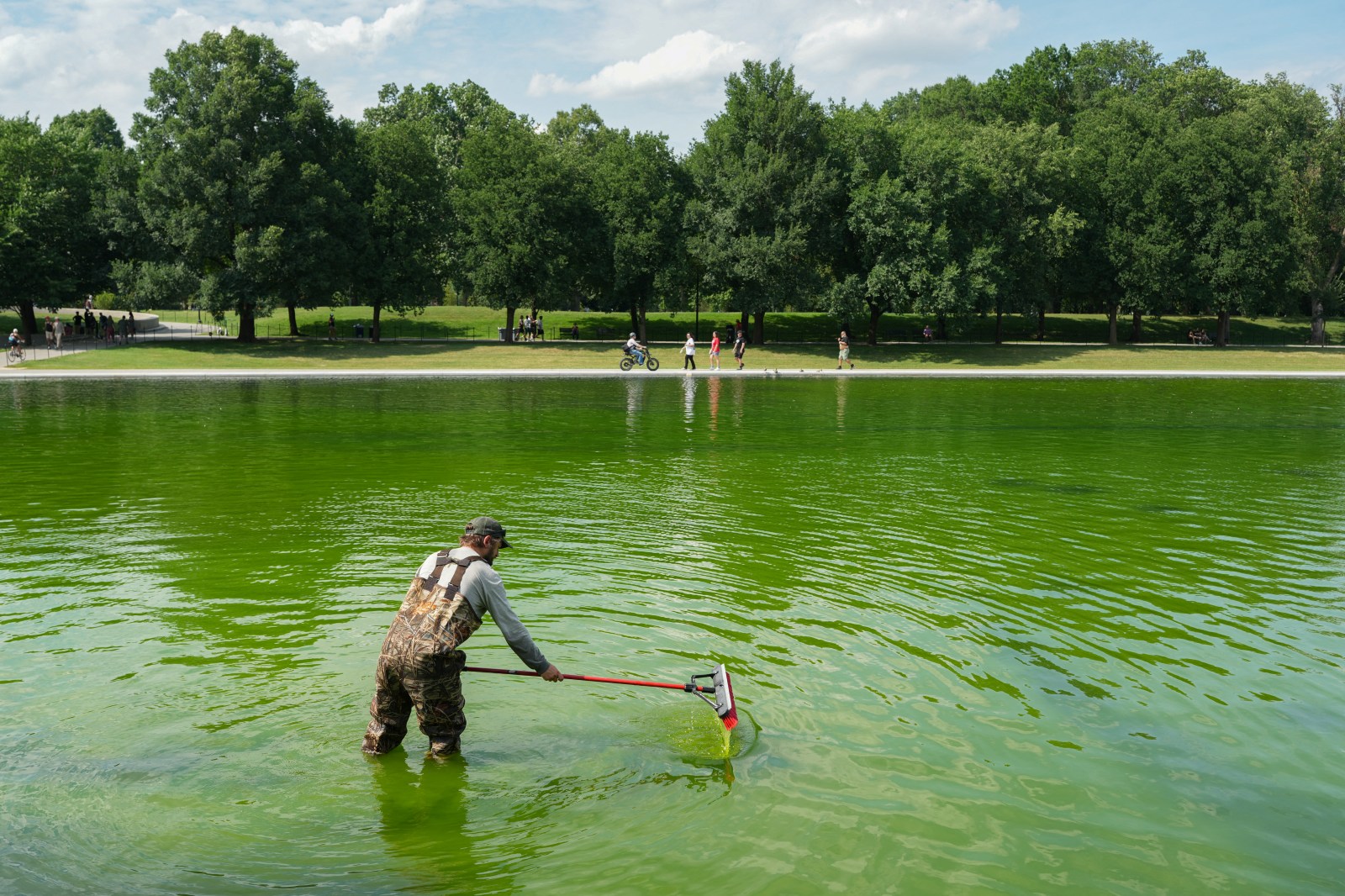
The Lincoln Memorial Reflecting Pool has unexpectedly turned green shortly after reopening. This change follows a multimillion-dollar renovation intended to give the pool an “American flag blue” finish. Workers have been seen adding what appears to be hydrogen peroxide into the pool to combat an algal bloom.
Why the Reflecting Pool Turned Green
Algal blooms in this pool are not unusual—it is a shallow, slow-moving body of water fed partly by the Tidal Basin. These conditions are perfect for algae. But the quick spread of this latest bloom is notable. After draining, repainting, and refilling the pool in a short period, residual algae may have remained in pipes. Freshly warmed water during early summer could have further encouraged growth.
Christopher Lowe, a marine biologist at Swansea University, explained that algae can enter water systems through various means, including being carried by birds. For a bloom to thrive, there must be enough light and nutrients. While sunlight cannot be controlled, nutrient levels can be.
Using Hydrogen Peroxide
Hydrogen peroxide acts as an oxidizing agent in water treatment, breaking down algae and organic contaminants. Officials say it is “milder” than chlorine and is often used in natural swimming pools with wildlife. Alongside this, “nanobubble” ozone systems help kill algae and pathogens throughout the water. But treating a pool holding about 6.5 million gallons is a significant challenge.
“At this stage, we are moving to pool maintenance, trying to control natural cycles. Hydrogen peroxide kills the algae and bleaches it, improving appearance,” Lowe noted.
Challenges in Using Hydrogen Peroxide
Questions arise about both the suitability and effectiveness of hydrogen peroxide treatment. Manual dosing of the pool could be limited by its scale. Videos show workers pouring containers of 12 percent hydrogen peroxide from the edge. In such large water bodies, concentration must be considered over volume.
Moreover, hydrogen peroxide offers a short-term solution. It breaks down into oxygen and water quickly, failing to prevent future growth. This leads to questions of cost-effectiveness. Constant treatment raises expenses, while targeting longer-term solutions like nutrient control might be more viable.
Design Trade-Off: Still Water vs. Circulation
The pool design favors still water for mirror-like reflection, encouraging algal growth. Increased circulation can minimize algae but disrupts reflections. Managing this balance is challenging and has influenced past renovations. Changes to the basin in recent overhauls might alter heat and nutrient behavior, potentially speeding up bloom conditions.
Wildlife and Environmental Impact
Birds, debris, and runoff interact with the pool daily. While chemicals clear the water, they do not threaten wildlife or humans. Still, natural factors contribute to algae growth. Even if sterilized, algae returns quickly. Frequent chemical use may render the pool an “ecological desert,” affecting aquatic life. Though hydrogen peroxide is less harmful than chlorine, continuous dosing could impact what plants and life forms persist.
Leave a Reply