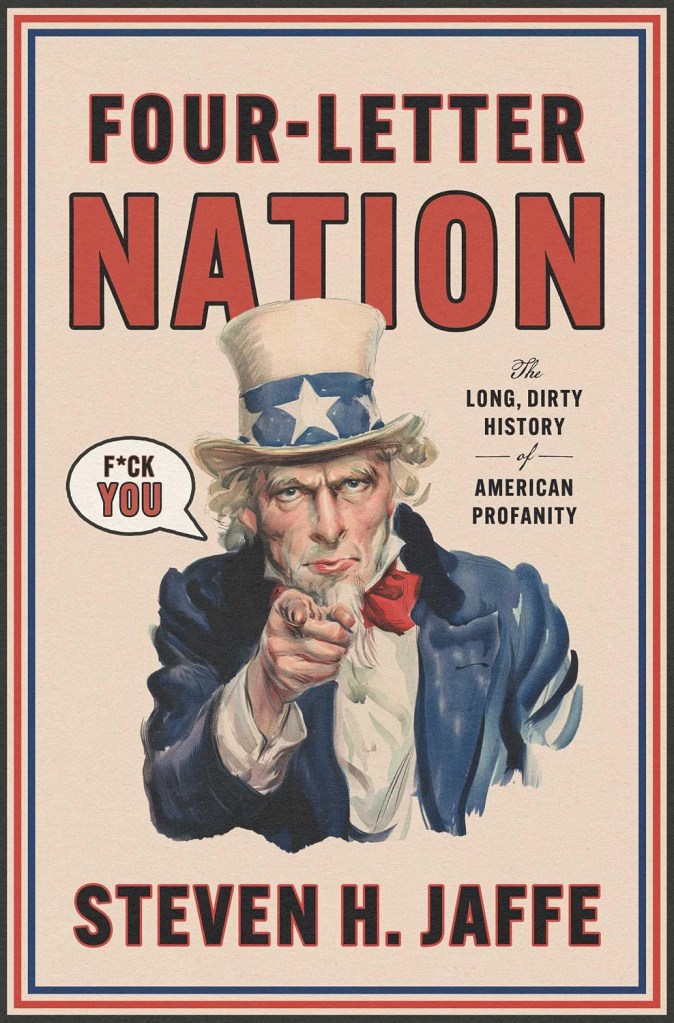
In 1665, John Porter Jr., a son of a Puritan farmer in Essex County, Massachusetts, faced the Quarterly Court. He was charged with disrespecting his parents by using offensive language. According to historian Steven H. Jaffe in his book, “Four-Letter Nation: The Long, Dirty History of American Profanity”, Porter’s crime involved calling his father a “s–t-a-bed” and his mother a “ram bugger.” Despite being sentenced to death, his mother’s plea saved him—unlike his father, who wanted the execution. Porter was fined two hundred pounds, worth about $50,000 today, and had to stand on the gallows with a rope around his neck for an hour as a lesson in humility.
Jaffe’s book explores America’s history of swearing, revealing that the nation is not only founded on dreams and creativity but also on a tendency for profanity—and the relentless attempts to suppress it. Cursing has been a part of American culture since the Thirteen Colonies, with efforts by some to silence these expressions.
The origin of American profanity is largely tied to English settlers. In the 17th century, these colonists brought with them a variety of expressive and provocative words. These words served purposes ranging from conveying shock and defiance to expressing intimacy and joy. Over time, cursing in America evolved into a significant cultural aspect.
Puritanical beliefs among settlers frowned upon bad language. Profane or vulgar words were often banned for being seen as irreligious or inappropriate. Jaffe notes that for generations, clean language was linked to godliness, decency, and social order—values that some Americans continue to uphold.
An example of America’s aversion to bad language is seen in 1662, when English immigrant Thomas Baker faced court in Maryland. His explicit remarks about the genitalia of his neighbors led to charges of ‘verbal injury.’ The court ordered Baker to publicly apologize on his knees, illustrating the stringent attitudes of the time.
In subsequent centuries, profanity and its acceptance evolved. During the Civil War, for example, variations of the phrase “kiss my ass” gained popularity. Capt. William Cronan of the 7th Vermont Infantry famously told an officer that a colonel could kiss his “royal, majestic, brown, military touch hole.” Ohio’s Lewis Jones used similar language in letters, highlighting how soldiers expressed frustration and boldness through swearing.
Even President Abraham Lincoln was part of this trend. In early 1865, with the Civil War nearing its end, Lincoln remarked that the Southern Confederacy could “kiss my ass.” This anecdote from Lincoln demonstrates how profanity permeated various social levels, including the highest one.
Profanity has continually adapted to American culture. The emergence of new curse words such as ‘motherf–ker’ in the late 19th century marked a shift in language. In 1888, in Bremond, Texas, J.M. Joiner famously used this term before committing murder, showcasing how language could be both powerful and dangerous.
By the early 20th century, curse words transitioned from being purely offensive to expressions of rebellion and candidness. Jaffe explains that these words became part of an American style characterized by frankness. Despite their widespread use, curse words haven’t lost their impact. They continue to break through superficiality to reveal genuine emotions.
Historically, men dominated the use of swear words. However, over the last century, women have also embraced this form of expression. Although women initially used profanity more discreetly than men, they have since used it with enthusiasm.
Nowadays, cursing is commonplace, but our exposure has desensitized us to its shock value. Before the 1960s, many of today’s common profanities would have caused scandal. Jaffe suggests that people’s acceptance of rough language has increased, but they still maintain personal lines for specific words in different contexts.
Despite the proliferation of cursing, Jaffe questions the significance of swearing if it is ever-present. He argues that ‘four-letter words’ still retain power, particularly as younger generations invent new expressions on platforms like social media.
Gen Z has created slang that seems indecipherable to older generations. Jaffe points to the enduring effect of curses like the f-bomb and s-word, which still hold weight in certain situations.
Leave a Reply