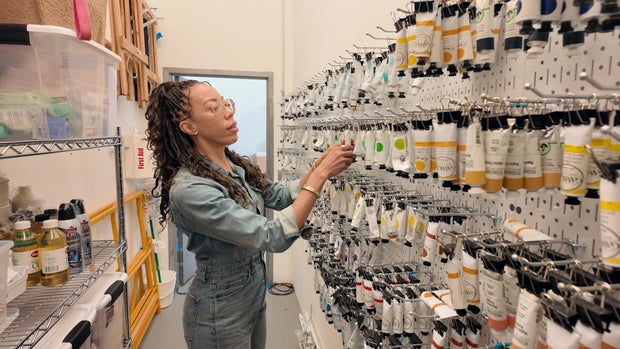
Amy Sherald has made a name for herself as one of America’s most renowned painters, particularly known for her official portrait of former First Lady Michelle Obama. At 52, her work is celebrated across major museums. Her bold decision to cancel an exhibition at the Smithsonian’s National Portrait Gallery last fall drew widespread attention. Her fear of censorship due to political pressure highlighted ongoing challenges she faced.
Artistic Style and Inspiration
Sherald’s subjects, often Black Americans, are portrayed with a direct gaze. Her paintings use monochromatic or vibrant backgrounds, offering a unique perspective. A painting of a farmer on a pristine John Deere tractor exemplifies her style.
Amy Sherald explains, “The portraits are not confrontational. They demand presence and an exchange.”
Her work is a visual narrative of real people whose names are rarely disclosed. Her process involves photographing subjects whose energies resonate with hers. She uses friends, models, and even strangers, often dressing them in thrift store finds she collects.
Significant Works and Exhibitions
Some of her notable works include a portrait of Breonna Taylor and the renowned painting of Michelle Obama, “Michelle LaVaughn Robinson Obama,” unveiled in 2018.
Her recent retrospective “American Sublime” was showcased at the Whitney Museum of American Art. Sherald often meditated on the prospect of having a show there. She describes the experience as perfectly aligning with her vision.
Sherald shares, “This is exactly what I envisioned.”
The Gray Scale Technique
Sherald’s distinct use of gray tones for skin color in her portraits started as a stylistic choice, echoing old family photographs. She believes the grayscale encourages viewers to see beyond racial identifiers.
Challenges and Triumphs
Sherald overcame significant personal challenges, including a rare heart condition diagnosed in 2004. In 2012, she underwent a heart transplant, which saved her life. The donor, Kristin Lin Smith, remains a presence in her life, with Sherald frequently acknowledging her.
Her heart transplant experience did not deter her. Instead, she continued painting, each piece carrying the spirit of her donor.
Political and Cultural Impact
Sherald’s works are politically charged by nature. When the Smithsonian sought to contextualize a painting of a trans person as the Statue of Liberty, she withdrew her show to protect its integrity. Her stance was viewed as politically divisive by some but underscored her commitment to artistic vision.
Her paintings went on to be exhibited at the Baltimore Museum of Art and are currently showcased at the High Museum in Atlanta.
Sherald comments, “Art can be political, but it starts from personal insights within me.”
Claiming Patriotism
Sherald embraces her American identity, expressing that being Black is deeply intertwined with America’s history. She considers her work a patriotic assertion of her identity.
“We are deeply ingrained in the fabric of this country… I am the definition of an American,” Sherald affirms.
Leave a Reply