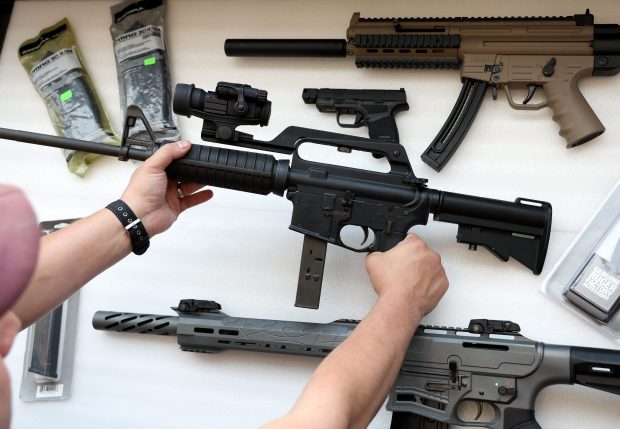
The U.S. Supreme Court announced it would hear arguments, possibly later this year, regarding Cook County’s ban on assault weapons and a similar law in Connecticut. This decision could lead to a significant ruling on the constitutional right to own such firearms. The Cook County lawsuit involves three residents and two gun rights organizations challenging the county’s ban, claiming it breaches the Second and Fourteenth amendments.
Cook County State’s Attorney Eileen O’Neill Burke confirmed her commitment to defending the ordinance. She remarked, “Assault weapons have no place in our communities.” Her statement emphasized the tragic impact of gun violence and her resolve to protect Cook County’s residents through this ordinance.
The county’s ordinance prohibits the sale, manufacture, and possession of over 100 types of rifles, shotguns, and pistols, as well as large-capacity ammunition magazines, typically those holding more than 10 rounds. Certain exemptions exist, such as for law enforcement and military use. Fines for violations include $5,000 for a first offense and $10,000 for a second, potentially leading to six months in jail.
Illinois Ban Also Examined
The Cook County case is distinct from another challenge in the U.S. 7th Circuit Court of Appeals concerning Illinois’ statewide ban on assault weapons and magazines. A ruling in the county case might influence the state case. Governor JB Pritzker signed Illinois’ law in January 2023 after a mass shooting in Highland Park. Despite challenges, the state’s ban has been upheld so far.
U.S. Supreme Court Justice Clarence Thomas previously signaled the need to review Illinois’ law, raising concerns about its constitutionality. The impact of a favorable Supreme Court ruling for Cook County plaintiffs on Illinois’ law remains uncertain, yet David Sigale, representing the Illinois State Rifle Association, predicts a Supreme Court decision favoring plaintiffs could heavily influence the state case.
The Illinois Attorney General has maintained that the banned weapons do not fall under “arms” as defined by the Second Amendment due to their military-grade qualities, intended more for combat than self-defense.
National Implications
A ruling in the Cook County case could affect similar laws across a dozen states. These laws cover cities like New York, Los Angeles, and Washington, D.C. Following the expiration of a national assault weapons ban in 2004, Democrats have urged for its renewal after mass shootings. Connecticut’s legislation, passed after a mass shooting at Sandy Hook Elementary School in 2012, supports this stance, citing the weapons’ suitability for mass attacks.
Janet Carter from Everytown Law has defended these bans as essential public safety measures. Conversely, gun rights groups challenge these bans as unconstitutional, arguing semiautomatic rifles are commonly owned and protected under the Second Amendment.
Adam Kraut from the Second Amendment Foundation stated that the Supreme Court’s upcoming considerations will offer needed guidance on the issue. He emphasized semiautomatic rifles’ widespread use in households nationwide.
The Stakes Are High
The plaintiffs in Cook County argue their case based on key Second Amendment rulings, especially the Supreme Court’s Bruen decision in 2022, which reinforced Second Amendment rights. This ruling emphasized historical consistency in firearm regulation.
The Cook County plaintiffs assert the banned firearms are in “common use,” thus protected by the Second Amendment. However, the district and appellate courts previously ruled in favor of Cook County for lack of supportive evidence from plaintiffs.
Darrell Miller, a law professor, acknowledged the stakes of Second Amendment cases due to the Bruen decision. He noted the unpredictable outcomes, given political sensitivities. The Supreme Court has defended Second Amendment rights in recent rulings, but has upheld certain restrictions.
The issue remains contentious, as conservative justices aim to protect Second Amendment rights amidst political divides. The Supreme Court’s rulings could reshape the legal landscape concerning gun legislation.
Leave a Reply