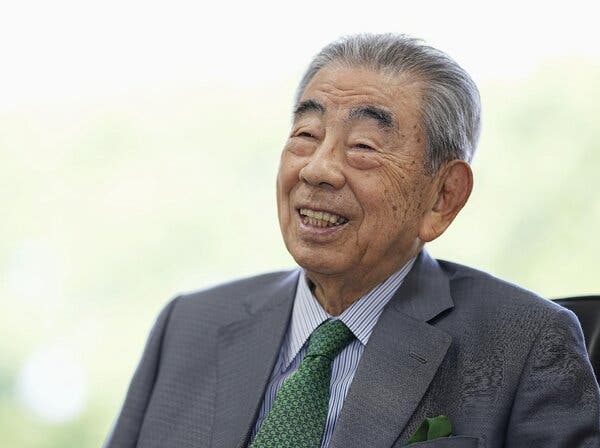
Toshifumi Suzuki spent four decades transforming 7-Eleven into a cornerstone of daily life in Japan. His efforts turned the franchise into a sprawling empire, renowned for innovation.
Mr. Suzuki, who passed away last week at 93, was confirmed by Seven & i, the Japanese operator of 7-Eleven, where he held the title of honorary adviser. Under his leadership, the business evolved from a single store on Tokyo’s eastern bay to tens of thousands of locations.
He pioneered many of the modern Japanese convenience store features, such as in-store banking and seaweed-wrapped rice balls, adored by many domestically and abroad. Since his 2016 resignation, 7-Eleven has faced challenges, including stagnant profitability and a tumultuous takeover bid from a Canadian rival. The company also struggles with leadership changes aimed at reviving growth, as some employees feel innovation has waned.
Mr. Suzuki’s journey began in Japan’s Nagano Prefecture, where he worked in publishing sales before being personally recruited by Masatoshi Ito, Ito-Yokado’s founder. He joined this major retail chain, becoming a director in 1971.
His career pivoted in the mid-1970s when he noticed an American convenience store chain, 7-Eleven, operated by Southland Corporation in Dallas. Despite skepticism over the success of American-style convenience stores in a market dominated by small shops, he saw an opportunity to bring the concept to Japan.
Leave a Reply