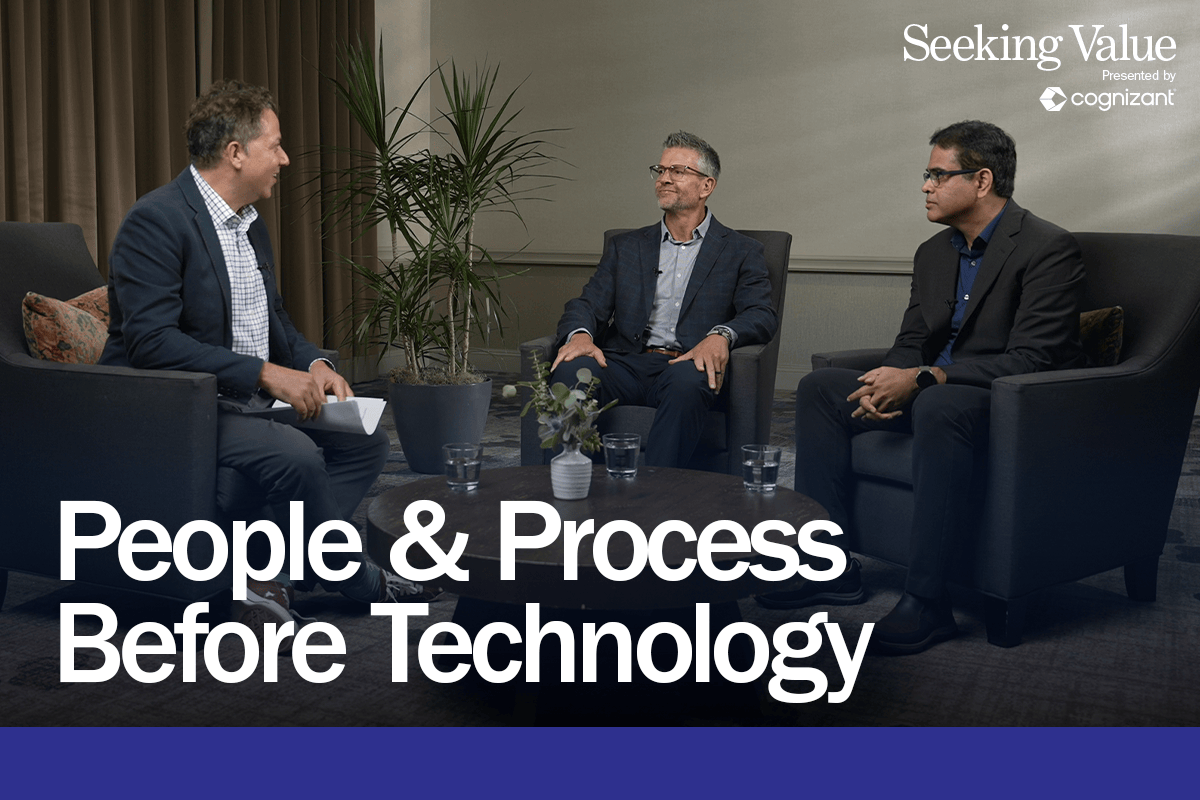
At Toyota Motor North America, the monthly process of supply-chain planning traditionally involved over 75 spreadsheets. Employees often found themselves finishing one cycle only to begin the next. To streamline this process, Toyota is developing digital tools aimed at reducing this burden. According to Jason Ballard, vice president of digital innovations at Toyota Motor North America, their digital transformation has yielded a $3 return for every $1 invested over approximately five to six years. This return encompasses various operational and technological initiatives, including machine learning.
Ballard discussed this development in the Seeking Value video series presented by Cognizant, alongside Nishanth Vallabhu, strategic business unit head for manufacturing and automotive at Cognizant. According to them, two major crises—the COVID-19 pandemic and the semiconductor shortage—spurred Toyota to re-evaluate its supply chain. He noted that skilled employees kept operations running under immense pressure, indicating the company’s heavy reliance on individual judgment. “We can’t continue to count on that,” he mentioned in an interview with Newsweek.
During these crises, dealer inventory levels dropped from over 50 days’ supply to figures in the teens. This situation prompted questions on whether Toyota comprehended which vehicles customers preferred and if the right vehicles were reaching dealerships. Ballard received questions from friends and family that encapsulated the issue: “How come I can track a Domino’s pizza, but I can’t track where my $50,000-or-more vehicle is?”
Toyota then initiated efforts to enhance visibility into vehicle orders and optimize planning decisions. Teams experimented with individual applications to assess effective approaches, gradually pulling a platform into existence. Toyota’s architecture accommodates various applications through shared components, beginning with machine learning and optimization to bolster demand forecasting and supply planning. They are now incorporating generative AI and preparing for agent-based planning and decision-making.
Ballard described a modular architecture consisting of reliable data as the base, with built services built on top, an intelligence layer to back agents, and products providing a familiar interface to employees. Toyota also seeks flexibility in AI model selection instead of binding its systems to a single provider. Leading models often surpass one another with new releases, so maintaining choice is crucial.
The financial justification was initially unclear. Ballard explained that Toyota presented finance and accounting teams with a broad range of potential outcomes, rather than specific forecasts. Early projects yielded returns close to the optimistic predictions, bolstering further investment. Decisions, as Ballard stated, involved some science and gut feel.
Financial benefits stemmed from various domains. Historically, Toyota had not optimized vehicle configurations for maximum profitability. With better insight into customer preferences, the company is now aligning configurations more accurately with demand for increased revenue. During the semiconductor shortage, a digital twin using machine learning evaluated component availability and the feasibility of assembling specific vehicles, aiding production decisions and keeping assembly lines running despite constraints.
These technological advancements are transforming how Toyota’s planning teams function. As Ballard noted, these changes are “elevating the game for our team members, so they don’t spend a lot of time on the routine work.” Instead, employees focus more on analyzing and acting based on aggregated information.
However, Vallabhu pointed out that quantifying these improvements remains a challenge. In manufacturing, quality enhancements or inventory reductions are quantifiable, but office-worker efficiency gains are less straightforward to assess in terms of financial impact. Economic benefits depend on subsequent actions.
Vallabhu highlighted the need for bold investment in driving value creation rather than assuming it in manufacturing. He advised careful evaluation of productivity improvements because tangible benefits often require several changes before sharpening sales metrics.
Toyota’s gains were validated financially, which Vallabhu found crucial given Cognizant’s long-standing partnership with Toyota. Understanding Toyota’s business involves familiarity with its culture, decision-making processes, and operational practices. Nonetheless, introducing new ideas and capabilities from outside remains essential.
Cognizant’s collaboration with Toyota spans approximately two decades. Ballard considers Cognizant a strategic partner whose employees work closely with Toyota’s teams. They are encouraged to introduce fresh ideas and challenge existing practices to facilitate transformation.
Employee involvement has been crucial at Toyota too. The company emphasizes respect and continuous improvement, involving experienced workers in operational redesign. Many of these had dealt with persistent issues and understood enough about emerging technologies to envision alternatives. Ballard noted the importance of uniting these perspectives to recognize opportunities a standalone technology team might overlook.
The goal extended to revamping the entire operation, not merely updating tasks. Toyota aimed for radical change, prioritizing people, processes, and then technology. Understanding how changes impacted jobs was also pivotal. Ballard emphasized explaining the benefits of new tools to ensure that employees felt the changes were positive.
Leave a Reply