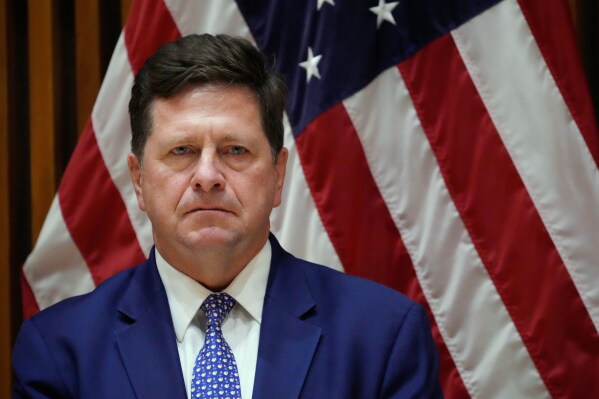
President Donald Trump recently disrupted the confirmation of Jay Clayton, his chosen nominee for leading the nation’s intelligence agencies. This unexpected decision has complicated efforts in the Senate to renew a crucial surveillance program, further straining relationships with Republican legislators.
In an overnight social media message from the Group of Seven summit in France, Trump announced a delay in Clayton’s nomination as director of national intelligence. This declaration came hours before Clayton’s scheduled hearing, despite broad support for him from both parties and Republican attempts to expedite the process.
Senate Intelligence Committee Chairman Tom Cotton expressed readiness to proceed with the Clayton hearing. However, he postponed it when Trump instructed Clayton not to appear, terming the situation “regrettable.” Cotton reiterated Clayton’s qualifications and hoped for a future confirmation.
With Clayton’s delay, Trump’s interim pick, Bill Pulte, is likely to assume the role when Tulsi Gabbard steps down. Pulte, lacking national security experience, has faced criticism from both parties. Nonetheless, Trump defends Pulte, describing him as “fair” and “talented.” Trump’s preference for a quick confirmation process was termed a “rush act” by Democrats.
A critical challenge is the renewal of Section 702 of the Foreign Intelligence Surveillance Act (FISA). This legislation aims to prevent terrorist activities by monitoring communications of foreign targets. Democrats have conditioned supporting the bill on withdrawing Pulte’s interim role. The surveillance authority expired recently.
The biggest obstacle to resolving these issues has not been Senate Democrats or Senate Republicans. It has been the chaos and confusion coming from the White House itself.
– Virginia Sen. Mark Warner
Further complicating the situation, Trump insists on adding proof of citizenship requirements for all voters to the FISA renewal. This proposal lacks sufficient Senate support. Trump’s demands have left Senate Republicans seeking clarity on the White House’s stance.
Republican Sen. Thom Tillis expressed concern over undermining efforts, highlighting the potential impact on FISA’s reauthorization. Tillis called Pulte a “sycophant” to Trump, questioning his suitability for the intelligence role.
Democrats argue Trump’s actions compromise national security to favor loyal allies. Sen. Elissa Slotkin described Pulte’s potential leadership as alarming. Sen. Angus King regretted the halted nomination process, while Sen. Patty Murray accused Trump of diversion tactics amidst international tensions.
National security officials have deemed Section 702 indispensable for intelligence operations against terrorism and espionage. Concerns over incidental data collection on Americans persist. A March court order extended the program temporarily, but there is uncertainty about future cooperation from communication companies.
Senate Democratic leader Chuck Schumer criticized Trump’s handling of the confirmation, suggesting a lack of commitment to resolving FISA issues.
Associated Press writers Kevin Freking, Joey Cappelletti, and others contributed to this report.
Leave a Reply