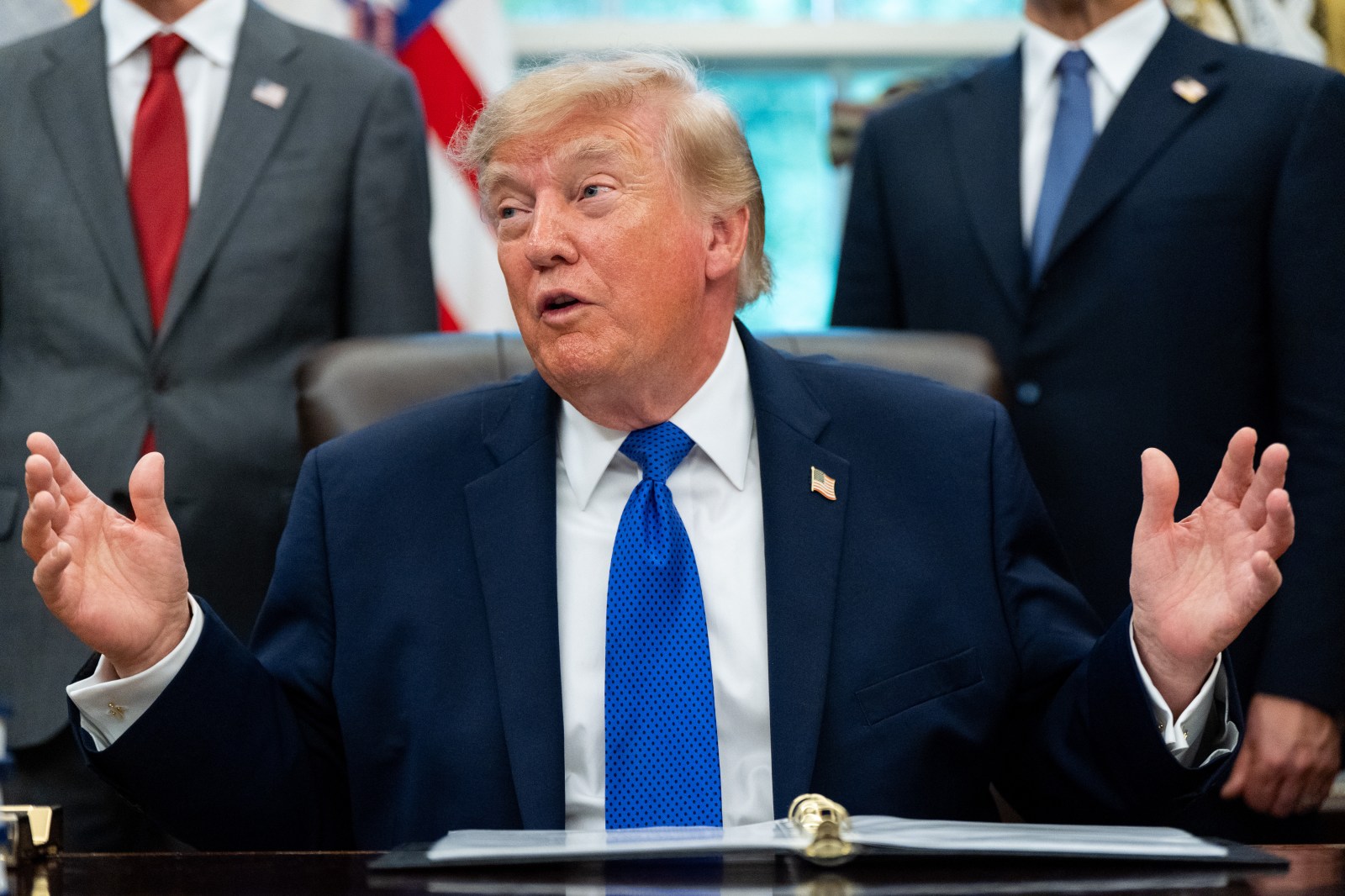
President Donald Trump escalated his criticisms of Canada, labeling it as one of the worst countries globally as trade tensions between the two nations intensified. Recently, Trump imposed 50 percent tariffs on approximately $28 billion worth of Canadian goods. In response, Prime Minister Mark Carney stepped up with equivalent measures, asserting ‘dollar for dollar’ tariffs.
In the Oval Office, Trump accused Canada of being unfair to the United States. He pointed to steep tariffs on American agricultural products and alleged a sense of entitlement from Canadian leaders. ‘They want a deal with us,’ Trump stated. ‘They call us continuously. The issue is their unfair treatment towards the United States. They’ve been among the most difficult countries internationally. We maintain good relations with China and others, creating beneficial agreements, but Canada challenges us. They impose 400% tariffs and beyond on our farmers, exploiting our patience.’
Trump further claimed that Canada relies heavily on the U.S. economy while contributing little in return, highlighting American military cooperation and icebreaker support. He insisted the U.S. is not reliant on Canadian resources, asserting, ‘There’s nothing we need from them.’
Despite these comments, Canada is the second-largest trading partner of the United States, following Mexico closely in trade volume. Trump’s remarks followed Carney’s support for Canada’s potential status as the European Union’s first associate member to deepen economic ties with Europe, aiming to prevent any single country from dominating Canadian markets.
As relations with Washington have soured, Carney has sought to strengthen ties elsewhere. He is pursuing a trade agreement with India and has mended relations with China through an agreement to lower tariffs on Canadian canola and allow limited numbers of Chinese electric vehicles into Canada.
Todd Belt, a professor at George Washington University, remarked on Carney’s unexpected resolve. ‘Donald Trump underestimated Carney,’ Belt noted. ‘He likely assumed the newly appointed Prime Minister would be easily influenced. That assumption proved incorrect.’
Belt also noted Trump’s failure to foresee Canadian retaliation strategy. ‘Canadians would respond strategically, targeting states like Michigan, Ohio, and Alaska known for Senate toss-up seats,’ he explained.
This article is classified as breaking news, with updates expected. Newsweek employs Martyn, an AI assistant, to support its editorial team in producing content.
Leave a Reply