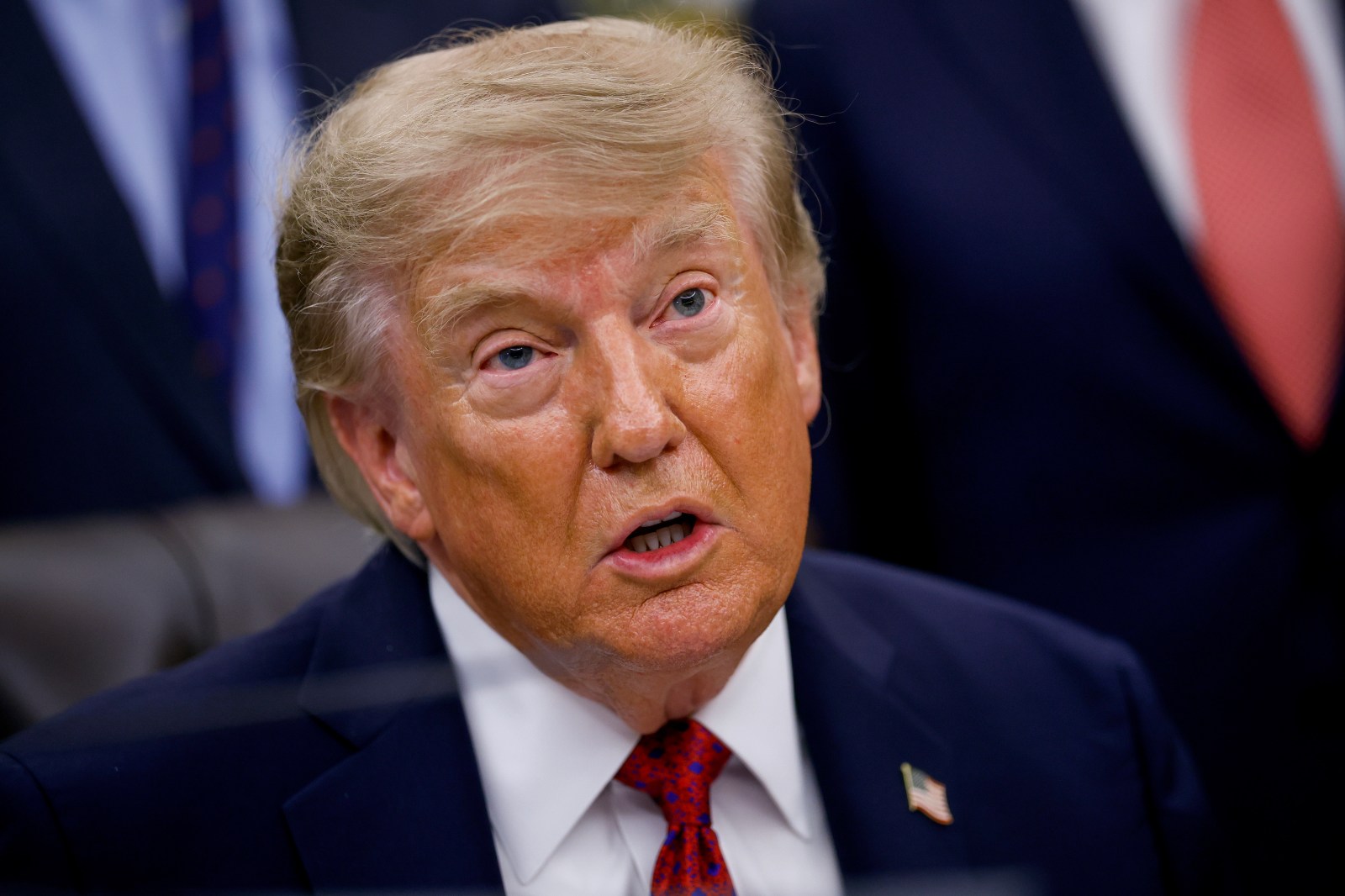
Some of President Donald Trump’s supporters are becoming disillusioned, with his approval rating reaching a record low according to a new University of Massachusetts Amherst poll released on Monday.
Trump’s approval has significant implications for the Republican Party in the upcoming midterm elections. The party is defending key seats crucial for controlling the House of Representatives and the Senate. Since returning to office last year, Trump’s popularity has dwindled due to voter frustration over economic issues, rising inflation, and the unpopular war in Iran.
Approval Rating Trends
Historically, a president’s low approval rating often leads to losses in midterm elections. This was evident in 2018, when Republicans lost seats in Trump’s first midterm. Democrats anticipate that Trump’s declining approval could allow them to contest traditionally conservative states, such as Texas.
Voter Preferences
“One in 6 Trump 2024 voters wouldn’t vote for him again.”
The poll indicates that 84% of Trump voters would choose him again if the election were held today, compared to about 94% of those who voted for Democratic former Vice President Kamala Harris, who would vote for her again. However, those disaffected Trump voters might not switch sides to support Harris. Only 2% would, while 7% might opt for a third party and another 7% might abstain from voting.
Regarding those who did not vote in 2024, 20% would vote Trump if the election occurred now, 27% would vote Harris, and 14% would choose a third party. Still, 40% would refrain from voting.
Approval Rating Statistics
Trump’s net approval rating dropped to -32 points, with 32% approving and 64% disapproving of his job performance. This represents a decline from March 2026, where it was at -29 points, and from July 2025, where it was -20 points according to UMass Amherst polling.
Poll director Tatishe Nteta noted, The clock is ticking for President Trump and the Republican Party to offer solutions to the nation’s most pressing problems. A failure to do so could continue to erode Trump’s approval and jeopardize Republican control of both the House and Senate.
The survey polled 1,000 respondents between August 21 and 26, 2026, with a margin of error of plus or minus 3.5 percentage points.
Other Polls’ Findings
Many polls reflect Trump’s declining approval as the midterms near. A Morning Consult poll shows a less negative picture for Republicans, with Trump at -14 points (41% approve, 55% disapprove). A Quantus Insights poll reports Trump’s net approval at -15 points (42% approve, 57% disapprove).
The YouGov and The Economist poll reveals a -21 point approval (36% approve, 57% disapprove). Meanwhile, a Reuters/Ipsos poll shows a -32 point approval, with 65% disapproving and 33% approving. Each poll surveyed over 1,000 adults within similar time frames, employing margins of error ranging from 3.0 to 3.5 percentage points.
Trump’s Reaction
Trump has criticized recent polls showing his declining approval. On August 30, he dismissed them on Truth Social, calling them fake polls used by our crooked media.
He called for action from the FCC, describing the situation as intense manipulation by Democrats to demoralize Republican voters.
The White House spokesperson referenced Trump’s Truth Social post when commenting to Newsweek.
Economic Factors
Trump’s approval fall coincides with dissatisfaction concerning the economy. CNN data analyst Harry Enten shared that inflation, a factor that initially favored Trump, now significantly undermines his popularity among independents.
The UMass Amherst poll indicates that only 22% of Americans believe Trump managed inflation well, while 75% disagree. On job management, only 31% viewed his handling positively.
In contrast, the YouGov and The Economist poll shows that 39% of Americans trust Democrats more on economic issues, compared to 32% trusting Republicans. A mere 3% rated the economy as excellent,
with 40% rating it as poor.
Economic prospects appear bleak, with 57% expecting deterioration.
High gas prices, influenced by the Iran conflict disrupting the global oil supply, have further compounded economic dissatisfaction.
For further information, contact Newsweek editors Samantha Beech and Sam Wilson.
Leave a Reply