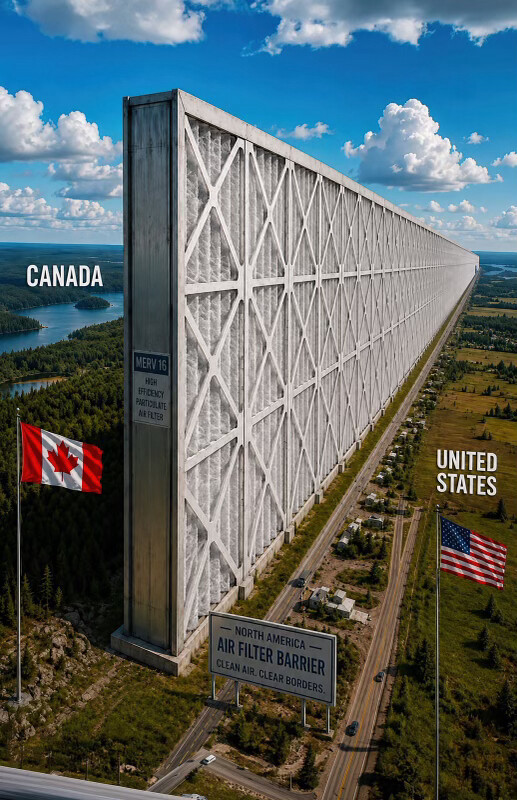
President Donald Trump shared a created image showing a giant air filter on the U.S.-Canada border. This image highlights his critical stance toward Ottawa as smoke from Canadian wildfires affects U.S. air quality. He has blamed Canada for the decreasing air quality and proposed considering wildfire smoke in economic decisions about tariffs on Canadian goods.
Despite this, Canada points to their long history of collaborative firefighting efforts with the U.S. Personnel and resources frequently cross borders during intense fire seasons. Newsweek contacted the White House and the Canadian Prime Minister’s office for comments outside standard business hours.
The Shared Image
The image, posted on Trump’s Truth Social, depicts a massive filtration barrier with the label “MERV 16 High Efficiency Particulate Air Filter.” The barrier separates the Canadian and American flags beneath a banner stating “North America Air Filter Barrier. Clean Air. Clean Borders.”
Canada’s Response
Trump argues that Canada’s severe wildfires are due to poor forest management. This claim intensified as smoke spread across the U.S., causing air alert warnings in Michigan and New York. Trump described the air as “filthy and polluted” and suggested increasing tariffs on Canadian imports to account for this.
Prime Minister Mark Carney responded, explaining that Canada is actively addressing wildfires. He highlighted the large forest areas Canada manages, explaining dry conditions are similar across a vast region, analogous to the size of Texas and extending to Minnesota.
Understanding Canadian Wildfires
Canadian wildfires are common, especially in boreal forests, with increasingly severe seasons due to warmer weather. Rapid ignition and fire spread are linked to higher temperatures. Researchers say large fires often start by lightning in remote areas.
Human activities such as unattended campfires and power-line failures can also ignite fires. Many current fires burn in Ontario and northern regions lacking easy access, complicating suppression efforts.
Impact on the U.S.
Last week, wildfire smoke affected major cities like Chicago, Detroit, and New York City, leading to air quality alerts. Residents experienced orange skies and poor visibility as pollution levels became dangerous.
The smoke has decreased but may be noticeable again soon. Washington Post meteorologist Ben Noll noted that while the East may not face severe air quality issues, haze will be seen in the coming days.
Future Outlook
Canada’s wildfire season is active from May to September, slowing with cooler temperatures and moisture in fall. Continuing dry weather might sustain air quality issues in parts of Canada and the northern U.S. for several more weeks.
Leave a Reply