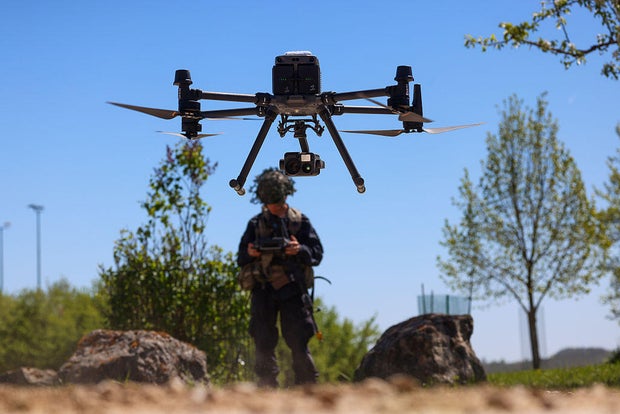
The U.S. Army intends to dissolve a drone battalion formed to gather insights and strategies from drone warfare, such as those seen in the Ukraine conflict, as confirmed by an Army official to CBS News on Thursday. This decision arose amidst discord between senior officials advocating for the unit and Gen. Christopher LaNeve, now serving as the acting chief of staff of the Army.
The initiative to establish the battalion was spearheaded by former Army Chief of Staff Gen. Randy George and Gen. Christopher Donahue, formerly the commander of U.S. Army Europe and Africa. Both generals were dismissed or retired prematurely, enabling LaNeve’s advancement to acting Army chief of staff. This unit, called the Unmanned Assault Battalion, was specialized in drone warfare and intended for rapid deployment in regions requiring drone operations.
The ongoing conflict in Ukraine has underscored the crucial role of drones in modern warfare. This insight was reinforced during a U.S. and Israel-led war against Iran, as Iran targeted U.S. military bases across the Middle East with one-way attack drones.
The Unmanned Assault Battalion is participating in a concluding exercise extending into September. During this period, it will share accumulated knowledge to aid the Army’s approach to future conflicts. An Army official mentioned that following the exercise, the battalion will “refocus on its core warfighting tasks as an airborne infantry battalion,” meaning its soldiers are proficient in parachuting from aircraft. This battalion belongs to the 173rd Airborne Brigade.
The Wall Street Journal initially reported the unit’s impending phase-out. In the previous year, Gen. George and Army Secretary Dan Driscoll launched the Army Transformation Initiative, prioritizing unmanned systems. “Nobody I spoke with has questioned the importance of learning from the events in Ukraine,” Driscoll stated to Margaret Brennan on “Face the Nation.” The Army secretary’s spokesperson expressed Driscoll’s lack of comment on the drone unit’s discontinuation.
“There needs to be more drones.” — David Petraeus
Several current and former officials revealed persistent disagreements between LaNeve and prior senior leaders who supported the unit’s foundation. The tension reportedly stemmed from LaNeve’s abridged tenure as the commander of the Army’s 82nd Airborne Division. Following his “soft relief,” he was hurriedly evicted from his Fort Bragg residence to accommodate the incoming commander. This incident strained relations between LaNeve and Donahue.
A representative for LaNeve referred inquiries to the Army, which declined further comment beyond confirming the unit’s termination plans. LaNeve shared his aspirations for the Army in a document titled “The Army Azimuth.” This document emphasizes maintaining fundamental soldier skills while integrating new abilities, like defending against drone threats.
“Every Soldier deserves to know where this Army is headed,” LaNeve mentioned. “Our mission remains fighting and securing victory today.”
In April, David Petraeus, a retired Army general and ex-CIA chief, asserted the U.S. should swiftly integrate drones into future military strategies. He critiqued the notion some Western nations have of “innovating” by merely supplying 50 drones to an armored battalion, advocating instead for dissolving armored battalions in favor of drone-focused units.
Capt. Ronan Sefton, deployed to Germany with the Army’s 2nd Cavalry Regiment after Russia’s 2022 invasion, expressed that American forces were gaining insights from Ukraine’s battlefield tactics. “The first stark lesson for us was, more drones are needed,” Sefton shared with CBS’ Holly Williams on “60 Minutes.” He explained that they must play a role in training to increase realism.
Sefton communicated with every U.S. senior commander he encountered that “this shift is critical, it’s altering warfare, and we must implement these changes now.” He later joined the Army’s Ukraine Lessons Learned Task Force, separate from the soon-to-be-disbanded unit, which was also tasked with adapting Ukraine’s combat learnings for the U.S. military. Sefton clarified that new technologies won’t render the U.S. military’s traditional firepower obsolete but stressed the urgent need for adaptation to counter adversaries’ drone developments.
Leave a Reply