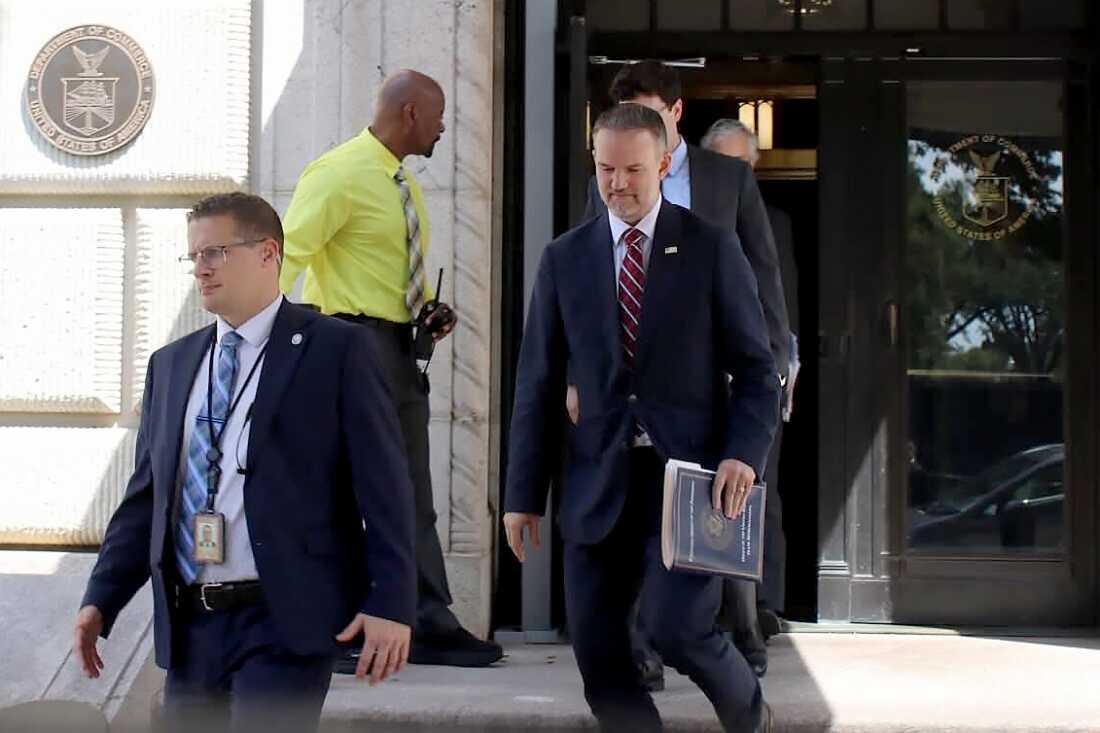
United States Trade Representative Jamieson Greer left the U.S. Department of Commerce following discussions with Canadian officials on Monday, August 17, 2026, in Washington. The discussions were part of efforts to avert looming trade sanctions.
President Donald Trump announced on his social media platform that he would delay imposing 50% tariffs on $20 billion worth of Canadian imports. This decision came after a last-minute agreement between the U.S. and Canada, which was reached just two hours before the tariffs were set to take effect. The delay allows time for further negotiations and temporarily eases tensions between the two allies.
Trump posted, “I have paused the 50% Tariffs against Canada, that were scheduled to kick in tomorrow morning for a three day period, based on the fact that Canada and the U.S.A., subject to the finalization of documents, have a DEAL!” If they had been implemented at 12:01 a.m. Wednesday, U.S. tariffs would have affected Canadian products, including hockey sticks and tongue depressors. However, the political ramifications of the tariffs could have been more significant than the economic impact.
Canada threatened to retaliate with its own levies, potentially escalating a trade conflict between nations that exchanged $880 billion in goods and services the previous year. A White House statement indicated that Canada committed to removing measures deemed discriminatory by the Trump administration against U.S. alcohol, dairy, and motor vehicle exports. Canada did not immediately verify these commitments.
Canadian Prime Minister Mark Carney stated that while “substantial progress” had been made, crucial work remained. Canada agreed to a three-day delay in tariffs as negotiations continued. Carney and Trump engaged in phone conversations twice over two days, emphasizing their efforts to finalize a deal.
Both nations had compelling reasons to avoid a tariff-induced conflict. Nearly 72% of Canadian goods exports went to the United States last year. Meanwhile, the Trump administration faced the risk of imposing significant tariffs before the November midterm elections, with U.S. voters already frustrated by the high cost of living.
“I don’t think either side really wants these tariffs to come into effect,” said Ryan Majerus, a partner at King & Spalding and former U.S. trade official. There was strong motivation on both sides to prevent the tariffs.
Candace Laing, President and CEO of the Canadian Chamber of Commerce, stated that the temporary tariff delay provides businesses with some relief but lacks the assurance of a signed interim agreement. “This limbo state is not anyone’s preferred outcome,” she said, stressing the importance of swiftly reaching a deal.
Trump’s tactics with Canada diverge significantly from the historically cooperative relationship between the two countries. He has imposed tariffs on Canadian goods, aiming to boost U.S. manufacturing, and has made provocative comments about Canada becoming the 51st U.S. state. Tariffs have become a central part of Trump’s second-term economic policy. Last year, he imposed high import taxes globally, attempting to address the U.S. trade deficit as a national emergency. However, the Supreme Court ruled in February that he had overstepped his authority, which led to the federal government needing to refund importers.
Seeking alternative legal grounds, Trump invoked Section 338 of the Tariff Act of 1930 to justify a 50% tariff threat on certain Canadian exports, affecting about 5% of Canada’s exports to the U.S. Passed during the Great Depression, the 1930 law aimed to tax imports globally. Section 338 tariffs have never been activated before. This section permits the president to levy up to 50% tariffs on imports from countries that discriminate against U.S. businesses, without requiring an investigation or time limit for the tariffs’ duration.
During renegotiations of the North American trade agreement—USMCA—Trump leveraged the threat of Section 338 tariffs to seek provisions from Canada, highlighting the ongoing economic diplomacy between the two nations.
Leave a Reply