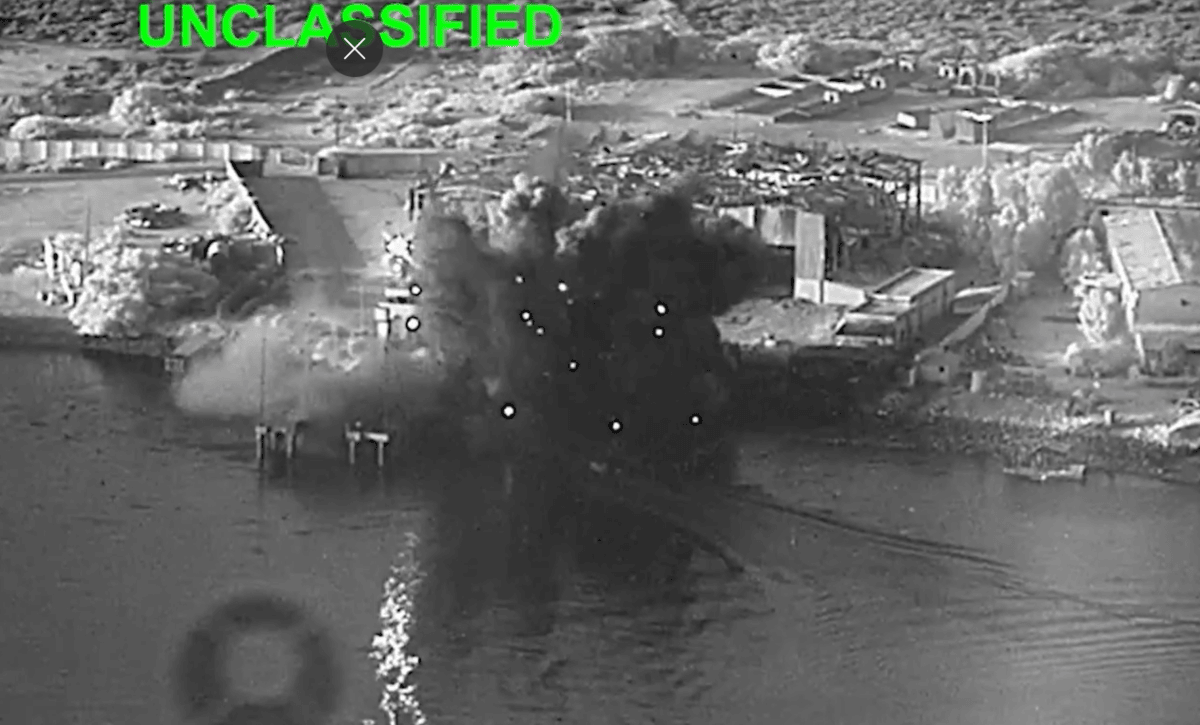
The U.S. military has implemented sea drones in combat operations for the first time, targeting a southern Iranian facility used for submarine repairs. This move represents a significant escalation, as these drones, known as kamikaze one-way attack sea drones, had not been utilized in wartime missions by a major Western military until now.
Sea drones had previously been employed by Ukraine against Russian ports in the Black Sea. Iran has used its own fast-attack boats to threaten commercial vessels in the Strait of Hormuz, heightening tensions with the U.S.
The U.S. military deployed three Corsair naval drones to hit a port at Iran’s naval base in Bandar Abbas. This city hosts a significant portion of Iran’s naval forces and is strategically located north of the Strait of Hormuz. Saronic, the Texas-based company behind the Corsair drones, expressed pride in the deployment of their technology.
The Corsair sea drones, with a length of 24 feet, can travel at approximately 40 miles per hour and cover a distance of about 1,150 miles. These are part of a trio of autonomous surface vessels from Saronic.
In December 2025, the U.S. Navy agreed on a $392 million contract with Saronic for Corsair drones. Recently, a Corsair drone was used in the rescue of two U.S. soldiers from a helicopter crash near the Strait of Hormuz.
The U.S. Central Command released a video on Monday displaying the moment Corsair drones impacted at Bandar Abbas. Overhead shots showed three drones approaching the port, followed by footage from the drones themselves capturing their collision and subsequent explosions. Newsweek has not independently verified this footage.
State media in Iran reported three fatalities in the southern region. The U.S. confirmed that the drone strikes weakened Iran’s capability to disrupt commercial shipping.
The U.S. carried out a third consecutive night of strikes into Tuesday. Respondingly, Iran claimed attacks on two tankers associated with the United Arab Emirates in the Strait of Hormuz, escalating tensions significantly. This incident has undermined the preliminary agreement reached on June 17 between the U.S. and Iran, designed to provide time for negotiating a comprehensive peace agreement.
The Emirati government reported one death and eight injuries from missile strikes on the tankers in Oman’s territorial waters. Fires were ignited aboard as a result.
Iran also declared its targeting of U.S. military installations in Jordan and Bahrain. This conflict began with U.S.-Israeli coordinated strikes on Iran in late February, prompting retaliatory measures from Iran against U.S. allies in the Middle East.
Attempts by the U.S. to fully reopen the Strait of Hormuz have been ongoing, a vital route through which 20% of the world’s oil and gas are transported. President Donald Trump announced plans to reimpose a blockade on Iranian ports, introducing a 20% charge on goods passing through the Strait.
The initial blockade was enacted by the U.S. in mid-April, with intentions to grant access to and from Iranian ports under the recent agreement framework.
An Iranian parliament member revealed plans to strengthen Iran’s hold over the Strait, following the overnight downing of U.S. drones.
Leave a Reply