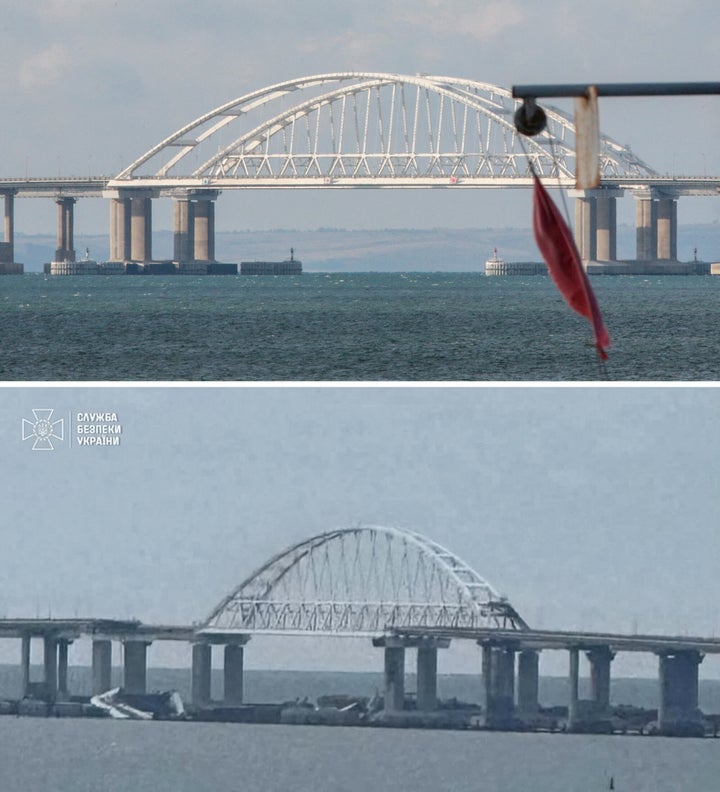
Ukrainian drones and missiles targeted the bridge linking Russia and Crimea on Tuesday, leading to the destruction of its central road section. This incident delivered both a military and symbolic setback to President Vladimir Putin. The attack occurred days before his planned meetings with China’s Xi Jinping and U.S. President Donald Trump.
Ukrainian President Volodymyr Zelenskiy shared images showing the bridge’s main road arch collapsed into the sea, causing a significant gap. Zelenskiy remarked on Russia’s daily attacks on Ukrainian infrastructure, including bridges, and emphasized that the war would eventually reach its initiators.
The 19-kilometer bridge, a significant construction project by Putin in 2018, symbolizes Russia’s claim over Crimea, annexed from Ukraine in 2014. The timing of the attack posed challenges for the Kremlin, as discussions at the upcoming Shenzhen meeting were expected to cover the ongoing Ukraine conflict.
Zelenskiy noted that the strike was part of a calculated operation that dismantled Russian air defenses and electronic warfare systems. Crimea’s Russian-installed governor, Sergei Aksyonov, reported two casualties and suspended road traffic, though rail traffic later resumed partially.
Bridge Repair and Military Implications
Kremlin spokesperson Dmitry Peskov promised a plan to restore the bridge, claiming enhancements in the process. However, military analysts argued that repairing the bridge during ongoing conflict poses significant challenges, given Ukraine’s offensive capabilities. Finnish analyst Emil Kastehelmi suggested repairs would be improbable before the conflict ends.
The bridge’s role as a strategic supply route for Russian forces diminished, with a land corridor through eastern and southern Ukraine now serving as the primary logistical path.
Deputy Prime Minister Marat Khusnullin mentioned a governmental review to assess damage, initiate repairs, and address cargo delivery to Crimea via alternative methods.
Impact on Commercial Shipping
The bridge traversal impacts commercial shipping routes through the Sea of Azov, an essential grain export pathway. Despite limited export infrastructure damage, the prolonged bridge inaccessibility might delay the resumption of Sea of Azov grain shipments, according to Andrey Sizov from Sovecon.
Previously, Ukraine targeted the bridge in October 2022 using a truck bomb, leading to casualties and restricted bridge capacity, followed by further damage in July 2023.
Ukraine’s Expansive Drone Offensive
The recent overnight strike exemplified Ukraine’s most extensive drone attack, as reported by Russian state media. Russia claims to have downed 1,441 drones across 22 regions. Among other targets, refineries in Ufa and Salavat faced drone threats, with Ukraine claiming strikes on the Salavat refinery.
Moscow Mayor Sergei Sobyanin reported that 800 Ukrainian drones aimed at the wider Moscow area, with 321 intercepted en route.
Drone activity has risen from both nations, with intensified strikes on energy and strategic installations. Ongoing hostilities persist despite recent peace negotiations brokered by the U.S. in Abu Dhabi, which focused on prisoner exchanges without resolving core disputes.
Strikes on Kyiv’s Infrastructure
During the same period, Russian strikes targeted Kyiv, resulting in power and water disruptions. Mayor Vitali Klitschko confirmed damage to bridges and transit systems. Russia claimed to have targeted transport, military, and energy facilities in various Ukrainian regions, including Kyiv and Zaporizhzhia.
Both countries deny intentionally targeting civilians, with independent verification of certain reports still pending.
Leave a Reply