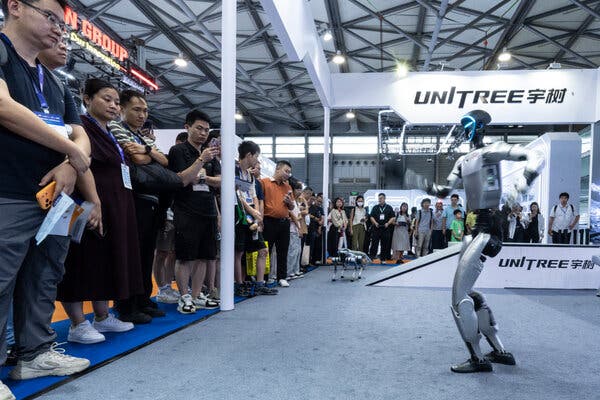
Shares of Unitree Robotics, a maker of humanoid robots based in China, surged dramatically on its debut trading day in Shanghai. Investors showed strong enthusiasm for this emerging company operating at the forefront of artificial intelligence.
On Wednesday, Unitree’s stock price increased nearly 500%, valuing the company at approximately $53 billion. Earlier in the month, the company had set its initial public offering at around $22 per share, aiming to raise about $900 million and valuing it at roughly $9 billion. At one point, shares escalated by as much as 629%.
Lian Jye Su, an analyst from Omdia, a technology research firm based in Singapore, stated, “Unitree is a company with strong fundamentals and impressive technology, but we’re witnessing a lot of speculative optimism in this initial trading day. Chinese retail investors are willing to invest at nearly any price.”
The excitement surrounding Unitree’s shares follows the recent rise in shares of another major player in China’s AI industry: ChangXin Memory Technologies (CXMT), the leading memory chip manufacturer in the country. As AI systems demand more powerful technologies, the need for chips that efficiently process data has increased.
CXMT experienced a 470% surge on its first trading day and has continued to rise, making the company worth about $545 billion, surpassing Tencent as China’s most valuable publicly traded entity.
Despite significant attention, investors in Unitree face uncertainties regarding the rapid development of the humanoid robot market. While some robots are still in the testing phase within factories, the mass market for such machines is yet to emerge.
Located in Hangzhou in eastern China, Unitree has gained admiration through demonstrations of its robots’ capabilities. Videos showcasing its machines performing kung fu, scaling walls, and executing backflips have amassed millions of views online.
Although popular, Unitree’s business scale is relatively modest. In 2025, the company generated about $250 million in revenue and was profitable. However, it faces significant competition from other companies in China and startups specializing in humanoid robots in the United States.
Analysts anticipate significant growth in the humanoid robotics industry. CLSA predicts the global market will expand to $69 billion by 2030, from around $2 billion this year.
Governments also recognize the strategic importance of humanoid robots within the AI sector. Last month, the Federal Communications Commission announced a ban on the import of new foreign-made humanoid and quadruped robots, citing national security concerns.
Unitree highlighted this concern in its IPO filing, acknowledging the risk of its new models being banned from the US market. While most sales occur in China, American purchases made up 13% of the sales last year.
Technology journalist Steve Lohr contributed to this report, focusing on the influence of technology on the economy, jobs, and the workplace.
Leave a Reply