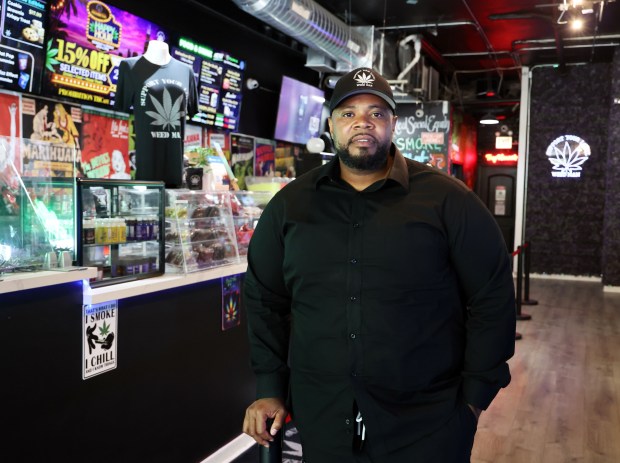
After the federal law legalized hemp in 2018, Samuel Wilson co-founded Prohibition THCafe. This cafe sells hemp-derived THC-infused edibles and beverages in the Near South Side. During the informal 420 cannabis holiday on April 20, Prohibition THCafe partnered with Harold’s Chicken to sell infused wings, attracting a long line of customers.
The future of Wilson’s business is uncertain due to new legal developments. A federal law proposes to ban intoxicating hemp sales, and an Illinois measure, awaiting the governor’s approval, seeks to restrict hemp sales to state-licensed dispensaries. This legislation aims to curb shops selling untested, unlimited hemp to minors. However, it might also close businesses like Wilson’s, who asserts that he provides tested products to individuals over 21.
“I was that innovator who chased the American Dream,” Wilson said. “To see that now in jeopardy after all the sacrifice and hard work I’ve done … it’s a hijacking of small operators and handing it over to corporate cannabis.”
Licensed cannabis businesses support the new law as it tackles unregulated hemp shops that lack product testing and labeling, putting licensed entities at a disadvantage. These businesses argue that the legislation is a necessary correction and an important advancement since recreational cannabis became legal in Illinois in 2020.
The proposed state ban would be broader than a federal law, capping hemp sales at 0.4 milligrams of total tetrahydrocannabinols, the psychoactive component. Both laws are set to take effect in November. Wilson hopes for changes to the federal law allowing hemp sales to continue, though any amendment faces significant challenges. Regardless, the Illinois proposal would stop unlicensed hemp sales.
Hemp startups have become significant players in Illinois, with over 1,000 retailers generating around $870 million in sales in 2025. More than 500 wholesalers and processors employ about 13,000 workers, according to a Whitney Economics survey. The Illinois bill would also alter the cannabis industry, primarily dominated by large corporations.
Illinois residents would see possession limits increase to 60 grams of cannabis flower, 1,000 milligrams in edibles, and 10 grams of concentrate. Out-of-state visitors would have half these limits. Dispensaries could extend their operating hours until 2 a.m., though local ordinances could enforce different hours.
Medical cannabis users stand to benefit as any licensed dispensary could sell medical cannabis, exempt from the high retail taxes applicable to recreational products. This change could lessen travel burdens for medical users and allow newer dispensaries to compete by selling tax-exempt products.
The bill permits drive-thru services and allows cannabis in cars if it remains in original sealed packaging. Tiffany Ingram, executive director of the Cannabis Business Association of Illinois, praised the legislation, emphasizing its role in modernizing outdated regulations and addressing the issue of intoxicating hemp products sold outside the regulated market.
“(Senate bill) 3222 accomplishes both, making it one of the most consequential cannabis bills since legalization,” Ingram told the Tribune.
For hemp business owners, up to 145 new licenses will become available, allowing them to infuse and sell THC products. State Sen. Kimberly Lightford and Rep. Will Guzzardi support these changes to formalize the hemp market, modernize cannabis operations, and lower barriers for patients and smaller operators. Once signed, the bill would immediately prohibit sales of intoxicating hemp to individuals under 21 and ban misleading marketing targeting children.
The requirement for dispensaries to hire external security will be removed, allowing in-house security teams. With federal agencies short-staffed to enforce the hemp ban nationwide, state regulators and local police may assume enforcement responsibilities, posing a logistical challenge.
Leave a Reply