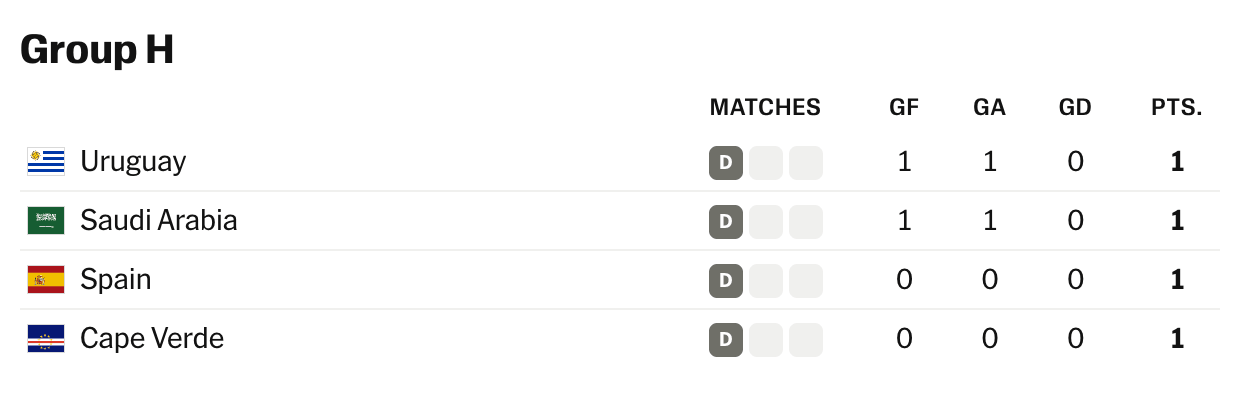
In Miami, Group H witnessed intense action as Uruguay narrowly escaped defeat against Saudi Arabia. The first half saw Saudi Arabia take the lead with a goal by center-back Abdulelah Al Amri, pouncing on a mishap by Uruguay goalkeeper Fernando Muslera. The goal temporarily placed Saudi Arabia, ranked 49th globally, at the top of Group H. However, Uruguay retaliated late in the game. Maximiliano Araujo scored to level the match in the final 10 minutes, capitalizing on a mistake by Mohammed Al Owais, Saudi’s goalkeeper. Despite the setback, Al Owais redeemed himself with crucial saves, ensuring Saudi Arabia secured a point.
Throughout the match, Uruguay dominated in terms of attempts, registering 21 shots. Both teams ended their first fixture with a point each, as did the other teams in Group H.
Asian Teams Impacting the World Cup
Historically, Asian Football Confederation (AFC) teams have struggled at FIFA World Cups, with only South Korea having reached the semi-finals in 2002. However, the expansion to 48 teams and the inclusion of more AFC nations has begun to change perceptions. In North America, AFC teams remain unbeaten in their first five games, achieving wins and draws.
Notably, South Korea and Australia, part of the AFC since 2005, have secured victories. Qatar and Japan staged impressive comebacks. This progress is significant for Saudi Arabia as they aim to grow their national team ahead of hosting the World Cup in eight years.
- June 11, Group A — South Korea 2-1 Czech Republic
- June 13, Group B — Qatar 1-1 Switzerland
- June 13, Group D — Australia 2-0 Turkey
- June 14, Group E — Japan 2-2 Netherlands
- June 15, Group H — Saudi Arabia 1-1 Uruguay
Fernando Muslera’s Mixed Performance
Fernando Muslera was once Uruguay’s reliable goalkeeper for three World Cups. His journey featured helping Uruguay to the semi-final in 2010 and achieving knockout stages twice thereafter. But in Qatar, Muslera was replaced, and his time seemed over after a suspension and retirement announcement in 2024. Yet, his impressive season with Argentine club Estudiantes saw him return for this World Cup.
Muslera initially showed skill in the opener, making key saves. Unfortunately, a mistake allowed Saudi Arabia to score, undermining his efforts. His return marks him as the first Uruguayan to join five World Cups, a milestone shared by only 12 other players worldwide.
(REUTERS/Amanda Perobelli)
Bielsa’s Tactical Adjustments
Group H defied predictions, with Spain also failing against Cape Verde. Uruguay managed a draw against Saudi Arabia, displaying vastly different performances before and after halftime.
Uruguay’s first-half was marked by possession dominance but lacked creativity. Midfielders Manuel Ugarte, Rodrigo Bentancur, and Federico Valverde offered strength but rarely created opportunities. Uruguay’s play saw wingers placed high, leaving Darwin Nunez with limited involvement.
Coach Marcelo Bielsa reacted, making significant halftime changes, including replacing Nunez with Agustin Canobbio, who played on the right while Federico Vinas led the attack centrally. This reshuffle improved Uruguay as Vinas delivered threat from headers and Canobbio enhanced right-flank movements. However, Araujo’s equalizer followed a left-wing cross and a Vinas header rebounded goal.
Questions arise around Nunez’s spot for the next game against Cape Verde due to Vinas’ superior second-half performance.
Leave a Reply