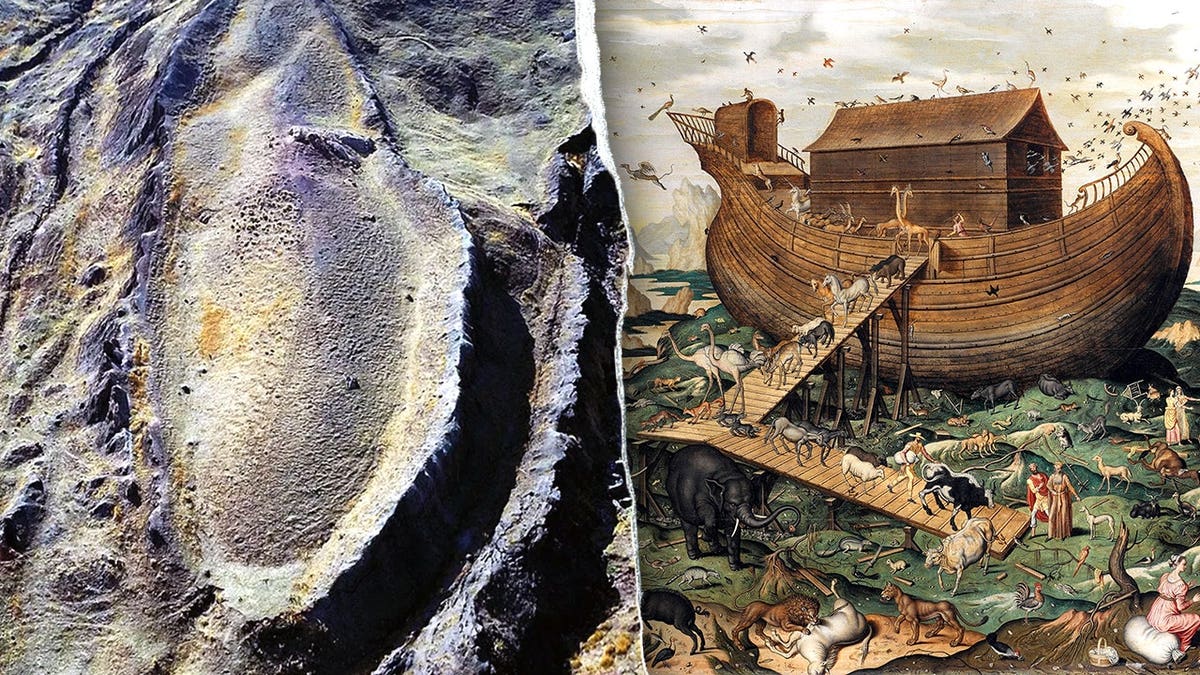
Andrew Jones, a researcher with Noah’s Ark Scans, has presented new soil data suggesting the remains of Noah’s Ark might be located in Turkey. The site in question, situated at the Durupinar location in eastern Turkey, has been under scrutiny since its identification in the 1950s. This site has sparked ongoing discussions between those who see it as a natural geological formation and those who believe it contains the biblical vessel.
Geologists have debated the site’s origins, and skepticism exists partly due to a 1996 paper in the Journal of Geoscience Education claiming the formation was natural. However, recent soil analyses from Durupinar reveal chemical differences indicative of decayed organic material. These findings bolster claims of an ark’s presence.
Speaking to Fox News Digital, Jones stated, “The differences between the ‘inside’ and ‘outside’ samples are statistically staggering. Organic matter was three times more inside the boat shape versus the soil just right outside.”
This observation suggests a high concentration of decayed materials like wood and animal residues. The 1996 paper by Lorence Gene Collins and David Franklin Fasold described earlier ark claims as unfounded, labeling the site a natural rock structure.
Recent findings are derived from soil samples collected in 2024. Researchers claim the composition points to a higher presence of decayed organic material beneath the surface. They cite higher potassium levels, linked to wood ash, and a significant pH difference as evidence.
Jones explained, “An eight-times difference in pH and three times the organic matter suggests a ‘closed system’ where biological materials decayed over time, leaching minerals into the surrounding earth and permanently altering its chemistry.”
This new data adds more intrigue to the ongoing debate about Durupinar. Jones and his team are advocating for further testing, including core drilling and advanced 3-D mapping, to establish a clearer picture. He mentioned that previous radar scans have identified subsurface features consistent with a man-made structure.
He concluded by emphasizing the internal structure complexity that is challenging to attribute to natural geological processes, “We’ve moved from asking ‘Does it look like a boat?’ to ‘Why is there a three-layered, right-angled inside structure, carbon-rich boat formation the exact length of Noah’s ark given in the Bible buried in the middle of a mountainside in the mountains of Ararat?'”
Leave a Reply