A plan to auction over 100 artifacts salvaged from the Titanic wreck, including personal belongings, currency, kitchen items, and decor, is encountering opposition from the U.S. government. This is confirmed by newly unsealed court documents.
RMS Titanic Inc., holding exclusive salvage rights to the North Atlantic wreck, aims to sell these artifacts for the first time. Previously, agreements had restricted them to museum and traveling exhibitions.
The Georgia-based company proposed auctioning these items during a global tour planned across four cities, which remain undisclosed. Among the artifacts listed are a bronze cherub, a necklace of gold nuggets, and a heart-shaped pendant.
The National Oceanic and Atmospheric Administration (NOAA) is tasked with representing U.S. interests relating to the wreck site. The agency argues that such a sale would breach RMS Titanic’s legal obligations, as outlined in documents the judge recently unsealed.
The government’s case against the sale emphasizes that RMS Titanic Inc. has not sought legal approval nor believes it’s necessary. The company maintains its right to sell the artifacts unimpeded.
On Monday, representatives for RMS Titanic Inc. did not respond to requests for comment. Previously, their attorneys claimed in federal court that the auction plan doesn’t violate current court orders and agreements.
Since 1987, salvage operations have retrieved thousands of Titanic items, including parts of the hull. The company generates revenue through their exhibition. It has attempted to sell artifacts to fund future explorations and alleviate financial distress. However, such efforts faced opposition from U.S. courts, preservationists, and victims’ relatives.
Although artifacts salvaged from the wreck are restricted, items saved by survivors or rescued can be sold, often commanding substantial sums. In April, a Titanic life jacket auctioned for $906,000. A Titanic lifeboat seat cushion fetched $527,000 at the Henry Aldridge & Son auction.
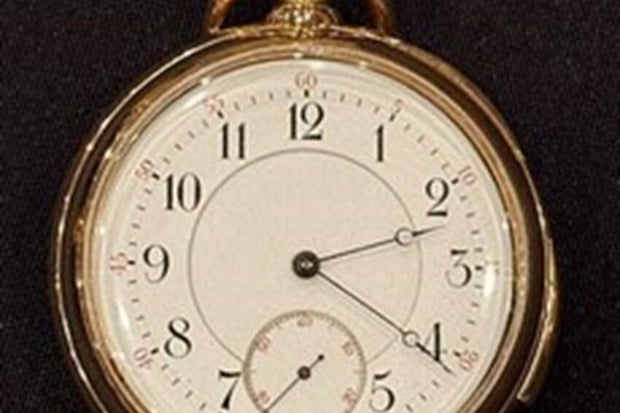
In 2025, a collector purchased a gold pocket watch linked to the Titanic for record $2 million. The watch belonged to Isidor Straus, gifted by his wife Ida for his 43rd birthday. Straus, an American businessman and owner of Macy’s, was a first-class passenger. Other collectibles sold in recent years include a Titanic menu, a launch ticket, and a letter by passenger Oscar Holverson.
A violin believed to have been played on the Titanic before sinking sold for $1.45 million in 2013. Auctioneers attribute the high demand and prices to the Titanic’s tragic story and artifact rarity.
This trans-Atlantic dispute centers on RMS Titanic Inc.’s intent to auction initial salvaged items. These were retrieved in France, granting them to the salvager. French oceanographic institute IFREMER collaborated on the wreck discovery.
Subsequent expeditions claimed salvage in a U.S. District Court in Norfolk, Virginia. NOAA argues that all 5,000 items, claimed in both France and the U.S., should remain together per U.S. court conditions. On their website, NOAA highlights that the French court also mandated the artifacts to stay in single collection, prohibiting individual sales.
The company asserts that the U.S. court lacks jurisdiction over items claimed in France. The French government representatives did not respond to inquiries on Monday.
Some underwater explorers are against selling Titanic artifacts, advocating public display. Greg Stone, an experienced ocean explorer, supports artifact recovery if handled properly. He prefers nonprofit efforts.
Richard Daynard, Northeastern law professor focusing on public advocacy, says artifact regulation aims to safeguard the wreck’s integrity. He warns against billionaire purchases merely exhibiting wealth.
Leave a Reply