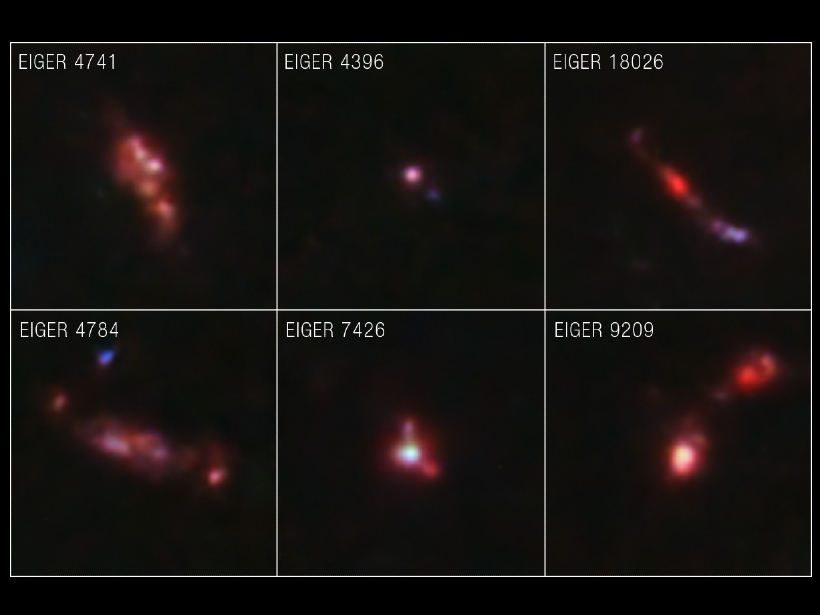
Since the James Webb Space Telescope (JWST) began its mission, it has provided astronomers with valuable insights into our universe’s early history. By capturing detailed images and spectra, it has unveiled galaxies existing when the universe was a mere 900 million years old. These discoveries result from the combined efforts of NASA, ESA, CSA, and researchers from institutions like ETH Zurich and MIT.
Revolutionizing Astrophysics
The JWST stands as the most powerful telescope launched into space, marking a shift in the study of distant and early galaxies. Unlike researchers in fields like paleontology who search for ancient artifacts, astronomers look back in time by observing distant galaxies. This method, as described by Jorge Moreno, astronomy professor at Pomona College, allows scientists to explore the universe’s history without a time machine.
The telescopic images reveal galaxies that formed just 200-500 million years post-Big Bang. These galaxies appear significantly larger and brighter than anticipated, sparking global debate among astronomers.
Understanding Light’s Role in Observations
The telescope can detect some of the earliest galaxies due to its ability to capture faint light from them. As this light travels vast distances, it shifts to the infrared spectrum, making it necessary for telescopes like JWST to detect it. This phenomenon, known as cosmological redshift, results from the universe’s expansion and elongates wavelengths as they journey through space.
For context, while sunlight takes about eight minutes to reach Earth, light from Proxima Centauri—our closest stellar neighbor—requires over four years.
Rethinking Galaxies’ Growth
The unexpected brightness of these early galaxies has surprised many astronomers. Typically, a galaxy’s luminescence suggests its mass, as the starlight constitutes its glow. However, existing models predicted that galaxies couldn’t amass size so rapidly post-Big Bang.
Moreno likens the discovery to encountering teenagers in a kindergarten. He posits that other factors, such as active supermassive black holes or hot dust, may alter perceived mass, influencing galaxy brightness.
Advanced Structures in Young Galaxies
Previous assumptions held that early galaxies appeared as amorphous blobs rather than structured forms. Yet, JWST findings indicate some galaxies possess significant structure, including potential spiral arms, reminiscent of local universe galaxies.
Questioning the Universe’s Age
Some researchers now challenge the accepted age of the universe, currently calculated at about 13.8 billion years. They propose an age of 26.7 billion years, following a study combining two models of cosmic expansion. One model, broadly accepted, details space expansion causing light to shift from blue to red. The other, now discredited, suggested light reddening from energy loss over time.
Moreno criticizes the combination of these models without substantial evidence, stressing the importance of maintaining simpler, supported theories unless new evidence emerges.
Awaiting Further Insights
As the JWST continues to yield data, it offers prospects for fresh solutions to astronomical puzzles. Moreno emphasizes the importance of measured reflection alongside discovery enthusiasm, noting galaxies’ natural cyclic brightening and dimming patterns.
This analysis was meticulously compiled by the Short Wave team, including Rachel Carlson, Rebecca Ramirez, Berly McCoy, Anil Oza, and audio engineer Josh Newell.
Leave a Reply