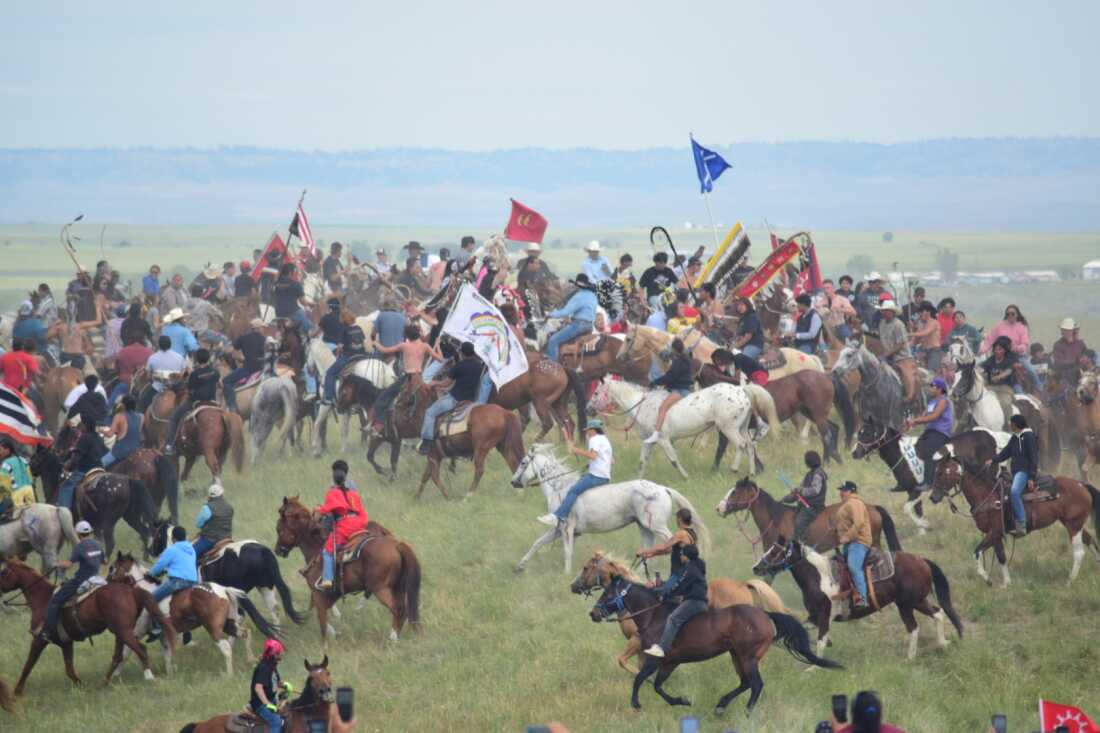
Crow Agency, Mont. — Under the vast Montana sky, hundreds from 19 tribal nations gather at America’s renowned battlefield. They witness Native American riders charging onto the land where their ancestors triumphed 150 years ago, defeating the U.S. Army’s 7th Cavalry led by Lt. Col. George Armstrong Custer.
The riders race across the dry terrain, kicking up dust as they circle atop a hill at Little Bighorn Battlefield National Monument. Wearing varied attire, from headdresses and regalia to tank tops and T-shirts, many riders carry tribal flags. This display of unity echoes the alliance that enabled their decisive victory on June 25, 1876.
Custer aimed to force Native Americans onto reservations. Following the 1874 gold discovery in the Black Hills, Indigenous peoples living outside reservations were ordered to report to U.S. field offices, known as Indian Agencies, or face hostility.
Native leaders, including Crazy Horse and Sitting Bull, unified villages and tribes in resistance. Multiple battles unfolded in Montana and South Dakota as forces sought to push those groups onto reservations.
Christopher Eagle Bear, a Sicunga Lakota from the Rosebud Sioux Tribe, describes how Crazy Horse coordinated efforts, rallying leaders for a greater cause. In 1876, Custer tracked a village comprising Oceti Sakowin (Sioux), Cheyenne, and Arapaho, aided by Arikara and Crow scouts—common in tribal practices with the U.S. government.
Custer split his forces, numbering around 700 men, into three columns, aiming to encircle the village. By June 25, the village had expanded to roughly 8,000 people. Fearing dispersal, Custer attacked prematurely, a fatal error.
Eagle Bear recounts the battle, known as Greasy Grass to the Lakota: “It was early morning, they were camped. Then all of a sudden they’d seen Custer’s platoon coming over the ridge.”
Outnumbered, Custer faced a swift defeat. Of his troops, 268 were killed—most U.S. soldiers; Custer included. On the opposing side, fewer than 100 Native Americans perished, including women and children. Fear and outrage ensued nationally, prompting a change in U.S. Indian policy towards forced assimilation.
Three years post-battle, the first off-reservation federal Indian Boarding School opened in Carlisle, Pa., heralding a century of attempts to erase Native lifeways.
Eagle Bear reflects: “They realized that they couldn’t destroy us head on. … So after that, they did the next best thing to tear apart a nation—take away the children.”
Inspiring Future Generations
At the historic village site, Eagle Bear camps to honor the victory. Various tribes have erected tipis, with a council lodge centrally placed. Coordinating for the Rosebud Sioux Tribe’s camp, Eagle Bear aims to set an example for future generations. “Someday from now, the kids here today will gather for the 200th anniversary remembering what they witnessed,” he says.
Near the camp, children play lacrosse with traditional sticks accompanied by drumming, while Sicunga Youth Council members handle cooking. Ashlen Bonshirt from the council shares, “We planned lacrosse, yoga, and amazing activities for youth, yet there’s planning for essentials like garbage and showers.”
Children occupy the camp. School groups, youth councils, and families stay in tipis, discovering battle truths overlooked in school. Thirteen-year-old Gianna Larocque-Mahto voices concern over biased teaching, advocating for diverse perspectives in learning.
Eighteen-year-old Champion Marquez, a Cheyenne, volunteers at the camp, assisting elders and ensuring security. He sees hope for future generations understanding the Battle of Little Bighorn’s history.
Marquez observes: “Seeing all these kids enjoy themselves and knowing they’re learning our history [reassures] that we’re still here.”
Leave a Reply