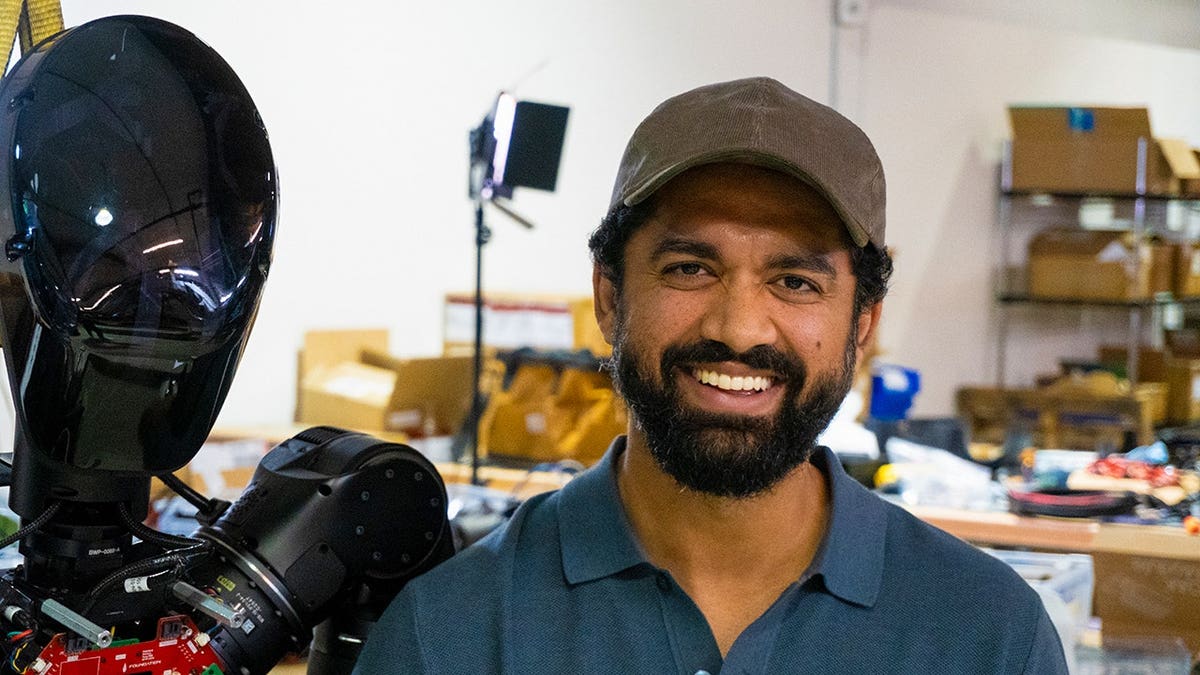
Humanoid robots capable of independently navigating difficult terrain and identifying people may eventually be deployed alongside federal agents at the southern border. A U.S. robotics company has demonstrated this technology to Department of Homeland Security (DHS) officials.
Sankaet Pathak, the founder and CEO of Foundation, discussed the company’s progress in humanoid robotics and their possible applications at the border. Foundation is currently in discussions with numerous national security agencies.
“We’re in conversations with almost all national security government bodies, including the Air Force, Navy, Army, and DHS,” Pathak said. “We continue to have dialogues and are negotiating contracts and applications.”
The Phantom humanoid robot, developed by Foundation, is designed to patrol difficult terrain and identify potential border crossings. However, a DHS spokesperson confirmed that there are no formal agreements or active contracts with Foundation at this time.
Pathak envisions the robots conducting reconnaissance and surveillance in areas challenging for humans, vehicles, drones, or cameras. “If drones and watchtowers were able to solve everything, why do we still have humans at the border?” Pathak explained, emphasizing that humanoid robots could bridge the current gaps in automation.
The Phantom robot can recognize human shapes, traverse uneven ground, and create maps of its environment. Foundation aims for these robots to perform reconnaissance tasks autonomously, alerting human officers to potential border crossings.
A rugged version of the Phantom is in development, expected to feature waterproof and dustproof capabilities. Pathak also highlighted potential uses like monitoring tunnels along the border.
“Our main goal is to ensure officer safety while robots maintain 24/7 surveillance,” Pathak stated. He added that robots could highlight important activities, allowing human officers to respond as necessary.
A second-generation Phantom, designed to be more resilient in various weather conditions, is expected soon, addressing current weather resistance limitations.
While Foundation’s immediate focus is on surveillance and reconnaissance, Pathak mentioned that the company would comply if the federal government requested armed robots for border operations. Nevertheless, he reassured that enforcement decisions would not be made by robots independently.
“They will detect and flag, and then a human will decide the next step,” Pathak clarified.
Leave a Reply