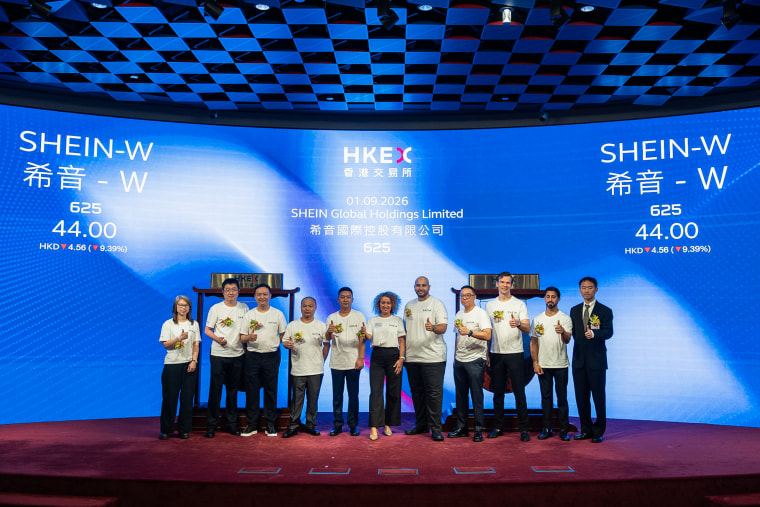
In Hong Kong, Shein’s shares experienced an 8% drop during their initial trading day. Investors expressed concerns regarding the setbacks that delayed its listing and impacted its competitive stance. Known worldwide for affordable fashion, Shein has struggled with tariff changes in the U.S. and Europe, as well as heightened scrutiny over its business practices. This led to blocked listing attempts in New York and London by Chinese authorities.
The stock traded at about 44.6 Hong Kong dollars ($5.68) in the morning, valuing Shein around $24 billion, significantly lower than its 2022 peak of nearly $100 billion. Meanwhile, Hong Kong’s Hang Seng Index saw a 0.6% decline.
“As a new company listed in Hong Kong, we will continue to innovate, optimize and cooperate with our supply chain partners for mutual benefit and win-win results,” stated Leigh Gui, Shein’s Chief Financial Officer at the opening ceremony.
During the event, Founder and CEO Sky Xu remained out of the spotlight, opting to take pictures with employees and avoid media questions.
Charu Chanana, Saxo’s chief investment strategist, commented on the lackluster debut, stating that despite a valuation reset, investors do not perceive Shein as a bargain. Chanana noted Shein’s valuation at 15 times its forward earnings, which is more than double that of its rival Temu owned by PDD, highlighting the premium cost despite growth and regulatory challenges.
Interest in Shein’s IPO was modest, especially when compared to prominent offerings from AI and robotics sectors. The retail portion was oversubscribed by 5.63 times, and the international segment by 2.59 times. In contrast, other deals often see much higher subscriptions, especially from Hong Kong’s retail investors who closely follow IPOs.
The IPO accounted for 6.6% of Shein’s expanded share capital. A fifth of this was taken by cornerstone investors locked for six months, leaving about 5% available for trade.
Last year, the removal of the U.S.’s de minimis duty exemption for e-commerce shipments affected Shein’s direct-shipping model, with Europe imposing similar fees recently. Consequently, Shein’s net income fell by 39% last year, and it reported a loss in the first quarter.
Sustaining its first-half operating profit margin proved challenging due to increased customs duties, tariffs, and logistics expenses across Europe and the Middle East, as Shein acknowledged.
According to Lorraine Tan from Morningstar, growth in new markets might counterbalance slowdown in the U.S. and Europe, though delivery costs remain a concern in developing markets.
In its diversification efforts, Shein expanded its third-party marketplace and acquired the U.S. apparel brand Everlane. It now aims to offer services to more brands, following its acquisition of brands like Pimkie and Missguided in 2023.
This IPO also facilitated compensation for early investors who had invested at higher valuations, with Shein agreeing to approximately $3.5 billion in cash payments and share adjustments for certain preferred shareholders.
“This IPO is not just a fundraising event — it’s also, and probably more of, a capital-structure event,” remarked Jianggan Li, CEO of consultancy Momentum Works.
Leave a Reply